Ant-Man and the Wasp: Quantumania has been out in theaters for a while – and the film is HUGE fun!
It’s no secret that the “big bad” villain in the movie is Kang the Conqueror, but we won’t say anything more about his motivations or machinations.
(That would be a “spoiler.”)
Still, a lot has been said already about Kang (and actor Jonathan Majors), with his introduction as the next major antagonist in the Marvel Cinematic Universe. We’re talking Thanos-level malevolence here.
Both look great in purple, too!
Understandably, people want to chat about Kang the Conqueror–his backstory in the comics, potential connections to MCU shows and films, his powers and motivations, and much more. But we won’t dive too deeply here, to avoid any spoiler territory. (If you’re curious, click on any of the links in this paragraph and speculate away.)
All this talk about the next new villain got me thinking about teaching. If teachers are like superheroes, then who plays the “villain” role?
Who is YOUR archenemy?
Or at the least, who’s your rival?
Or maybe just someone who bugs you. Whether they know it or not, sometimes this person drives you nuts.
To help reflect on educational antagonists, look at classic superhero/villain pairings.
Sometimes they are complete opposites. Superman is super-strong and a “boy scout.” Lex Luthor is super-smart and a malicious “man-child.” Or contrast the stoic, calculating Batman with the crazy, maniacal Joker.
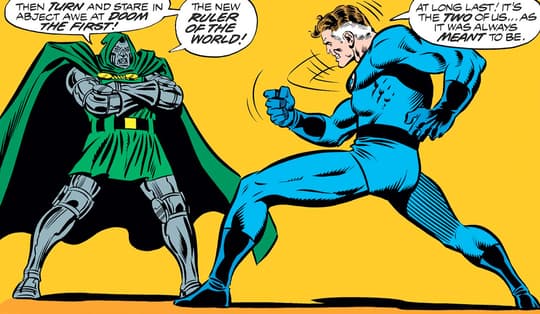
Archenemies can also be too much alike. Their mutual strengths create immediate conflict. Think of Wolverine and Sabretooth, both with claws, feral fighting skills, and healing factors. Or consider the intellectual enmity between Mr. Fantastic and Doctor Doom.
Another source of friction is a fundamental difference in ideology. Professor X seeks peaceful coexistence between mutants and humans, whereas Magneto prefers violent uprising and mutant dominance, no matter the cost. Captain America and Red Skull epitomize the Allies vs. Axis sides of World War II.
Remember, these examples are fiction. Superhero/villain matchups are mere illustrations for the types of conflict that can occur between two real people. I sincerely hope any opposition in schools is much less vindictive and destructive.
As teachers, we should use moments of disagreement as opportunities to model healthy communication and compromise. Remember, your students are watching!
That said, something (or someone) that is unethical or illegal should NOT win.
I remember a high school principal explaining one experience he had where “win-win” was not a viable option. Their school building was facing increased pressure and influence from violent gang activity. This principal shared how their school staff, students, families, and community banded together to find a “win-lose” solution: they were going to win; the gangs were going to lose (and leave).
Hopefully, the day-to-day conflicts and friction teachers experience are not as dire. And in any case, we can focus on productive (and creative) outcomes, with student learning and growth as the ultimate goal.
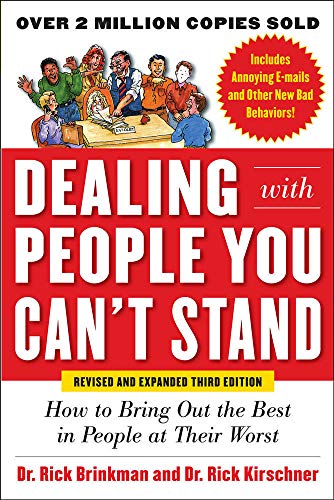
Here are just two resources for working with others (including those you can’t stand):
Imagine what would happen if some of our superhero/villain pairs paused to review these materials. Maybe they could even sit down and work out their differences.
Or maybe not.
But what about YOU?
And who exactly is a teacher’s REAL archenemy? Moreover, how do we “fight” them?
It wasn’t that long ago that we talked about Wolverine actor Hugh Jackman (and how teachers also need a “Hugh”).
Now we’re back with another teacher tip from everyone’s favorite Australian nice guy actor playing everyone’s favorite Canadian grumpy mutant hero.
(Quite the difference in personality there. I guess that’s why they call it “acting.”)
Let’s talk about one more difference between Hugh Jackman and Wolverine.
In the comics, Wolverine is stocky and short, with a height of 5′ 3″. In reality, Hugh Jackman is 6′ 2”.
It doesn’t take a math teacher to quickly figure out that’s a difference of 11 inches–almost one whole foot in length. (Or 27.94 centimeters for those of you using the metric system–Canadians and Australians alike.)
So how did a tall actor first win the part of Wolverine?
(Remember, before Hugh Jackman got this role for the first X-Men movie, he was a relatively unknown actor. Check out this neat time capsule web announcement announcing–and decrying–the official casting waaaaaaaaaaay back in 1999.)
Recently, CNN’s Chris Wallace asked the actor this same question (or very similar, at least). Zip ahead to the 0:45 mark for the question and answer:
In his explanation, Hugh Jackman also gives an example of his behavior. It may look goofy to “stoop,” but it got him the part! (His thespian skills probably helped, too.)
A while back, I read the following sentence in a reflection paper by one of my future science teachers:
“As an educator, I need to remember that my first priority is to the student. I need to STOOP and listen.”
There was a typo. She meant “STOP and listen.”
Still, my first reaction was to write a snarky response like, “If you teach elementary kids, you certainly will need to stoop!” 🙂
(I didn’t.)
The more I think of it, though, sometimes teachers DO need to STOOP. Not only when they stop and listen, but often when they interact with students. And not just with younger kids, but with all ages and grade levels.
There’s a whole bunch of research on “nonverbal behaviors,” those unspoken actions and mannerisms that occur during human interactions. Teachers can gain a lot of insight and application when they focus on such behaviors in the classroom.
But stop and think about what you actually look like when you teach. How is your eye contact? Your facial expressions? Hand gestures? Mannerisms and more?
And where are you compared to your students? The fancy name for this is “PROXIMITY.”
Wolverine (Mr. Logan) demonstrating why teachers should NOT stay at the front of classrooms, especially with their back turned to students.
Proximity is not just the front of the classroom versus the back, or in between student desks (although such movement is important for many reasons).
Proximity also includes the posture and level at which you interact with students. Check out this quote from Sean Neill and Chris Caswell, authors of the book, Body Language for Competent Teachers:
“Leaning towards another person, whether sitting or standing, is an ‘intention movement;’ your intention, if you actually moved, would be to get closer to them . . . . Leaning away sends the opposite signal. Leaning over someone, or being higher than them, is dominant and potentially threatening because if you actually wanted to attack someone you could launch your attack better from above. Sitting or kneeling down to someone, at or below their level, is correspondingly non-threatening” (p. 11)
So I guess we now know why Wolverine is always hunched over, ready to strike.
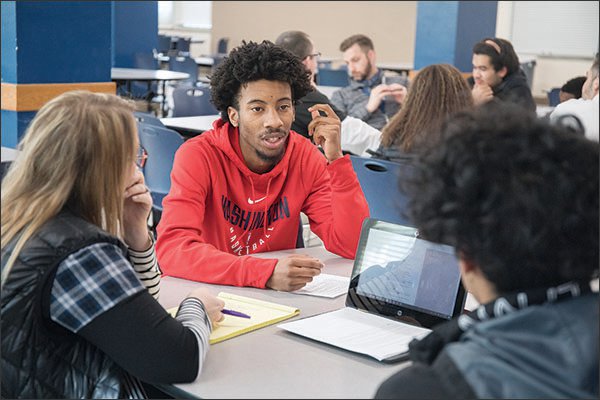
And we also know why it’s important for teachers to STOOP. Not always, but definitely when working with students in small groups or one-on-one. Leaning and learning–literally at “their level”–conveys a collaborative spirit. We’re in this together to grow and get better!
And who knows? Maybe all this learning will help us become “the best there is at what we do.”
Unlike Wolverine, however, what teachers do–learning and teaching–is VERY nice!
Find more SUPER-teaching resources and strategies HERE or HERE!
Discover where I’ll be speaking next (and request me as guest speaker), along with FREE online materials related to Teaching, Superheroes, Science Education, and other super-geeky fun!
DC’s Black Adam movie has been out for a while, but I finally sat down to watch it. If you like LOUD explosions and slooooow-motion action sequences, this movie is for you!
Personally, I prefer Dwayne “The Rock” Johnson less self-indulgent . . .
And more self-deprecating, like in the newer Jumanji films.
The neatest take-away I got from Black Adam is the “student-teacher” relationship between Adam and the teenager Amon. In particular, there’s a Terminator 2-type juxtaposition of the younger Amon trying to teach the elder Black Adam how to be a hero.
Specifically, the film focuses on superhero tropes like wearing a cape and using a well-timed catchphrase.
Black Adam eventually gets both lessons right (sort of). Still, he struggles with more serious, ethical principles like “Heroes don’t kill.”
Oh well. Two out of three ain’t half-bad.
There’s a problematic parallel in schools today. A lot of students (and non-teachers) have plenty of experience in classrooms. This familiarity can create an assumed expertise about “good teaching.”
In the same way that teenage Amon figures he knows all about heroes (he doesn’t), some students–current and former–might presume to be pedagogical experts (they aren’t).
Heck, I’ve worked in the education field my entire professional life, and I KNOW there’s LOTS I don’t know. (Proper grammar, anyone?) With every year that passes, I’m learning more and more.
Problems arise when students turn into teachers without transforming their understanding, attitudes, and application of effective instruction. Sadly, some remain fixed in latent beliefs and paltry practice. They incorrectly conclude there’s nothing for them to learn, since they’ve been in schools ever since they can remember.
She’s coming for your job!
Education historian Larry Cuban puts it this way: “Recruits to the occupation lean toward continuity because of their prior school experiences. As public school students for twelve years, future teachers unwittingly served an apprenticeship as they watched their teachers teach” (1993, p. 19).
This dilemma is not new. As a result, some of the underlying issues schools face – uninspired classrooms, fill-in-the-blank rote memorization, “teach to the test” – are the same ones they’ve been dealing with for years.
Back in 1969, Neil Postman and Charles Weingartner described this narrow student-to-teacher transition as follows: “most of them simply move from one side of the desk (as students) to the other side (as ‘teachers’) and they have not had much contact with the way things are outside of school rooms” (p. 139).
Early (grainy) footage of me as a college student. I’m teaching “to the board” as opposed to my students. (Evidence that I had a lot more to learn about teaching.)
I’ll admit, I made a similar “change” when I first began as a teacher. In fact, before I even started my pre-service teacher program, I doubted the value for going through formal preparation. Like some teachers before me, I thought I knew enough about my subject to teach it. And more troubling, I thought I knew enough about teaching.
Clearly, I did NOT know enough about either.
Like young Amon in Black Adam, I know my share of superhero lore. But I’ve never been a superhero. And I wouldn’t deign to tell somebody how to be one. Especially Dwayne “The Rock” Johnson.
First Lesson of Hero Club: Don’t touch the shiny helmet.
I know a bit more about teaching. A little knowledge came from my time as a student. More importantly, I learned from mentors who provided purposeful instruction and practice as a teacher. And I’m still learning.
Like the best students, the best teachers are eager to learn more. What are you learning?
Never too old to learn. (Or sport a new backpack.)
This year was special not only because you could find bat-signals around various cities, but also because 2019 is the 80th anniversary of Batman!
Batman’s 80th birthday is also timely given recent news casting the upcoming movie’s Caped Crusader.
That’s right. Robert Pattinsonagreed to take on the role. He’s best known as Edward from the Twilight films, although I’d argue his best work was Cedric Diggory in Harry Potter and the Goblet of Fire. Nevertheless, this news lets us revisit one of the best meme images ever:
Some fans aren’t happy about Robert Pattinson’s casting, but that’s nothing new. It seems every Batman casting has its detractors, but things usually simmer down after a while.
Interestingly, another actor’s name came up in the recent Batman casting.
Milo Ventimiglia, the gone-but-never-forgotten hunky dad Jack from NBC’s This is Us, had been interested in donning the cape and cowl. But at 42, he was considered “too old” for the part.
(Author’s Note #1: Robert Pattinson is currently 33.)
(Author’s Note #2: No Batman role in my future, either.)
For now, let’s avoid any discussion of “age discrimination” and turn our attention to TEACHING.
Can you get TOO OLD to teach?
Let’s first look at the average teacher today. Below is a summary from a U.S. Department of Education study in 2017:
I’d argue that age has little to do with being “too old” to teach. Instead, the issue is a combination of a mental, emotional, and physical attributes.
I know some teachers who are qualified for retirement, but are still “young at heart.” They exude enthusiasm and energy in the classroom, becoming an inspirational example of learning for their students.
On the other hand, some relatively young teachers already show signs of being tired and uninspired (and uninspiring).
What makes the difference?
We often want our students to be “lifelong learners,” and I’d say the key is to model the same attitude and habits ourselves.
For some, that may mean teaching the same subject for decades, earnest in learning more ideas and methods to enhance their teaching and students’ learning. For others, it may mean adding certifications, degrees, or more, along with potential career changes within the field of education or beyond.
Here are a few other resources to help teachers maintain a youthful enthusiasm for students and education:
My favorite “old Batman” story is the Batman Beyond animated series, which features an elderly Bruce Wayne still fighting crime by mentoring a new futuristic (non)Caped Crusader:
Captain Marvel is the latest superhero box office smash, and it’s a must-see for fans of the 1990s and/or cats.
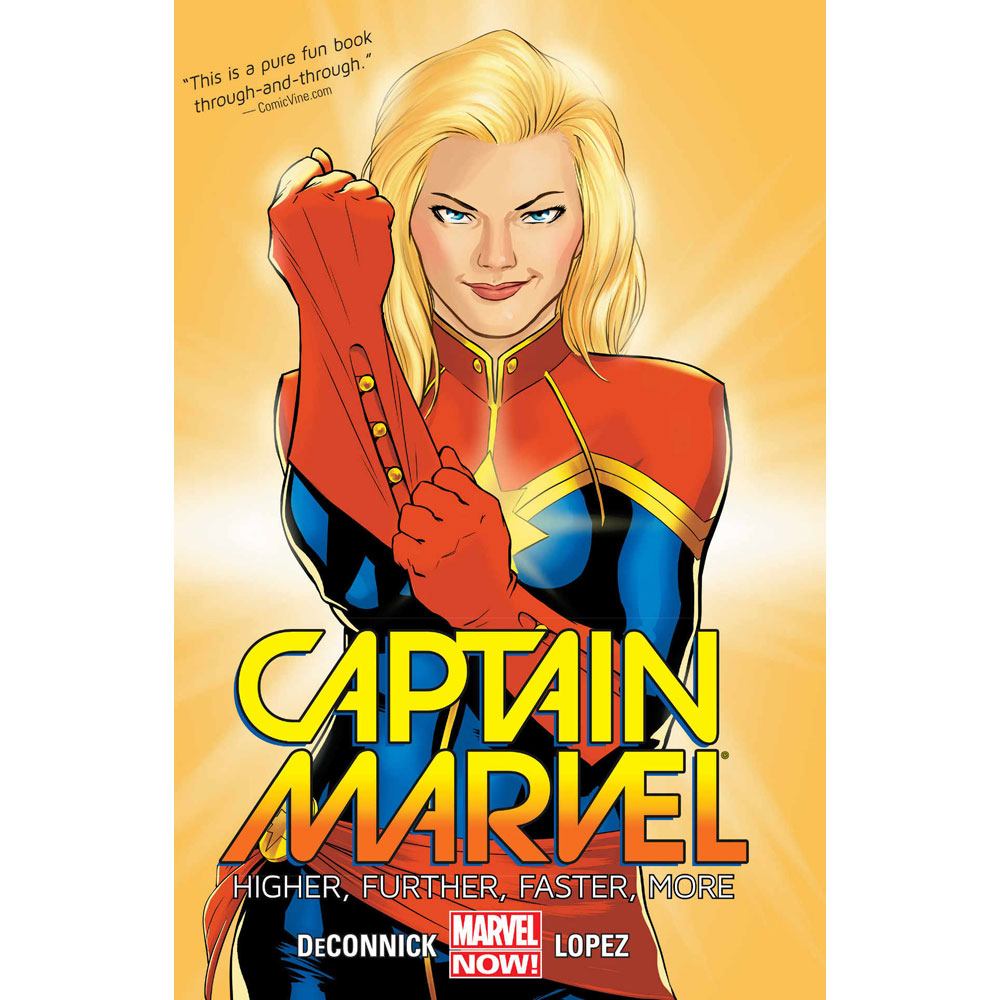
I’m particularly fond of the movie’s motto: “Higher Further Faster,” which comes from a well-regarded comic book storyline by Kelly Sue DeConnick and David Lopez.
The first thing that came to my mind was the single “Harder Better Faster Stronger,” mixed and remixed by French masters Daft Punk, which you can watch and listen to HERE. (Readers prone to seizures – be wary.)
Added geek bonus: There’s an anime music video based on the entire Daft Punk album “Discovery.”
The other reason I like Captain Marvel’s catchphrase is its application to teachers. In fact, I have a couple of related slogans I like to use with educators:
The first line is wholly original:
The best teachers keep getting better.
The second one updates a well-worn teacher maxim about getting lesson ideas:
Beg, borrow, steal . . . and make it BETTER.*
*We could talk a lot more about “making it better,” but for now here are twoarticles with some ideas. (Even though both are science-focused, all teachers can apply some of these strategies to their respective subjects.)
These two sayings deal with “lifelong learning.” We teachers must practice an attitude of ongoing learning and actions toward improvement, especially if we expect our students to do the same.
Although the above blog’s target audience is business owners and managers, teachers can still learn something for themselves and their students.
Speaking of students, a recent article at Education Week tells of a Des Moines high school’s professional development approach to include both teachers AND students.
Students may not use the technical language teachers employ when commenting on lesson plans, but “you’ll hear patterns of what’s considered best practices for engaging students.”
Teachers, what are you doing to get better?
Maybe you don’t have a formal joint student-teacher professional development program. But hopefully you listen to your students and pay attention to their ideas, gaining insight into your own instruction.
There are plenty of other ways to get better – professional conferences, publications, workshops, graduate classes, and other traditional methods. Or seek out improvement through personal endeavors like a hobby, travel, and relationships with your family and friends.
The summer season is soon approaching, which is a terrific time to recharge and refresh. It’s also a time to review your performance and refocus efforts on getting better.
What workshop or class or trip will YOU take to improve over this summer?
I’m sure you’ll find time between superhero blockbusters to get better, higher, further, faster, stronger . . .
We’ve been a little light on blog posts lately, but for good reasons!
Over the past year, I’ve been busy writing a few other projects. The first one is coming out in February 2019:
My contribution to this book is only one chapter – “Impulsive Students, Speedster Teachers, and Education in the 1990s” – and here’s a preview:
In 1994, DC Comics presented a potential poster child for 1990s adolescence: Bart Allen, a.k.a. Impulse—a time-displaced teen speedster from the future with a short attention span, entertainment-first obsession, disregard for adult instruction, and a habit of leaping-before-looking. This chapter focuses on mentors Impulse encounters along the way—namely Wally West and Max Mercury.
To frame my analysis of Bart’s teachers, I applied the 1998 text Approaches to Teaching by Fenstermacher and Soltis. And, of course, I used content from over two dozen different comic books. Here are a few examples:
Wally West (The Flash) is similar to an “executive teacher,” hastening with curriculum, outcome-oriented lessons, and direct instruction for his student Bart. Taken too far, this teaching can overwhelm the student, even one with super-speed. And the results can backfire . . .
In contrast to Wally, Max Mercury is more like a “therapist teacher,” also called a “fostering” or “facilitator” teacher by Fenstermacher and Soltis. But I doubt the authors envisioned a “therapist teacher” doing things like these . . .
As a “therapist teacher,” Max focuses his attention not only on Bart’s skills, but also on the teenager’s personal development — making friends, making decisions, experiencing effects of relationships and choices. Cultivating personal development means not always giving students an answer, even when they beg for it at super-speed:
Other times, a therapist teacher simply tells the student the honest truth, helping them refocus on the important goals:
What kind of teacher are you most like? Both approaches have strengths, some more advantageous in one situation or another.
Learn more when the book comes out February 2019. You can find it HERE and HERE.
In the meantime, we’ll revisit some of these topics here on this blog – hopefully sooner rather than later!
Nerds love to debate superhero superlatives. Who’s the strongest? Who’s the fastest? Who’s the most powerful?
Thanks to @reddit_user_1948, now we know which Avenger is the most talkative:
Iron Man a.k.a. Tony Stark.
These results are based on comparing dialogue from the six original Avengers in the Marvel movies, summarized below:
Dialogue in the classroom is another topic of extensive study. In such research, teachers are like Tony Stark in that they dominate the spoken word.
One of the most well-known researchers in classroom interactions is Ned Flanders.
(No, not this Ned Flanders.)
Back in the 1960s and 70s, Flanders found that 70% of classroom time is talk, and 70% of this time is teacher talk (1970). He also reported that teachers of high-achieving students talked less (55% of the time) than teachers working with low-achieving students (80% of the time).
No mention of cause and/or effect here, but one could also consider the advice of Harry and Rosemary Wong (First Days of School), who note that those who are “doing” more are the ones who are learning more. In this case, it stands to reason that classrooms with higher rates of student talk (on task) would result in greater student learning.
Instead of Tony Stark/Iron Man, perhaps teachers should look to less vocal heroes like Hawkeye, the archer Avenger. Following Hawkeye’s example, teachers can use fewer words with more precision.
Like well-aimed arrows, teachers could use purposeful questions and prompts to engage students, assess understanding, and guide discussion.
We’ve discussed questions before (such as here), and unfortunately, good questions don’t always come easily.
Additional research has found that of the 80,000 or so questions teachers ask annually, 80% of them are low level, requiring simple student responses without much thought (Gall, 1984; Watson and Young, 1986).
Like the Flanders research, some of these studies on teacher questioning are several decades old (“classic”). Effective teaching is timeless, however.
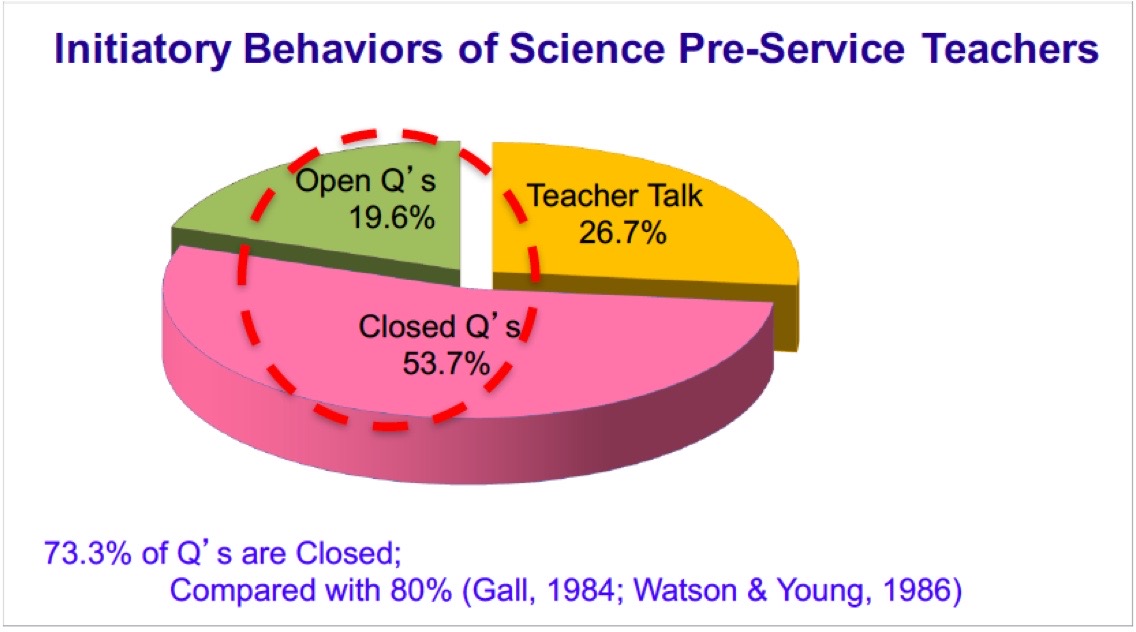
Likewise, several classroom habits still linger. For instance, I’ve studied pre-service teachers’ questioning (Bergman, 2013) and found classroom patterns similar to the past. Here’s a sample of those results:
No matter how much you talk in the classroom, be sure to make it count. Be intentional in your speech with planned questions and responses to engage students in thoughtful learning.
At the same time, be thoughtful in your own teacher talk. Be flexible and nimble, too, ready to “ad lib” when necessary.
After all, one of Tony Stark’s most memorable movie lines was improvised. Maybe you remember this ending to the very first Iron Man film:
Here’s the “behind-the-scenes” story of this famous line, which was instrumental in shaping the entire Marvel Cinematic Universe. Consider how teachers’ words in the classroom can be equally impactful toward student learning and interest.
If you pay attention to sports, you may know about basketball super-star LeBron James of the Cleveland Cavaliers.
If you don’t pay attention to sports, here’s a recap of “King James” highlights:
After recent struggles with player morale, LeBron’s Cavaliers team underwent a massive personnel shift, trading away 6 of their current players and 2 future draft picks in exchange for 4 new players and 1 different draft pick. To put this into context, these changes involved 3 separate deals with 4 different teams, resulting in a turnover of nearly half the entire Cavaliers team.
Teams typically don’t make changes this big so late in a season, but since the trades Cleveland has handily won two games against tough teams. Now, many experts have already pegged the Cavaliers as the “team to beat” in their conference.
One of the new Cavaliers players, George Hill, recently assessed his team this way:
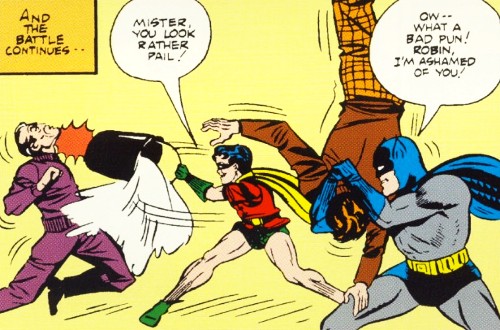
“We have one of the best players in the history of the game, I’m sure he’s going to dictate the tempo and things like that. We just got to do our job, be the best role players we can possibly be. He’s the Batman, and we got to be all Robins. We got to figure it out.”
What about all of us teachers? Are you Batman? Or are you a Robin? I would argue that teachers should be BOTH.
First, you are Batman.
Consider how you can mentor and guide a younger teacher also working in the crusade for education. You can provide lesson ideas, management suggestions, and an exemplary model of a caring and competent professional educator.
Need some ideas on how you can be a Batman for other teachers? Take a look at these articles (and excerpts) about being a teacher leader and mentor:
“Becoming a teacher leader” (Edutopia.org) — “[T]ry all the opportunities presented, listen up for colleagues who are nudging you along, and don’t be afraid to take risks — that’s what it’s all about.”
“Leading change from the classroom: Teachers as leaders” (American Institutes for Research) — “Today, leadership roles have begun to emerge and promise real opportunities for teachers to impact educational change-without necessarily leaving the classroom. Teachers are now serving as research colleagues, working as advisor-mentors to new teachers, and facilitating professional development activities as master teachers.”
“Eight qualities of a great teacher mentor” (Education Week) — “Great mentors push your thinking and help you grow in new ways. They alert you to new teaching methods and provide tips for how to handle various situations throughout the year. Most importantly, though, these “tips” are often posed as questions. Questions require new teachers to discover and learn for themselves.”
So in some ways, being a teacher is like being Batman. (Just don’t let it go to your head–and eat a Snickers when necessary.)
You are also a Robin.
As an exemplary teacher, hopefully you are also modeling the commendable habits of a lifelong learner. You are supportive, a sounding board, eager to help, and even provide corny jokes when the opportunity arises.
The neat thing about Robin is that there are multiple versions. Each individual has his or her own personality, backgrounds, strengths, weaknesses, and more.
In fact, DC Comics featured a whole host of “Robins” in the yearlong series We Are Robin. As explained by series writer Lee Bermejo in a USA Today article, “Maybe there could possibly be many of these kids out there on the streets who have different talents and different capabilities that could be useful to Batman.”
Likewise, teachers can fulfill the supportive, helpful, humor role in many ways and at many times. This includes having a “mentee attitude” throughout your career. Lifelong learning means there’s always more to learn. (The best teachers always strive to get better.)
Here’s a neat article at WeAreTeachers.com about “How to be (or find) a truly great teaching mentor,” and it includes a section titled “How to make the most of your mentor,” including the following strategies:
“Ask specific questions . . . The more specific your questions, the more helpful your mentor can be.”
“Know when to say ‘I don’t know’ . . . The point of mentoring is to improve, so resist the temptation to say everything is fine when it’s not.”
Teachers, are you more Batman or more Robin at this point in your career?
Full disclosure: I took both quizzes and found out I’m “The Nurturing Nightwing.”
Learn more about yourself and reflect on your profession, personality, and current position. Then go out and be a great teammate, sidekick, teacher, and superhero.





































 Teach Like a Superhero!