Beyond Buzzwords

Standard

Teachers may have seen the goofy gallery mixing educational jargon with bad 80s haircuts. Here are a few favorites, and you should check them all out at Teacher Misery.

Creator Jane Morris explains her distaste for buzzwords and mottos: “[T]hey take a fairly simple concept that most teachers do anyway and turn them into complicated, irritating nonsense.”

Inspired by this wombo-combo, I’ve created my own mini-album of buzzwords using 80s era Marvel superheroes (and super-hairdos). Behold!

All fun aside, it is a serious matter for educators to go beyond superficial labels or condescending catchphrases. (Even superheroes get lampooned with silly slogans or benign battle cries.)

Consider the true origins of such sayings, and reflect on what these terms REALLY mean.

To help with reflection, take a look at an article I wrote for the great folks at Edutopia.

Click HERE (or on the image above) to read the entire thing, and please share your comments here or there.

Either place, I’d love to learn what buzzwords drive you nuts (and why), along with what bad hairdos you secretly like.

Prime Time!

Standard

Fun Fact #1:

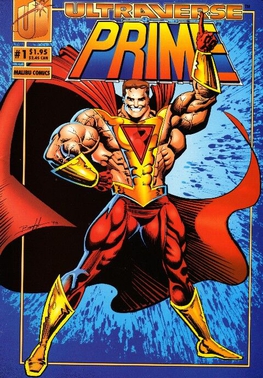
There’s actually a superhero known as Prime!

Way back in the 90s, the now-defunct Malibu Comics published PRIME, featuring a kid-turned-superhero sort of like SHAZAM (a.k.a. Fawcett/DC Comics’ Captain Marvel).

Fun Fact #2:

Amazon’s Prime Day is going on, and my book, Teaching Is for Superheroes! is listed 50% OFF!

Find the book HERE, and SHARE the news with your friends and fellow teachers and/or superheroes! (Stock up on your gifts TODAY!)

Bizarro Blues

Standard

The newest Superman movie mere days away!

Over the years on this blog, we’ve talked many times about connections between the Man of Steel and Teachers of Schoolsecret hideouts, weird superpowers, extreme makeovers, teaching with hope, and more.

Let’s take a look at one more element of Superman lore and its educational applications – Kryptonite.

Most casual fans know that Kryptonite is the radioactive green mineral that can weaken or even kill Kryptonians like Superman. What you may not know is that there are ALL kinds of Kryptonite colors – each one with its own side effects.

My personal favorite is Periwinkle Kryptonite, which you can learn more about HERE.

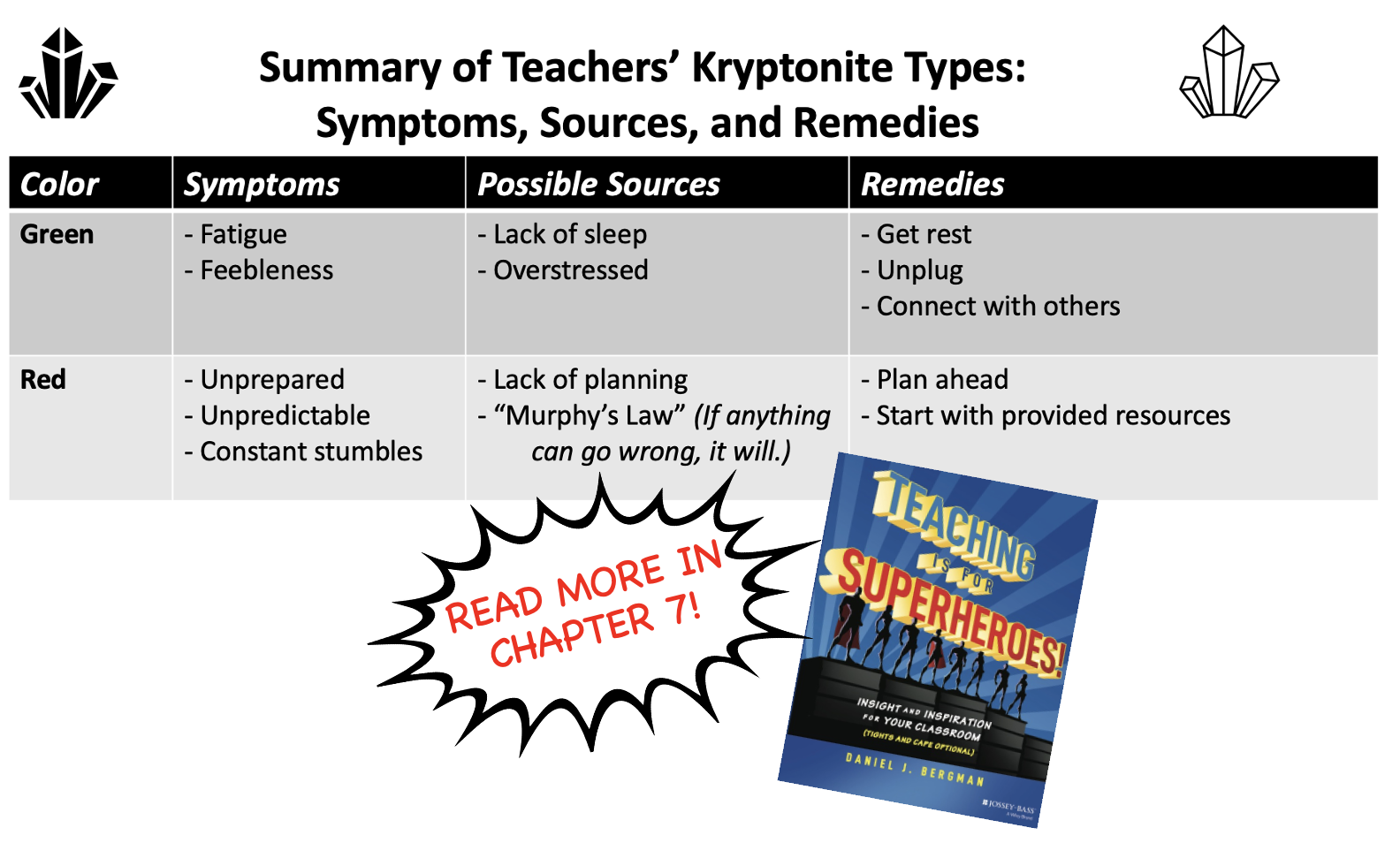
In my book, Teaching Is for Superheroes!, I devote an entire chapter to assorted Kryptonite colors and parallel vulnerabilities experienced by teachers (e.g. green = fatigue, red = unpredictability, white = lack of growth, etc.). Here’s a sneak peek:

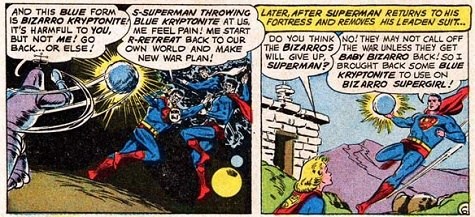
One color NOT covered in my book is Blue Kryptonite. This type is harmless to Superman, but is dangerous and lethal to his distorted doppelganger, Bizarro.

How does Blue Kryptonite apply to teachers? Each educator has their own strengths and weaknesses, personalities and professional expertise. It stands to reason, then, that we each may be vulnerable under different contexts and conditions.

Think of it this way: What’s an issue you consider no big deal, but is an incredible struggle for a colleague? When others want to rip out their hair, you simply shrug your shoulders.

This could be anything during a given school day or year. There are “big” things like curriculum choices, assessment plans, or management models. Or it might be something “small” like a fire drill, a jammed copier machine, or empty coffee pot*.

*If you’re not a coffee drinker, who cares? But watch out for Shannon, who gulps down three Ventis before lunch.

Courtesy of KamranAydinov via Freepik

Many challenges become less of an issue as you gain experience and skills. Regardless, a seemingly “minor” item may be VERY “major” to a particular person.

Vulnerabilities often appear alongside our strengths. Teachers with meticulous lessons might struggle when plans change. Others who “wing it” day-to-day could falter when they must prepare for a substitute teacher or formal observation. Someone who’s a wiz with Apple technology could feel useless with a Chromebook, and vice versa.

Here’s the beauty of Blue Kryptonite: Those unaffected can help others who struggle. And we should ALL stay humble, knowing every one of us has our personal pitfalls.

Don’t view someone as “bizarre” for their unique liabilities. Instead, look for ways to support them and learn as a community of imperfect individuals.

This applies to our teaching colleagues as well as our students. Each classroom contains a colorful roster of characters-such as those in the new film! (See you at the theater!)

Views on Reviews

Standard

Even though the new year has barely begun, it’s always a good time to reflect and review.

Unfortunately, the previous year wasn’t kind to superhero shows. (Or maybe it’s the other way around: Superhero shows weren’t kind to 2023.) Here is a list of superhero movies from last year and their scores on the “Tomatometer” –

Notice that only two films reach the equivalent letter grade of an “A” (both animated, by the way). And seven of these ten movies average out to a “C” or worse – including three below 50%. (Ouch.)

Aside from critics’ reviews, a film’s success also depends on how much money it makes (and also how much it costs). The criteria for “hit” movie, then, is multifaceted.

In the same way, teachers must consider a variety of factors when reflecting on classroom success.

Beyond summative assessment scores, we should account for pre-assessments, school context, and external factors. And go beyond academic measures for “success,” acknowledging the power of social and affective factors.

Here’s a neat-o graphic inspired by work from York, Gibson, and Rankin on “Defining and Measuring Academic Success” (2015).

Again, I would argue these aspects (and more) influence all kinds of success, not merely “academic.”

We’ve talked before on this blog about defining success and evaluating outcomes. But for now, let’s focus on reviewing teachers. How do we measure teaching effectiveness? And who should do it?

Not long ago, Edutopia asked this latter question, and summarized research into various teacher evaluation methods. This is their headline and graphic, and you should click HERE to read more.

For now, here’s a quick summary (you’re welcome) on some useful elements to enhance teacher evaluation:

  • Teachers should review their teaching with a peer, including fellow experts in content and pedagogy.
  • Wellwritten rubrics (and well-trained evaluators) help provide structure and intentionality.
  • Video recordings afford flexibility and efficiency for review, as well as opportunities for self- and peer-reflection. (This one is a personal favorite, and helps you reach “iconic” status.)
  • Student feedback can be a powerful supplement to other evaluations, especially to gauge rapport, management, and relative rigor.

Teachers, what do you think? How do you use any or all of these in your self-evaluations and self-improvement?

That last one – student reviews – can be tricky. The researchers acknowledge this, noting that some students may evaluate their teachers too harshly. In the entertainment biz, it’s called “review bombing,” and teachers can be mindful of such pitfalls, however rare. (As one of my mentors used to remind her colleagues, “consider the source.”)

I’m encountering a new sort of review process now that my book, “Teaching Is for Superheroes!” is out and in the public. (Have you heard? Or seen? Or both?)

Writers are cautioned to avoid reading their own book reviews, as this habit can stunt, distort, or even paralyze the creative process.

I’ll admit, I’ve taken a peek at a few reviews of my book. They’re not too bad (yet). And hey, I’ve still been writing! (Exhibit A: This blog.)

Still, I don’t want to get bogged down in second-guessing, cringe-inducing, and/or back-patting obsessions.

Teachers must also be careful in focusing too much on reflection and review that they forget to actually teach. Use reviews purposefully and proactively, but not at the expense of your instruction.

Teachers, what else do you do to review, reflect, and improve your teaching?

Please share your ideas. (Sharing and supporting the profession is a great way to help others AND yourself.)

Here’s one more suggestion: Check out a book on teaching! (I have a recommendation.)

And when you do, please provide an honest review at your favorite online merchant (or two), Goodreads, social media, or your own personal blog or podcast. I promise not to look at it . . . more than twice.


Excused Absence?

Standard

You may think this blog’s title refers to the relative lack of new posts in recent months. 

I wouldn’t blame you. Hopefully we’ll get back to a semi-regular schedule soon.

But I’ve had my reasons for such blog-paucity. It’s been a busy fall semester. Exhibits A-J . . .


Actually, the topic of “Excused Absences” comes from a social media post by Marvel Studios.

Check out this “Permission Slip” fans can use to skip school or work (or both if you’re a teacher). 

What’s your reaction to this note? 

  1. Ha! That’s funny.
  2. Hey, that’s not a bad idea.
  3. Gasp! How dare they make light of skipping school and/or work, especially in light of data on chronic student absenteeism and the detrimental effects on learning and retention?

If you responded closest to #3 above, chances are you’ve had some prior experience with students that miss or skip classes. 

(Still, I’d hope you can take it as a clever joke. And maybe sympathize with those of us excited to witness two landmark events in the wider Marvel Cinematic Universe.)

But since the issue is on the table, let’s look at students who miss school. And if it’s any encouragement, superheroes go missing all the time . . . .

Focusing on STUDENTS, the causes and effects of missing school are diverse and interdependent. For example, is a student not doing well because they are missing class, or are they missing class because they are not doing well? 

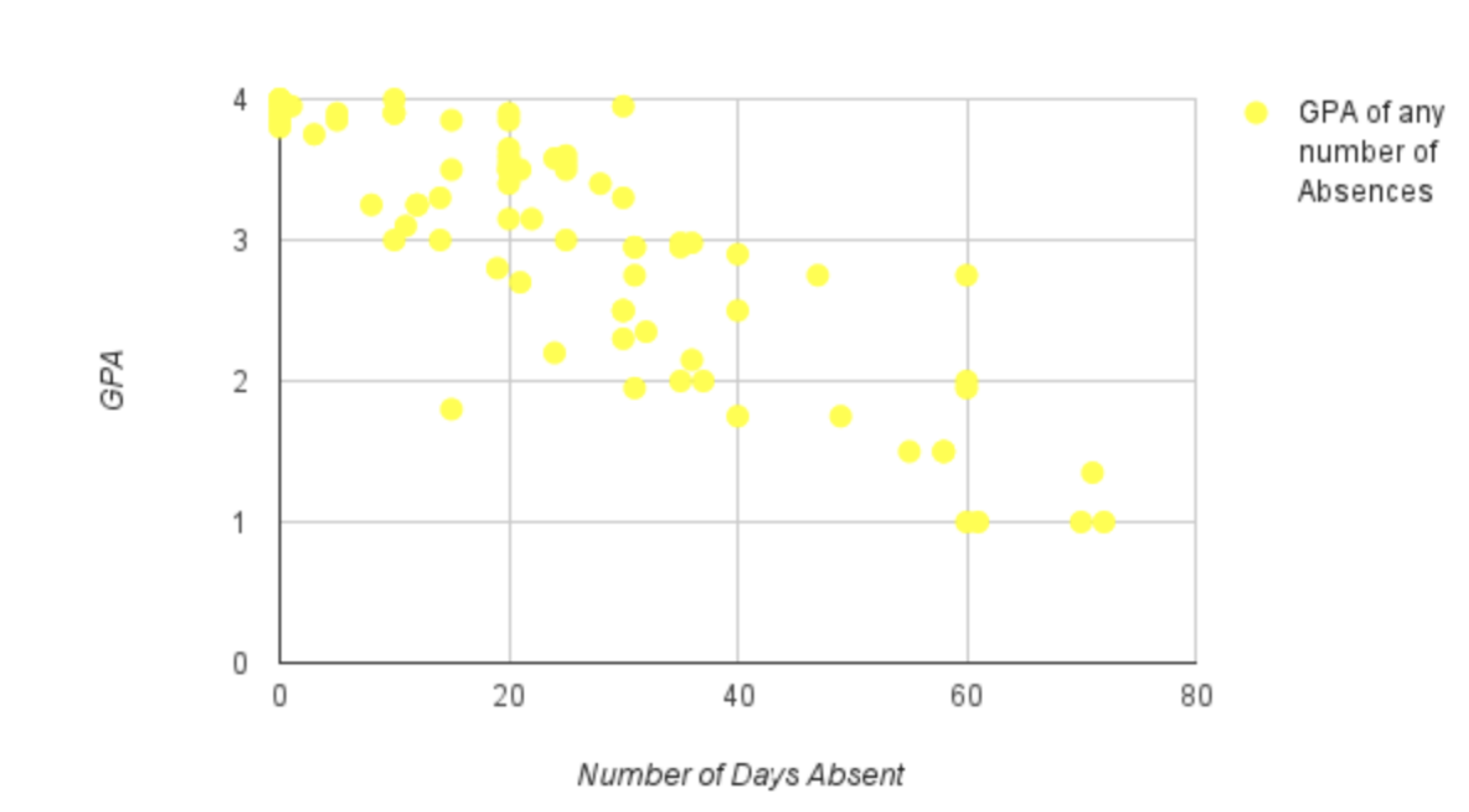
Regardless of causation, we can clearly see correlation. Here is a graph based on data of students in my university, courtesy of our Office of Academic Affairs. 

Sure, there are outlier individuals who buck the trend. But overall, it’s not too hard to notice that the more classes you miss (Number of Days Absent), the lower your overall grade point average (GPA).

You can find all kinds of data and research on this important issue, including the ones listed here.

(Notice this topic is so crucial that even the White House has an official position statement on the matter!)

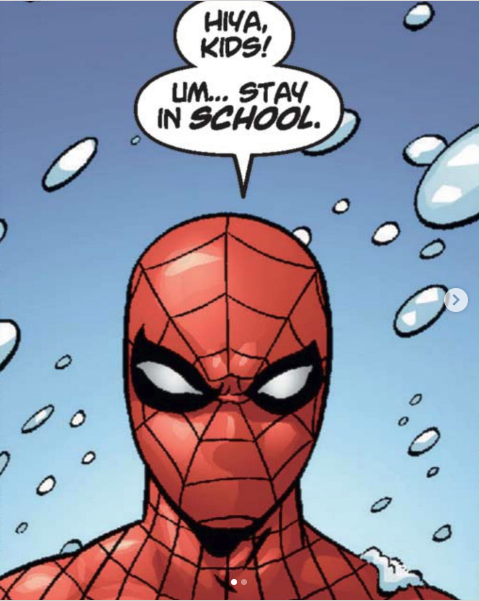
No big surprise, then, that a general rule of thumb is “Stay in school, kids.” 

See? Even Batman and Spider-Man agree!

Easier said than done for some, of course. Start with the list above for resources to increase attendance and engagement.  

And please share what you and your school do to help invite and retain students. Successes? Struggles? Lessons Learned? Advice to Share?

We welcome your feedback! (And will even write you a note if you need one.)

Good Teachers – Born or Made?

Standard

The title of this blog entry has been a question I’ve been considering and writing about lately:

Are good teachers “born” and naturally effective in the classroom?

Or are good teachers “made” through preparation and practice?

I wrote a short essay on this topic for MiddleWeb, a terrific website not only for middle school teachers, but for anyone in ANY teaching field.

Find my article here – https://www.middleweb.com/49591/what-is-your-teacher-superhero-origin-story/

And check out these amazing plugs from MiddleWeb and other teacher networks. NICE!

Vibrant “Hughs”

Standard

Although the upcoming Deadpool 3 movie is a loooong way from its release in theaters, fans are still excited for any news.

The BIGGEST reveal came recently with a sneak peek photo of the film’s two stars, Ryan Reynolds (Deadpool) and Hugh Jackman (Wolverine). Check it out!

Understandably, the BIG DEAL is that for the first time in two decades of movies, Hugh Jackman’s attire finally bears close resemblance Wolverine’s comic book costume. Nice!

Before, many fans believed it impossible to pull off a nearly all-yellow, non-ugly outfit in live-action cinema. But I admit, Hugh’s golden duds look pretty good. Chalk it up to movie magic!

This is not the first time we’ve used Hugh Jackman as a launching point to discuss teachers and teaching. Now in Part Three of our “Hughology” (trademark, 2023) we’ll use the charming Wolverine actor to reflect on teaching wardrobes.

We’ve also talked before about teacher outfits based on superhero icons, including both what to (or not to) wear in the classroom, and when (and how) to undergo an “extreme makeover,” which is more than just appearances.

Now let’s ask another important question:

Should teachers wear yellow?

Ready for the answer?

It depends.

Is yellow part of your school colors? Do you root for the the “Yellowjackets,” or “Golden Lions” or “Wheat Shockers?” If yes, then by all means, go for it. Especially on game days. Who cares if yellow is a bad match for your complexion? Show your team spirit!

All teachers can still wear yellow, no matter their school’s mascot. In fact, yellow is a common color recommendation for first day outfits. Both style and teaching websites give their approval (and examples, such as below).

You can find additional resources at websites like This Stylish Teacher, The Styled Teacher, Real Men Real Style, and more. (Keen observers will note Mr. Harrington wearing his golden jacket for the Midtown School of Science and Technology Academic Decathlon Team!)

Beyond trendy styles, there’s actual research to support adding a ray of sunshine via your threads. Fashion psychologists note how the color yellow conveys optimism, brightness, and energy. These are all great things to share in the classroom, on the first day of school and beyond.

A little bit of yellow goes a long way, however. A teacher with too much brightness and energy can overwhelm a class, whether by what they wear or how they act. Be purposeful and judicious in your appearance and behavior.

For further superhero inspiration, consider how many of the following heroes brandish yellow–sometimes a bit, sometimes a bunch–on their costumes. Instead of insignias or capes, teachers can add their own bright splashes with a necktie, scarf, jewelry, and more.

If you want to learn more about fashion psychology and superhero costumes, there’s a super-neat four-part feature at Comics Alliance about different color combinations, including those shared above.

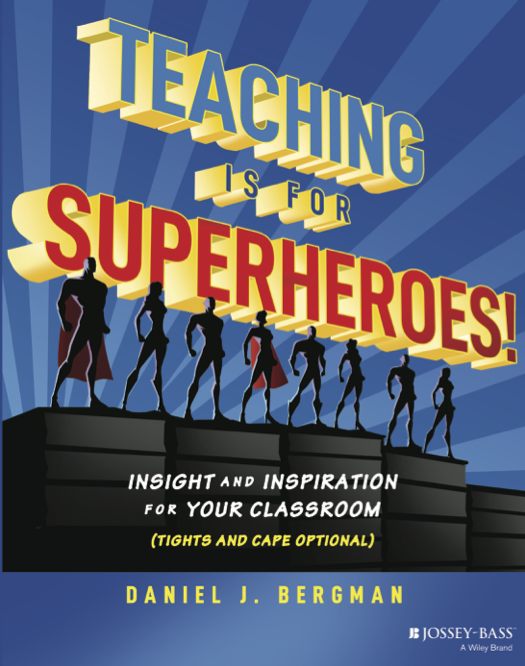
And read more about teacher attire AND teacher actions in my new book, Teaching Is for Superheroes! – NOW available anywhere online where you find GOOD BOOKS! Find out the latest at www.TeachingIsForSuperheroes.com!

(Note the savvy use of yellow on the cover – just enough to catch your attention!)

My OWN Teaser!

Standard

On this blog, we’ve talked many times about using classroom TEASERS (not Spoilers) as a way to ENGAGE and MOTIVATE students.  Travel back in time to read more about this strategy HERE and HERE.

For the present, enjoy our very OWN teaser for the trailer to the upcoming book, Teaching Is for Superheroes!

(I did my own stunts.)