KISS = Keep It Simple Superman

Standard

The latest Superman film is almost here, with a slew of predictions, hype, and interviews. (Sort of like every back-to-school season, right? No? At least we get a playlist.)

One interesting super-nugget came from a recent interview with writer/director/co-producer James Gunn. The movie’s official title has changed from Superman: Legacy to just Superman.

Here is a quote from Gunn about the name change:

[I]t was called Superman: Legacy. Even though I was the one that gave it that title, I just wasn’t sure. First of all, I’m sick of the superhero title, colon, other-name thing. And then also it seemed to be looking back when we’re looking forward . . .

This is a trend in other DC film projects. Another immediate name change is to upcoming film Supergirl: Woman of Tomorrow, reducing it to Supergirl. Again, not a huge trim, but definitely simplified.

Heck, just take a look at the Superman movies over the last half-century and notice simplification to not only the titles, but the logos as well.

Maybe you’ve heard the acronym, KISS, for “Keep it simple, stupid.” Rather blunt, but I guess that’s the point. Don’t let things get too complicated or clunky to become a distraction or detriment.

In the world of education, we also see this emphasis on simplification (often from a reactionary stance). You can find calls to simplify in teacher advice, pandemic adjustments, blogs, businesses, and more.

Cognitive Overload (courtesy of jcomp via Freepiik)

Scientifically, keeping things simple helps avoid “cognitive overload,” which the American Psychological Association defines as “the situation in which the demands placed on a person by mental work (the cognitive load) are greater than the person’s mental abilities can cope with.”

You can find this definition and strategies for simplifying lessons at a helpful essay (and book excerpt) from Miriam Plotinsky and Edutopia HERE.

You can also find inspiration from the American classic Walden by Henry David Thoreau, and his famous lines published waaaaaay back in 1854:

“Our life is frittered away by detail. Simplify, simplify, simplify! I say, let your affairs be as two or three, and not a hundred or a thousand; instead of a million count half a dozen, and keep your accounts on your thumb-nail.”

Educators can apply another idea from the James Gunn interview about producing multiple superhero projects. In discussing title changes, the creator describes a process he calls “premortem,” in which he and his team preview potential problems with their show and proactively address them. If the production were to fail, they challenge themselves to consider some reasons it might. This could be anything from casting to the aforementioned title.

Teachers, we should do the same thing for our lessons. How could the lesson fail? What are some potential pitfalls–logistically or academically? Where do you need additional details? Fewer? Where can you simplify?

If it helps, use a handy checklist like this one. Or maybe your school district provides guidelines. (Word of Caution: You can find a lot of these online, and some could be simplified!)

A lesson that needs changes (courtesy of stockking via Freepik)

For all you teachers in the midst of your summer “break,” pause a moment to try two things.

First, perform a mental “premortem” on at least one of your challenging lessons or units. Where could you simplify or make other adjustments to improve student learning? (Maybe wait until your back-to-school week to really get into it. Until then, just jot down things to check as they come to mind.)

Second, in the meantime, get away and go somewhere–maybe a picturesque landscape that’s nearby–to reflect and refresh. It doesn’t have to be Walden Pond (or outer space), but wherever you can unplug and reconnect with what–and who–is important.

Talk with the Hand (Gestures)

Standard

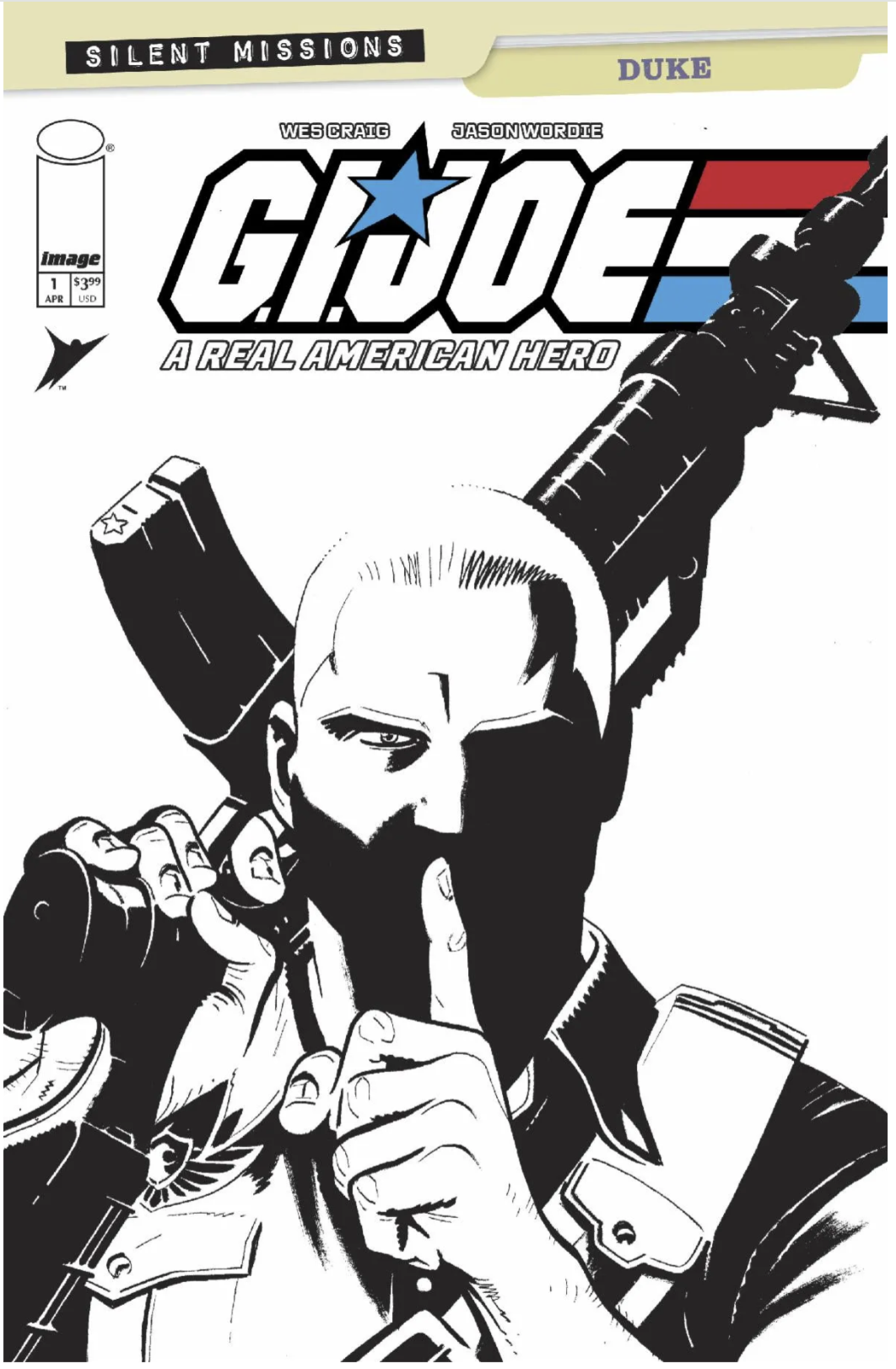
G.I. Joe (A Real American Hero) is back in the spotlight of the comic book world, with multiple ongoing series and a whole new interconnected universe.

For those NOT in the know[ing is half the battle], G.I. Joe is basically “army superheroes.” It’s got high-stakes sci-fi action, soap opera drama, and all a store rack full of colorful characters.

We’ve already featured G.I Joe here in the past, focusing on the milestone “silent issue” #21 that tells a complete comic book story with ZERO dialogue and sound effects.

Check out our original post HERE, which discusses all of the unspoken behaviors that impact classroom instruction, and strategies for teachers to improve their interactions with students.

G.I. Joe #21 is so influential that many other comic books tried their own “silent” issues over the years. In fact, publisher Skybound has announced a special “Silent Missions Month” in April 2025. Five different Joes get their own story told in the same word-free style.

Silent stories with Beach Head, Jinx, and Spirit? Sign me up! Not sure about Roadblock, though, given his role as Heavy Machine Gunner and knack for bad rhymes (in the cartoon, at least).

Regardless of how “Silent Missions Month” goes, this news gives us another opportunity to look at nonverbal teaching actions in the classroom.

In an article for Edutopia, Todd Finley shares a helpful summary of research, specific strategies, and takeaways all focused on . . .

My favorite section of this article is “When should students use gestures?”, which also includes a discussion of when NOT to use gestures.

Nonverbal communication is important for a productive classroom, but it is not an exclusive tool. Similarly, comic books can’t rely on using silent issues all the time. Like all teaching strategies, anything overused soon becomes a gimmick and loses impact.

Teachers, what are your “go-to” gestures or unspoken mannerisms for effective instruction? Please share (or demonstrate) below!

Superhero Shuffle!

Standard

No, the “Superhero Shuffle” is not the latest dance craze (yet).

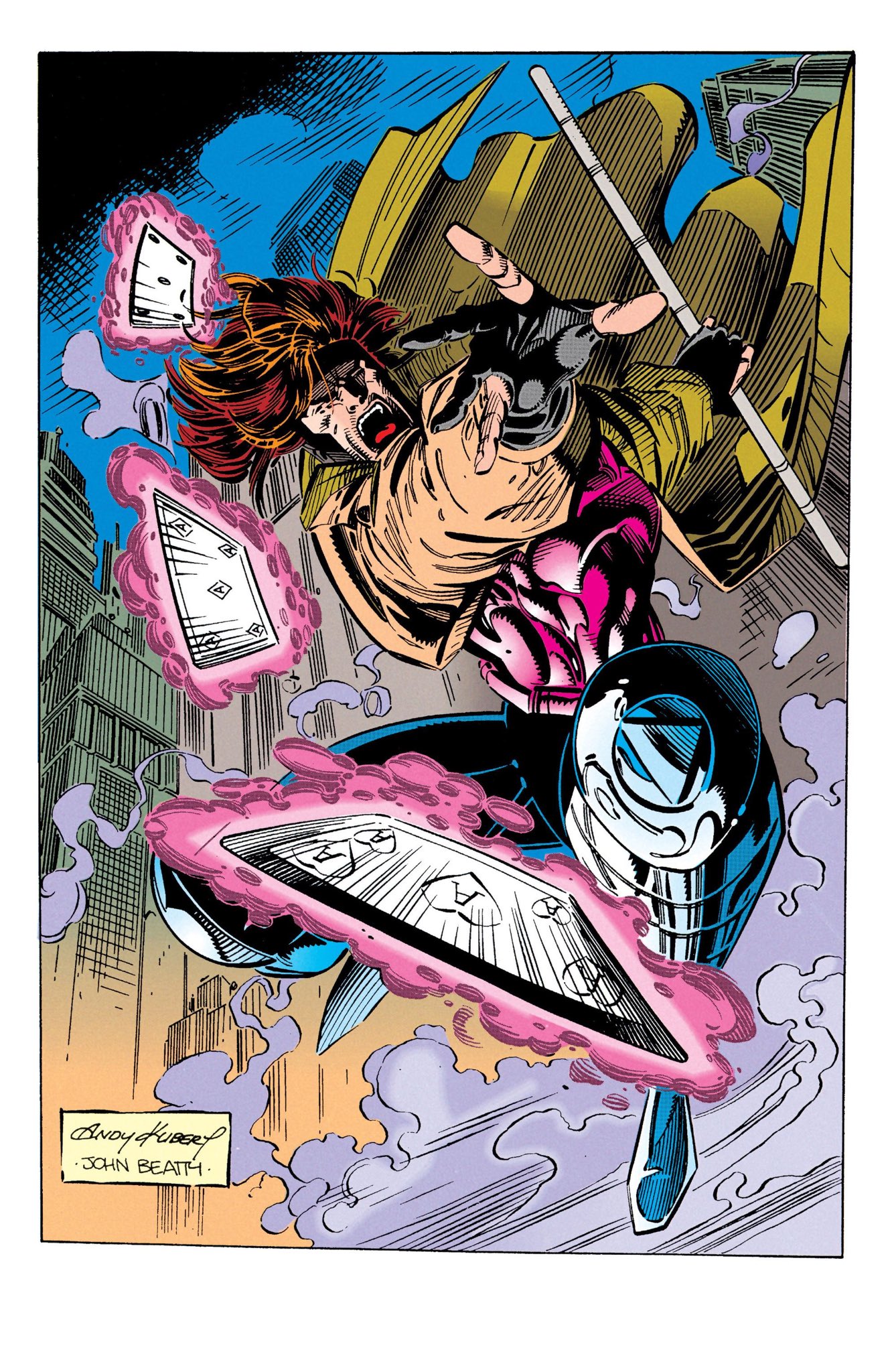
But I’ll still use any excuse to share this fabulous comic book page of Clark Kent dancing. Shake that Super Bootie!

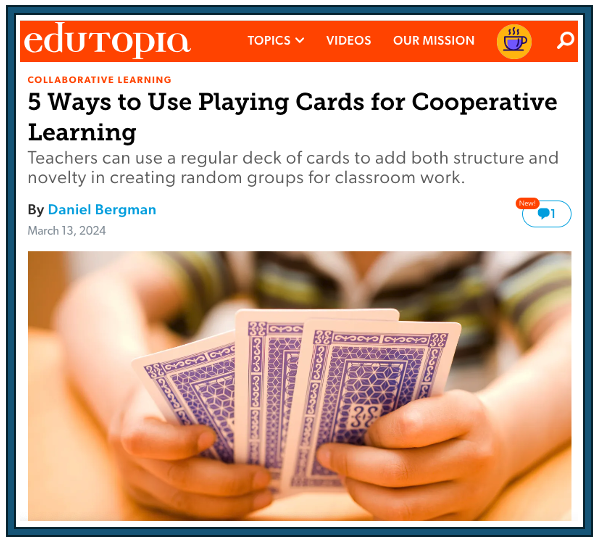
Instead, this blog is about shuffling CARDS — namely playing cards that teachers can use for different cooperative strategies in the classroom. Ante up!

Check out this NEW article I wrote for the great folks over at Edutopia, and try out one of these strategies with your students.

Just be sure to let your students–and colleagues–know that no one is gambling.

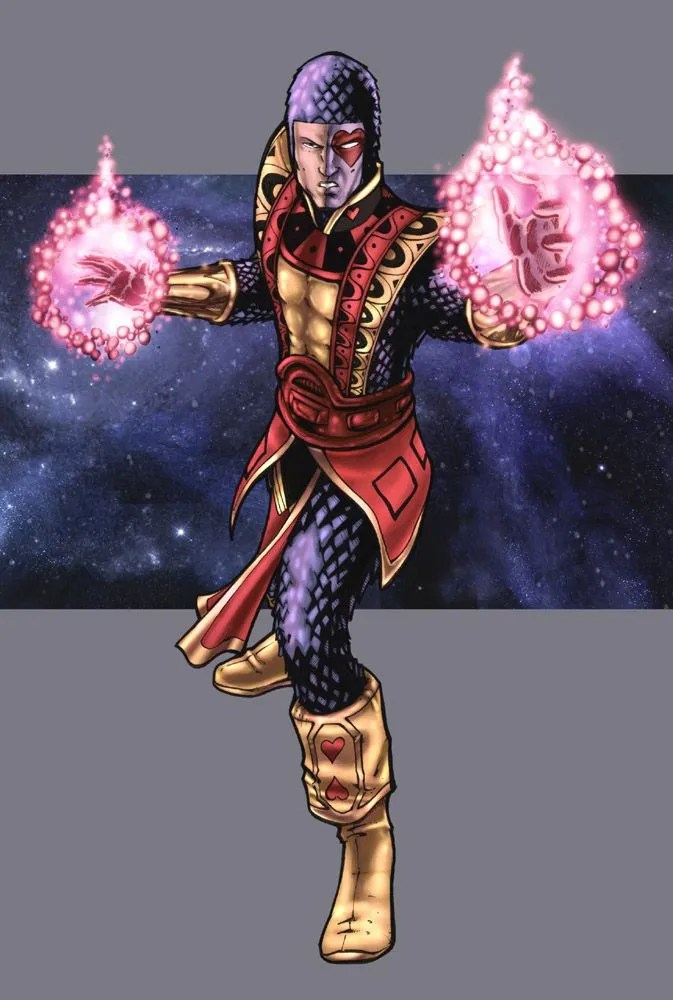
And to get back to superheroes, here are some heroes (and villains) famous for their card-themed connections. Deal me in!

Views on Reviews

Standard

Even though the new year has barely begun, it’s always a good time to reflect and review.

Unfortunately, the previous year wasn’t kind to superhero shows. (Or maybe it’s the other way around: Superhero shows weren’t kind to 2023.) Here is a list of superhero movies from last year and their scores on the “Tomatometer” –

Notice that only two films reach the equivalent letter grade of an “A” (both animated, by the way). And seven of these ten movies average out to a “C” or worse – including three below 50%. (Ouch.)

Aside from critics’ reviews, a film’s success also depends on how much money it makes (and also how much it costs). The criteria for “hit” movie, then, is multifaceted.

In the same way, teachers must consider a variety of factors when reflecting on classroom success.

Beyond summative assessment scores, we should account for pre-assessments, school context, and external factors. And go beyond academic measures for “success,” acknowledging the power of social and affective factors.

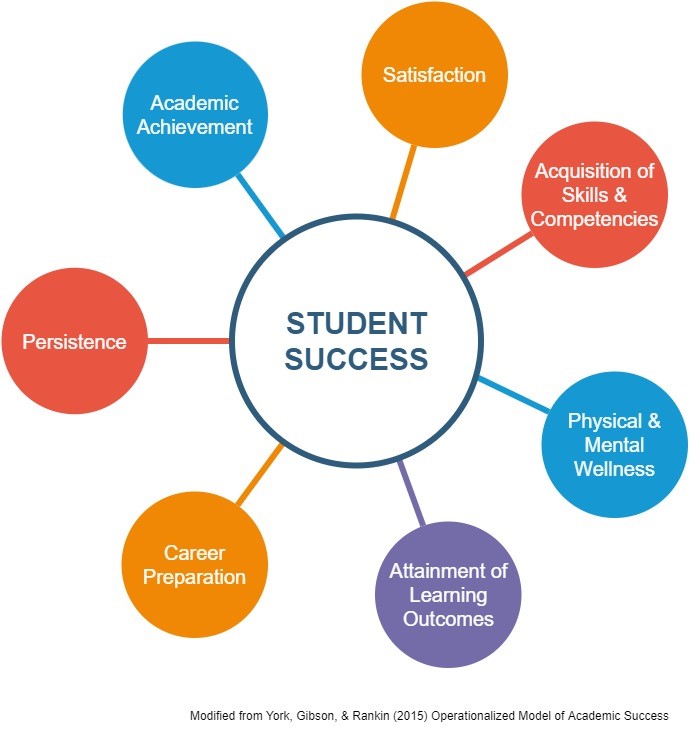
Here’s a neat-o graphic inspired by work from York, Gibson, and Rankin on “Defining and Measuring Academic Success” (2015).

Again, I would argue these aspects (and more) influence all kinds of success, not merely “academic.”

We’ve talked before on this blog about defining success and evaluating outcomes. But for now, let’s focus on reviewing teachers. How do we measure teaching effectiveness? And who should do it?

Not long ago, Edutopia asked this latter question, and summarized research into various teacher evaluation methods. This is their headline and graphic, and you should click HERE to read more.

For now, here’s a quick summary (you’re welcome) on some useful elements to enhance teacher evaluation:

  • Teachers should review their teaching with a peer, including fellow experts in content and pedagogy.
  • Wellwritten rubrics (and well-trained evaluators) help provide structure and intentionality.
  • Video recordings afford flexibility and efficiency for review, as well as opportunities for self- and peer-reflection. (This one is a personal favorite, and helps you reach “iconic” status.)
  • Student feedback can be a powerful supplement to other evaluations, especially to gauge rapport, management, and relative rigor.

Teachers, what do you think? How do you use any or all of these in your self-evaluations and self-improvement?

That last one – student reviews – can be tricky. The researchers acknowledge this, noting that some students may evaluate their teachers too harshly. In the entertainment biz, it’s called “review bombing,” and teachers can be mindful of such pitfalls, however rare. (As one of my mentors used to remind her colleagues, “consider the source.”)

I’m encountering a new sort of review process now that my book, “Teaching Is for Superheroes!” is out and in the public. (Have you heard? Or seen? Or both?)

Writers are cautioned to avoid reading their own book reviews, as this habit can stunt, distort, or even paralyze the creative process.

I’ll admit, I’ve taken a peek at a few reviews of my book. They’re not too bad (yet). And hey, I’ve still been writing! (Exhibit A: This blog.)

Still, I don’t want to get bogged down in second-guessing, cringe-inducing, and/or back-patting obsessions.

Teachers must also be careful in focusing too much on reflection and review that they forget to actually teach. Use reviews purposefully and proactively, but not at the expense of your instruction.

Teachers, what else do you do to review, reflect, and improve your teaching?

Please share your ideas. (Sharing and supporting the profession is a great way to help others AND yourself.)

Here’s one more suggestion: Check out a book on teaching! (I have a recommendation.)

And when you do, please provide an honest review at your favorite online merchant (or two), Goodreads, social media, or your own personal blog or podcast. I promise not to look at it . . . more than twice.

Top Lists

Standard

At the end of every year, you’ll find a smattering of “Top Ten” or “Best of . . .” lists. Do a quick web search and you’ll discover all kinds of countdowns for 2022.

Better yet, we’ve done some reading ourselves and provided a few hyperlinks, including Comic Book rankings by people at Polygon, Den of Geek, and Entertainment Weekly.

My favorite of 2022 was the new Batman/Superman: World’s Finest” series by Mark Waid, Dan Mora, and Tamra Bonvillain. It’s a fresh take on the old-fashioned DC team-up title. The art is dynamic and colorful, with big action mixing up characters both well-known and unknown.

Comics aren’t just full of superheroes, of course, as you’ll notice many different kinds of tales in these “Best” Comic Books.

For more capes and cowls, you can also find “Top” lists ranking favorite superhero television series, such as one by the folks at IGN.

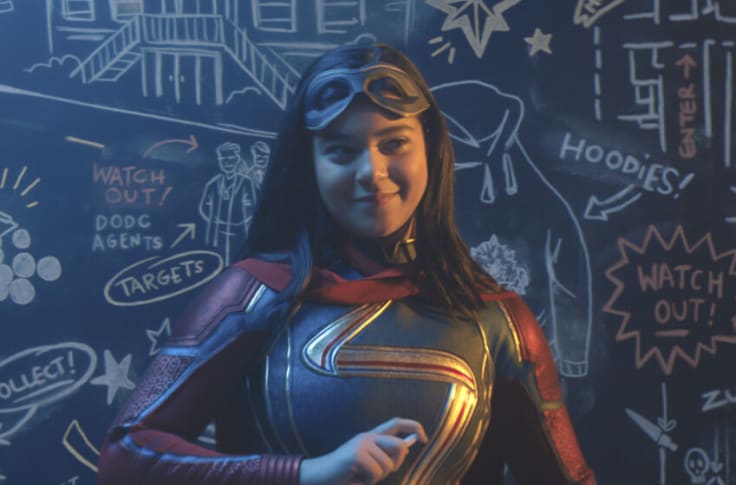
Again, my two-cents’ worth is that Ms. Marvel was the best choice in a very robust slate of superhero TV in 2022.

I’ve already talked about Ms. Marvel in a previous post. Simply put, it’s another fun teen title in the tone of Spider-Man.

Like Spidey, Ms. Marvel begins with our hero learning about their powers and living among family and friends. But “trial-and-error” adventures at the street level soon explode into a globe-hopping (and time-traveling) quest. Good stuff!

In addition to TV and Comics, there are even “Top” lists for Teachers!

Places like Education Week and Education Next highlight the most-read blog posts and articles in 2022. A lot of these deal with policy and trends in curriculum, as opposed to direct classroom practice. Still, it’s good to stay up to date with the latest. Keeping current is even more vital with RESEARCH in teaching and learning, as featured in Edutopia’s “10 Most Significant Education Studies of 2022.”

Here are a few of my favorite takeaways from their Top Ten:

#1 THERE’S NO CONFLICT BETWEEN RELATIONSHIPS AND RIGOR

“The researchers found that the most effective teachers build their classrooms by getting to know their students, being approachable, and showing that they enjoy the work—and then deftly translate emotional capital into academic capital.”

#10. AN AUTHORITATIVE STUDY OF TWO HIGH-IMPACT LEARNING STRATEGIES

“In the review, researchers explain that students who prefer techniques like reading and rereading material in intense cram sessions are bound to fail. Instead, students should think of learning as a kind of ‘fitness routine’ during which they practice recalling the material from memory and space out their learning sessions over time.”

Similar to “Top” rankings for the previous year, you’ll also find “Most Anticipated” lists previewing upcoming movies, comic books, and more.

Just as teachers can gain insight from reviewing the “best” of the past, they can also find inspiration in previewing the future.

What are you anticipating most in the next year? (Maybe a new book?)

Better yet, how can you help your students look forward to the future?

School-topia*

Standard

houseofxpowersofx


Recently, Marvel’s X-Men have shot back into the spotlight both in publishing and super- heroics.

This resurgence started off with the House of X/Powers of X mini-series in Summer 2019, and continues into 2020 with numerous X-titles and storylines.

One of the key elements of this new “Dawn of X” relaunch is that Professor X has created a paradise island nation for all mutantkind.

krakoa


The idea of a mutant utopia is NOT new in X-Men comics. In fact, there have been multiple “Mutopia” worlds in alternative universes, including House of M and Battleworld. One look at these stories shows that people’s ideas of a perfect world can be VERY different.


One of the most famous X-Men Utopias was an island in San Francisco Bay. Actually, before it was an island, this particular utopia was an asteroid controlled by Magneto. But it’s not that strange when you consider the recent Dawn of X utopia is the living mutant island Krakoa. (Hooray for comic books!)

House-of-X-03-720x741

Here’s the problem with utopias: They almost always end in catastrophe.

Think of any fantasy or sci-fi story featuring a utopian society. Typically, these worlds go crumbling down just in time for the thrilling climax, if they haven’t already collapsed to kick off the adventure.


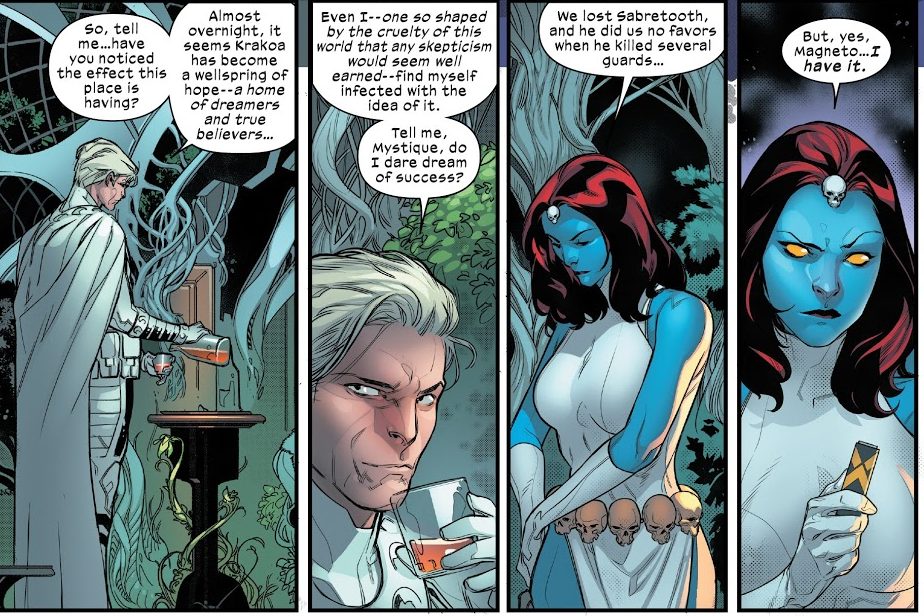
Also, many utopias hide a dark secret that becomes their undoing. It looks like this sort of thing may happen soon for the X-Men’s Krakoan utopia, thanks to shapeshifter Mystique (and Professor X? Magneto?).

magneto_mystique

Something is fishy here.

What about schools and classrooms? Is it possible for such a place to be utopian?

I once heard a principal at a large school speak about the “Perfect Day.” He said that a perfect day is NOT when nothing wrong happens. Rather, a perfect day is when issues come up, and the school teachers and staff handle them the right way.

I like this attitude. It’s not optimistic or pessimistic, but just plain pragmatic.

We are all human, teachers and students alike. None of us are perfect. So why would a school full of kids and adults ever be perfect?

kids-in-classroom

Something is fishy here, too.

In fact, teachers must be careful whenever we think we have reached perfection. No teacher is perfect, no matter their experience or awards. We all struggle and succeed in different areas, and we can all get better at something. The same is true for every day of school.

There is a short essay by Tim Slater in The Physics Teacher warning teachers about utopian school days. It’s called “When is a good day teaching a bad thing?” and you can find it HERE.

And here’s a teaser:

Screen Shot 2020-02-14 at 5.06.20 PM


Read the entire article and consider what sort of “Hidden Contract” you may be establishing with your students and colleagues. It’s not that well-behaved, on-task students are a bad thing. Far from it. But pause and consider why and how these expectations arise.

Do your students follow directions and contribute to class because they WANT TO or because the HAVE TO? (An easy way to find out is by leaving the room, or checking with the substitute teacher after an absence.)

Naturally, there are times when students (and all of us) do things because we have to, whether we like it or not. Exercise. Healthy diet. Pay taxes. Change diapers.

If we’re honest with ourselves, we can admit there is a positive payoff from these efforts, even if they are not easy. In many cases, practicing good habits in such endeavors will also increase the ease and even enjoyment.

A “perfect” classroom is impossible (and potentially dangerous). But hopefully teachers can instill solid skills and dispositions in students. One sign of maturity is doing things we don’t feel like doing. Another is doing the right thing even when no one is watching. (I’ve also heard this is the definition of integrity.)

So we may never reach school wide utopia. But maturity and integrity make for a good start!


*Admittedly, a much better pun than “School-topia” is “Edutopia.” But George Lucas already has the rights to that one. Take a look at this resource for educators, starting with https://www.edutopia.org .


Summer Break 2019

Standard

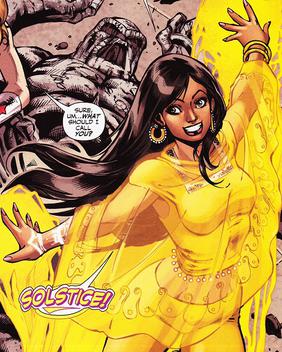
Happy Summer Solstice for all of you in the Northern Hemisphere!

SolsticeDCU

Check out “Five Fun Facts” about the longest day of the year.

Since it is officially summer according to astronomical coordinates, it’s time to officially celebrate summer for every teacher (even if you are still in a classroom somewhere).

For teachers who need something to do over the “break,” read the following resources:


You can also take a look at some highlights from the past school year:


Keep on reading and learning . . .


Grit-ty Heroes

Standard

“Grit” is a popular term in educational circles today, particularly with helping students succeed.

Grit is “passion and perseverance for very long-term goals,” “having stamina,” and “sticking with your future day-in day-out, not just for the week, not just for the month, but for years.”

I got those “gritty” quotes from the following TED Talk video with Angela Lee Duckworth, and you should watch the entire thing (about six minutes).


In the world of superheroes, “grit” has a much different meaning.  During the late 1980s and early 1990s, “grim and gritty” superheroes nearly saturated the comic book market.  If you’re interested, you can read a thorough analysis of this time period HERE.

“Grim and gritty” got so popular it seemed almost everyone got in on the act–Superman, Batman, Flash, Green Lantern, even Aquaman!

aquamanhook-1275533363

Coming to theaters near you!


Thankfully, most of these heroes’ gritty phases were short-lived and brighter days returned.  For some heroes (or anti-heroes), however, it’s always been about grim and grit:  The Punisher, Ghost Rider, Wolverine, and about 87% of Image Comics from the 1990s.  Exhibits A-to-Xtreme below . . .


Given the above definition of “grit,” I would argue that the grittiest superhero is Captain America.


captain-america-birthday-142652-1280x0

Remember, Steve Rodgers stood up to evil and injustice while he was still a 98-pound weakling.  His heart and passion did not change after he gained powers and a costume.  At times, Steve has given up or lost the title of Captain America. But he continued his work behind the scenes and/or assuming another superhero identity.

We’ve already gotten a glimpse that Steve’s non-Captain America heroics will appear in upcoming Avengers movies:

captain-america-avengers-infinity-war-1012169

(He’s even got a beard – extra grit!)


At the time of the TED Talk video, not much was known about teaching and cultivating grit in students.  Nevertheless, you can find research summaries HERE and HERE, which also include resources and tools for student grittification*.

*Trademark 2017, Daniel J. Bergman

In the video, Duckworth refers to research of Carol Dweck on “growth mindset” as one potential factor in teaching grit.  This is a good place to start.

growthmindset head


For example, HERE is one of Dr. Dweck’s articles (“The Perils and Promises of Praise”) that discusses the impact of teacher praise on students’ motivation and self-concept.  All teachers should read this article, since 1) it is short, and 2) it has direct application in the classroom. In other words, it won’t take a lot of grit. But you should stop and think about how you respond to students, and what other messages are conveyed in your words.

And this is just one step. As explained near the end of the TED Talk video, teachers who want gritty students must also be gritty themselves.

Don’t let grit become one more educational fad that passes away.


Super Women (and Men)

Standard

March is Women’s History Month, and Edutopia has provided several lesson ideas teachers can use to help students examine “women’s contributions, struggles, and triumphs throughout history.”

In recent history, Marvel Comics has given more support to their female superheroes, with solo titles starring a new Ms. Marvel, Captain Marvel (the old Ms. Marvel), Black Widow, Spider-Woman, and much much more . . .

An all-female X-Men team stars in the relaunched comic book X-Men.

XWomen

Why not “X-Women?”

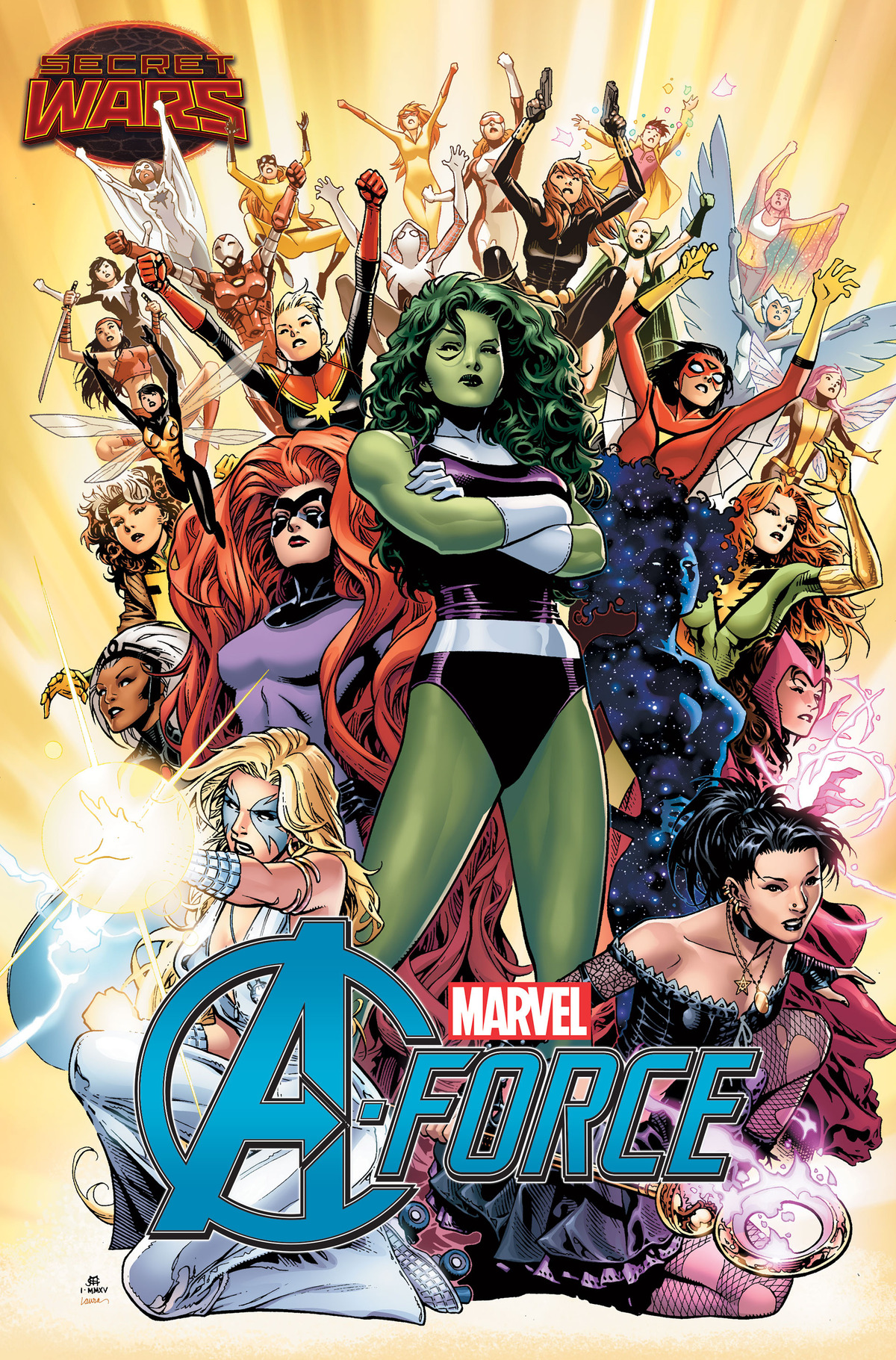
An all-female Avengers team will soon star in a book called A-Force.

AFORCE-1

Better than “FemForce,” although such a comic DOES exist.

Heck, even Thor is a woman right now, which hasn’t pleased everyone.

thor female

If I had a hammer . . . . I’d shatter the glass ceiling.

For their part, DC Comics has recently given Wonder Woman long sleeves:

new wonderwoman costume

Speaking of Wonder Woman, Harvard professor Jill Lepore’s The Secret History of Wonder Woman has earned all kinds of praise and prizes for its examination of the iconic super heroine’s creation as well as women’s history in the 20th century, which circles us back to the start of this blog post.

What does this have to do with teaching?

For better or worse, teaching has often been looked as a “woman’s profession.” In fact, another Harvard-based publication refers to teaching as “Woman’s ‘True’ Profession.”

While this notion may help to empower women and celebrate their impact on society, it can also lead to fewer men working as teachers, especially with younger grades. For example, a study in England found that 25% of all primary schools are staffed entirely by women. Is this good or bad? As a happily married male, I will respectfully and delicately sidestep that discussion for another time.

Another study in England found that women are disproportionally fewer in roles of “headteachers” and “school senior leaders” (translation: administrative and school leadership roles). Such a gender imbalance is probably not a good thing.

Male or female, super-powered or human, Marvel or DC, all teachers play a vital role in successful student learning. Or, as one new book says, “it takes team effort:”

it takes team effort book

“Men and Women working together to enhance children’s lives.”

That’s a wonderful thing.

Question(s) & Answer

Standard

Question_34

One comic book character who is prime for a screen adaptation is DC’s The Question.  In fact, the folks at  WhatCulture.com list The Question as one of their “10 Obscure Superheroes That Badly Need a Movie Treatment.”

A movie may work fine, but an ongoing Question TV Series would be a perfect fit, featuring a street-level noir hero with regular crimes and conspiracies to solve. If you want to see The Question in animated action, you can find some highly regarded appearances in the Justice League Unlimited series.

You can also find a nifty short YouTube documentary on “Who is the Question?” right here.  The most iconic version is Vic Sage, although more recently the moniker (and mask) was taken over by Renee Montoya, best known as a detective in the Gotham City Police Department.  [A live TV version of Det. Montoya has appeared in Fox’s Gotham series.  No sign of any Question(s), though.]

250px-Reneequestion

In case you’re wondering, there IS a superhero known as The Answer in comic books.  You can read more about The Answer here and here.  Judging from his appearance, I’d say a more appropriate name is The Exclamation Point or The Interjection!

the-answer-1

In teaching, we know that “Questions are the Answer.”  Often, what makes or breaks a lesson is how the teacher interacts with students during the activity.

Rather than just talking at students, teachers must ask questions throughout each lesson.  Questions and similar prompts are effective ways to encourage thoughtful reflection, promote engaged discussion, monitor student thinking, and more.

Unfortunately, research has found that a vast majority (70-80%) of questions asked by teachers require nothing more from students than reciting facts or guessing simple answers (Gall, 1984; Watson & Young, 1986; Bergman & Morphew, 2014).

So the question is this:  What kind of questions do you ask?  

Challenge yourself to challenge students by habitually asking  questions that require high-level thinking, such as those skills classified in Bloom’s taxonomy of educational objectives:  Application, Analysis, Synthesis, and Evaluation (Bloom, 1956).

How do you begin?  Here are a few resources I’ve recently come across that may be a good start:

– From Edutopia: “5 Powerful Questions Teachers Can Ask Students”

– From The Huffington Post*“25 Ways to Ask Your Kids ‘So How Was School Today?’ Without Asking Them ‘So How Was School Today?'”

*This second resource is more for parents, but teachers can gain ideas from the example questions for encouraging conversation.

The goal is to get kids thinking, reflecting, and sharing so you and their classmates can also think, reflect, and share ideas.

I’m glad there are two Questions running around in comic books. It reminds us that teachers need to use multiple questions in our interactions with students.  One question is often not enough.

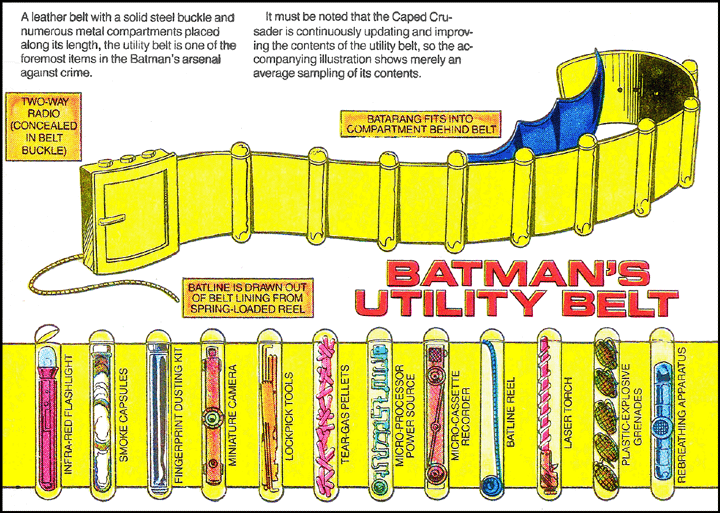
Like Batman and his utility belt, you should have an entire arsenal of prompts and queries at your ready, posing the right one at the right time.

Batman utility belt

I don’t own a utility belt, but I do keep a small index card in my pocket with question stems such as “In what ways . . .?”  “For what reasons . . .?”  “How might you . . .?” and many more.  Whenever I’m stumped for a good question, I can check my list to keep the conversation going.  And like Batman with his belt, you should continuously update and improve your questioning strategies.

Unlike the hero The Question, however, you will want to add engaging facial expressions.  Smile a little.  Make appropriate eye contact.  And talk in a welcoming tone of voice.

question image

Not the face you want to see in a classroom.

The Question wants to hide an identity and frighten bad guys.  Teachers, on the other hand, need to be personable and supportive of students.  Your questions and interactions, when used effectively, are an important part of this equation.

Speaking of which, there is no mainstream superhero called The Equation.  Get on it, math teachers!