Dress for Success

Standard

Back to school time is here, which means families are filling department stores to find the best bargains. But it’s not just students. Teachers are also looking to stock up on supplies and spruce up their wardrobes.

Take a look at a typical “Back To School” advertisement or website and you’ll see gobs of superhero clothing and accessories. Superheroes are famous for how they look just as much as they are for what they do.

IronMan

The good folks at Newsarama recently listed their “10 Best Live-Acton Superhero Costumes” and “10 Worst Live-Action Superhero Costumes.”

Here are some helpful lessons teachers can learn from these lists:

#1 – Maintain Functionality

Many of the “Best” costumes work because they look like something you could actually see in real life.  Rather than adhering too closely to garish comic book colors or styles, the designers keep things grounded and user-friendly.

TheDarkKnight Teachers should consider their daily tasks and possible actions, then dress appropriately.  Fabric that breathes, stretches, and covers is a must, along with some comfortable footwear.

Comfortable shoes, yes, but NO SNEAKERS (unless you teach gym).  Strapping on a pair of Asics Gel Virage 4 shoes is the quickest way to ruin an otherwise perfect teacher outfit.

Asics-Gel-Virage-4-Green-orange-White-Grey-Black-Silver-Red-Blue-Fluorescent-JYLRM

(It’s called “business casual,” NOT “business triathlon.”)

If you need super-supportive shoes that are also subtle, take a look at this list provided by We Are Teachers (although I squirm at the sight of #10).  This focus on footwear leads us to another lesson from live-action superheroes.

#2 – Focus on Simplicity

A quick comparison of the “Best” and “Worst” film costumes reveals a glaring difference in details.  In many cases, the outfits in the “Worst” category are just TOO MUCH.

BatmanAndRobin Resisting the impulse to add another buckle here or kneepad there, the “best” outfits keep it simple.  By doing so, these film versions highlight key elements that evoke iconic imagery.  In some cases, this means ditching the costume and favoring functional garb (see #1 above) with hints of style and symbolism.

Wolverine Teachers are iconic, and their choice of clothing should reflect their critical role in society.  Instead of chasing the latest fashion (floral vs. geometric print, fat tie vs. skinny tie, boot-cut vs. skinny jeans), focus on conveying an image that is classy and timeless–just like good teaching.

In case you think it’s passé to stick with the basics, take a look at two USA Today articles about teacher attire.  One is from 2003, the other from 2012.

Despite being nearly a decade apart, both articles list some of the same “Should’s” and “Should Not’s” for teacher apparel and appearance.  Neat and clean are always “in.”  Spaghetti straps, tight tops, short bottoms, excessive piercings and tattoos should stay out of the classroom.

#3 – Lean toward Conservative

We’re talking clothing here, not politics.  (Vote your conscience.)  In discussing attire, teachers should consider how to keep the focus on learning as opposed to fashion.

Whenever you struggle with what to wear, here are several mottos you can remember:  “Dress older.” “Dress like your boss.” “Dress for the job you want.”

HalleBerryCatwoman

“Teacher” is not the first profession that comes to mind.

These sayings will help with decisions as you stand in front of your closet.   Skewing conservative also works as you stand in front of the bathroom mirror.  Just like excessive makeup on movie superheroes, teachers with too much mascara will likely turn off their students.

#4 – Tone down the CGI

GreenLantern ‘Nuff said.

Hopefully these Hollywood examples will help teachers consider their choice of classroom attire.  For anyone wanting more ideas, check out this Education World article discussing jeans and flip-flops, or this About Education blog with useful guidelines, especially for younger teachers.

And remember:  Save the cosplay for your pets. Batman Dog

Summer Break 2015

Standard

It’s that time again when T4SH takes a short break during the summer months.

A break from lengthy blog posts, at least.  Look for resources, updates, and links via Facebook while you’re chilling out poolside, beachside, or inside.

bishop-front summer

Time-traveling X-Man Bishop proves that blue jean cutoffs NEVER go out of style. Just beware that nasty tan line.

BONUS!  Here are some blog highlights from the past academic year, if you need something to review and recharge your mutant teaching energy:

Teachers for Hire – Research and statistics on teachers’ time and money.

Question(s) and Answer – Resources and strategies for asking good questions in the classroom.

Flex Plan – Movie studios plan superhero movies YEARS in advance.  How far into the future should teachers plan lessons?

Fantastic Teaching – Timeless traits of effective teachers, inspired by Marvel’s First Family.

Weird Superpowers – Superman has some weird superpowers.  What’s YOUR weird teacher power?  (Hopefully it is not fake-super-flabby-arm.)

superman at beach

Take time this summer to work on your beach bod AND your classroom prowess.

Educatio!

Super Women (and Men)

Standard

March is Women’s History Month, and Edutopia has provided several lesson ideas teachers can use to help students examine “women’s contributions, struggles, and triumphs throughout history.”

In recent history, Marvel Comics has given more support to their female superheroes, with solo titles starring a new Ms. Marvel, Captain Marvel (the old Ms. Marvel), Black Widow, Spider-Woman, and much much more . . .

An all-female X-Men team stars in the relaunched comic book X-Men.

XWomen

Why not “X-Women?”

An all-female Avengers team will soon star in a book called A-Force.

AFORCE-1

Better than “FemForce,” although such a comic DOES exist.

Heck, even Thor is a woman right now, which hasn’t pleased everyone.

thor female

If I had a hammer . . . . I’d shatter the glass ceiling.

For their part, DC Comics has recently given Wonder Woman long sleeves:

new wonderwoman costume

Speaking of Wonder Woman, Harvard professor Jill Lepore’s The Secret History of Wonder Woman has earned all kinds of praise and prizes for its examination of the iconic super heroine’s creation as well as women’s history in the 20th century, which circles us back to the start of this blog post.

What does this have to do with teaching?

For better or worse, teaching has often been looked as a “woman’s profession.” In fact, another Harvard-based publication refers to teaching as “Woman’s ‘True’ Profession.”

While this notion may help to empower women and celebrate their impact on society, it can also lead to fewer men working as teachers, especially with younger grades. For example, a study in England found that 25% of all primary schools are staffed entirely by women. Is this good or bad? As a happily married male, I will respectfully and delicately sidestep that discussion for another time.

Another study in England found that women are disproportionally fewer in roles of “headteachers” and “school senior leaders” (translation: administrative and school leadership roles). Such a gender imbalance is probably not a good thing.

Male or female, super-powered or human, Marvel or DC, all teachers play a vital role in successful student learning. Or, as one new book says, “it takes team effort:”

it takes team effort book

“Men and Women working together to enhance children’s lives.”

That’s a wonderful thing.

Weird Superpowers

Standard

As first reported by USA TodaySuperman is getting a new superpower in the DC Comics universe.

Clark Kent’s alter-ego gets a costume update, too, complete with fingerless gloves.  This makes me wonder if his new power includes playing clarinet for marching band.

superman new costume

Take a look at comic book panels revealing this new ability in action.  (No woodwind in sight . . . yet.)

superman new power panels

Art by John Romita, Jr.

DC is touting this new talent–the Super Flare–as Superman’s “first new power in decades.”  They’ve even provided a handy-dandy timeline:

superman-powers time line

Superman must be short for “Superfluous-man,” given Kal-El’s multiple Kryptonian skills.  He’s a walking flying Swiss Army Knife compared to most heroes’ singular power sets (e.g. Flash = fast; Green Lantern = ring; Batman = ruined childhood).

Both Newsarama and IGN recently came up with lists of Superman’s Weirdest Powers to celebrate the inaugural Super Flare.  There are 15 listed by IGN, and Newsarama includes 10 in their countdown.  You’ll notice some overlap as well as some rather obscure abilities in Superman’s 75-year multi-media history.

My personal favorite is “Super-Dancing,” which Clark Kent can employ without even changing outfits.

Super-Dancing

Many teachers possess this power, too.

Weird Teacher Powers

This examination of weird superpowers got me thinking about teachers’ own unique abilities.  As mentioned in a previous post, one joy of teaching is bringing personal skills and strengths to the classroom, building off of sound research and practice.

Bringing in your unique personality can also lead to sharing some special talents and abilities.  Instead of settling for America’s Got Talent or David Letterman’s Stupid Human Tricks, teachers can put these gifts to good use in schools.  So . . .

stupid human tricks

What’s your weird teacher power?  

I’m not talking about the Superman-like ability to eat a complete lunch in under five minutes.  That goes with the profession.

super eating

Fifth period starts in two minutes!

What we want to examine is using uncommon strengths for the common good:  learning.

How can you use “weird teacher powers” to inspire and educate students?

If it helps, here is how I’ve applied a few of my own particular capabilities in educational settings.

1. Left-footed.  To be honest, this one hasn’t been that useful in the classroom, except to show students that everyone is different in different ways.   Accept that fact and get along.  (I’m still waiting on Bill Belichick’s offer to punt for the New England Patriots.)

2. Music.  Not a strange talent in most cases.  It’s all how you use it, though.  I sing and play trumpet, and have done one or the other in various settings to get students’ attention, share a mnemonic memory trick, or illustrate the physics of sound.

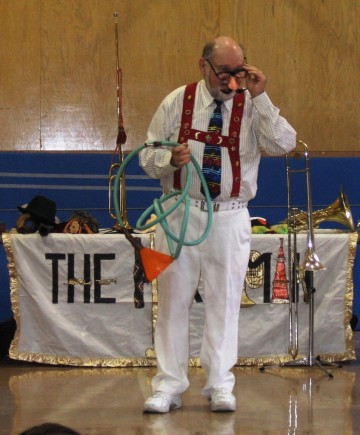
Plenty of weird potential, too.  When I student taught, one of my mentors taped a trumpet mouthpiece into one end of a garden hose, with a funnel sticking out the other end.  He would play his “hose-a-phone” on occasion, most frequently for students’ birthdays.  Not very educational, but certainly eye- and ear-catching among the students, something all teachers need.

CroppedHose-a-Phone-846x1024

Archival footage of hose-a-phone. Not actual mentor.

3. Goof.  Like my mentor’s example, often a teacher’s weird power lies in his or her ability to lower inhibitions and go for the gusto.  We don’t have to bounce off walls, but we can exhibit enthusiasm for school and learning in captivating and contagious ways.

I know an educator with a lively method of ending the class period on a day of doldrums.  When class limps into the last minute, this man pretends to get a call from the president via wristwatch, puts on a cape and cowboy hat, then runs out of the room yelling, “Super-Cowboy . . . AWAY!!!”

I’ve never tried that myself, but I have celebrated a unit assessment by theatrically revealing the test while blaring Strauss’s “Also Sprach Zarathustra” (a.k.a. the opening to 2001: A Space Odyssey).  Following a few confused faces, the triumphant entrance gets more laughs and eases anyone’s test anxiety.

During my chemistry classes’ Gas Laws unit, I make a point to wear the following t-shirt under my ordinary teacher outfit (shirt and tie, slacks).

sci never sucks t shirt

A gift from my brother (also a teacher).

The instant someone mentions the word “suck” to describe pressure differentials, I rip open my outer shirt to give the class a vivid reminder that “Science Never Sucks.”  To enhance the effect, I play Survivor’s “Eye of the Tiger” as accompaniment.

Silly?  Of course.  Memorable?  That’s the point.

Years later, all of my former students know there’s no such thing as a “suck force.”

And as an added bonus, for one fleeting minute I get to feel like a costumed superhero.

So maybe you can’t leap tall buildings in a single bound or outrace a speeding bullet.  But every teacher has special skills and quirks, able to spark meaningful and memorable learning in our students’ lives.

That makes us the most powerful superheroes ever.

Fantastic Teaching

Standard

The latest superhero movie teaser to hit the internet is that of Fantastic Four, a.k.a: FANT4STIC: 

fantasic-four 2015 logo

If a Fantastic Four movie sounds familiar, that’s because there have already been two big budget FF films since 2005.

For an interesting comparison, take a look at the 2005 Fantastic Four movie‘s trailer (starring a pre-Captain America Chris Evans and a post-Commish Michael Chiklis):

Now watch the teaser of the 2015 version:

Quite the difference in tone, don’t you think?

But to me, that’s what makes iconic superheroes so special.  Building off a core of archetypal characters and themes, different creators can tell stories through a variety of styles.  (And it’s always fun to see fresh new takes on superpowers.)

Like parallel universes in comic books, a parallel application exists in the world of teaching.  In order to reach students and inspire meaningful learning, an effective teacher applies his or her individual personality and talents to a framework of fundamental research and established methods.

So let’s talk about some essential elements of effective fantastic teaching, using Marvel’s first family for inspiration (and images courtesy of artist Bruce Timm).

Mr. Fantastic (Reed Richards)

mr fantastic Egocentric name aside, Mr. Fantastic is known for his amazing intellect as much as his elastic superpowers.  Two things we can take from the Fantastic Four’s leader:

1. Teachers must be smart.  For those of us with normal IQ’s, we must do our best to study and develop rich understanding.  This growing knowledge base should be limited to our particular subject(s), but all the arts and sciences, and–perhaps more importantly–research on how people learn and applicable teaching strategies.

2. Teachers must be flexible.  You don’t have to wear a uniform made of unstable molecules (though it’d be cool to try), but you must be ready to bend, twist, and stretch if you want to stay sane.

Human Torch (Johnny Storm)

torch timm In addition to flexibility, fantastic teachers have a healthy sense of humor, much like the FF’s resident jokester.  And figuratively speaking, teachers should be able to instantly “flame on” and fire up a jaded class into a group of enthusiastic learners.

Invisible Woman (Susan Storm-Richards)

invis woman Here’s where we get more profound.  Teachers are often most effective when they stay out of the spotlight.  Instead, they put the primary focus on learning and encourage students to take responsibility and leadership in the process.

A common motto used among educators is to relinquish the classroom role of “sage on the stage” and be a “guide on the side.”  Sometimes, that guide is so good the students hardly notice his or her presence.

invisible woman force field In many ways, Sue Storm has the most powerful abilities among her teammates.  Not only can she turn invisible, she also can produce invisible force fields for both offensive and defensive purposes.  Teachers must also do their best to protect their students and colleagues from all kinds of dangerous attacks – unseen or otherwise.

The Thing (Ben Grimm)

thing bruce timm small In addition to protecting students, fantastic teachers also need to protect themselves.  Like the ever lovable, blue-eyed Thing, teachers must exhibit some thick skin.  We have to withstand a daily barrage of gripes and wisecracks that rival Dr. Doom’s black magic blasts.

dr doom blast

Fool! Doom never does homework!

To use another metaphor, teachers should be judicious in deciding when “It’s clobberin’ time!”

clobberin time

Even fantastic teachers have students who occasionally act out worse than Mole Man’s Moloids.  We can’t simply exile these misguided minions into the Negative Zone.  But we can’t allow class clowns to ruin everyone else’s opportunity to learn, either.

moloids crowd

Your teacher’s worst nightmare.

It takes wisdom (sometimes a Reed Richards-level of intellect) to know how to squash misbehavior without squashing the student (emotionally, that is).  It also requires a mix of courage and compassion.  Even the best teachers aren’t perfect in determining when and how to manage, discipline, and/or overlook student actions and attitudes.

Nobody’s perfect.  But we can strive to be fantastic.  Use insight from the “World’s Greatest Comic Magazine” to help you get there.

No cosmic radiation required.

fantastic-four cosmic

Charge Up, Mon Chere

Standard

Newgambit bachalo

Add X-Man Gambit to the list of superheroes getting a new movie, starring hunky actor Channing Tatum. Here is Screen Rant’s review of the news and a brief bio of Remy LeBeau.

Gambit was a Marvel ‘90s superstar known for his Cajun accent and scheming ways as much as his mutant ability to charge objects with energy. (The trendy trench coat and headgear also helped enhance his popularity.)

Character issues aside, Gambit can inspire teachers with his superpowers. Instead of charging up playing cards, teachers should strive to charge up their lessons.   (Minus the headgear and explosions.)

Take a look at your most recent lessons. What question, prompt, activity, application, media, or more could you add to energize students?

gambit charge card

Non-Mutant Teachers

Standard

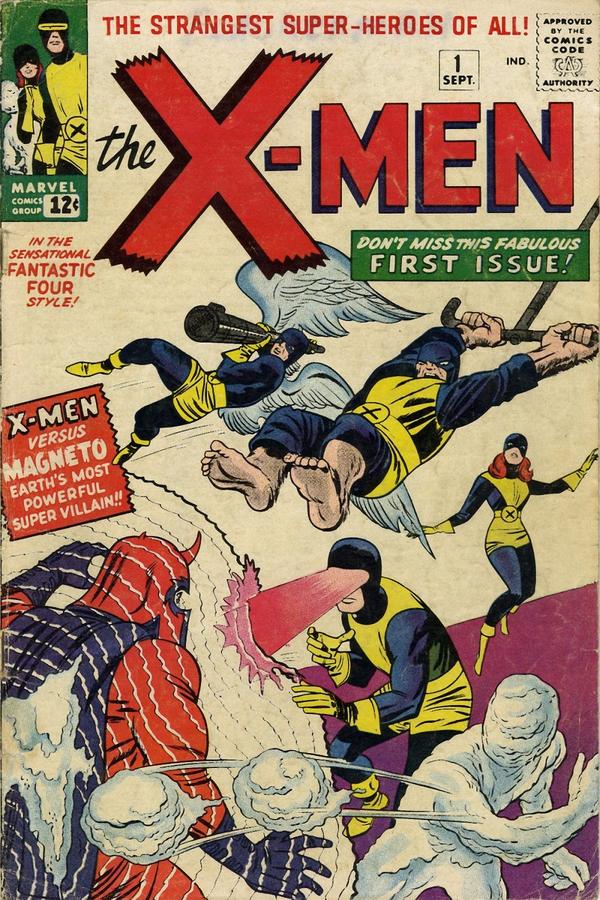
My favorite superhero team has always been the X-Men.  I’ll admit, these mutant heroes first caught my eye with their nifty matching uniforms.  Plus, “X” is the absolute coolest letter in the alphabet by far.  (Uncanny Y-Men . . . just doesn’t cut it.)

X-Men_Vol_1_1

The main reason I like the X-Men, however, is because this superhero team’s origin starts at a school.  “Gifted youngsters” have gathered together not because they’re family or friends or famous heroes, but instead to learn and understand their powers and identities.  And ultimately, these students strive to “protect a world that hates and fears them.”

A new generation of students has taken up the cause of Professor X, as featured in the series Wolverine and the X-Men.  Unfortunately, headmaster Wolverine has recently died in the Marvel Comics world, leaving a void in the faculty at the Jean Grey School for Higher Learning.

I bet Wolverine’s health will improve soon, but in the meantime another hero has joined the staff of mutant educators:  your friendly neighborhood Spider-Man.

Spider-Man_The_X-Men_1_Preview_3

That’s Mr. Spider-Man to You

One potential problem, though:  Spider-Man is NOT a mutant.  In other words, he was not born with his extra-human abilities.  Peter Parker needed a radioactive spider bite to get his superpowers.  Remember this iconic scene?

1567552-parker_spider_bite_super

Pre-Spider Bite Peter Parker = Lame-o

Differences in genetic background and superhero lifestyle could become a source of conflict not only between Mr. Spider-Man and his students, but also with the mutant teachers and staff at the school.

Such educational discrepancies do not occur in comic books only.  They can also arise in real life.

Real World Research

Research studies have found a “racial/ethnic gap between students of color and their teachers,” something that has increased over the years (Villegas, Strom, & Lucas, 2012).  With a growing population of minority students, teachers from similar racial/ethnic backgrounds are in high demand (Bireda & Chait, 2011).

Why is it important to match teacher and student demographics?

One may assume that students react more positively to teachers who share common characteristics.  Likewise, minority teachers can serve as positive role models to minority students.  However, clear empirical evidence of these assumptions is hard to find, understandable given the complexities of schooling and learning.

Some research studies have found learning gains when teachers and students share similar ethnicity (Dee, 2004; Klein, Le, & Hamilton, 2001).  Nevertheless, these reports note an underlying factor that could have the greatest impact on student success:  the actual quality of the teacher.

peter_parker_spiderman

Mr. Parker

Spider-Man does have previous teaching experience.  While plainclothes Peter Parker during the day, he did a stint as science teacher for his alma mater, Midtown High School, in Queens, New York.

250px-Midtown_High_School_from_Spider-Man_Season_One_Vol_1_1

Home of the Fightin’ Living Brains!

Mr. Parker’s public school teaching experience reflects real world trends.  Typically, teachers like to teach close to where they grew up as students (Reininger, 2011).  Or if not the same or nearby location, teachers may teach in a similar type of district or community.

That was me.  I grew up in a small Nebraska town of ~4,000 people.  I graduated from a public high school with a class of ~70 students.  My first teaching job was in a small Nebraska town of ~4,000 people (about 130 miles from my hometown).  Each graduating class at this public school had ~70 students.

What about you?  Where did you go to school?  Where do you teach?  

One of the biggest advantages about the teaching profession is that it can take you anywhere in the world.  Once I had a student encourage me to apply for a teaching job in Dubai.  (Maybe he had selfish motives for introducing me to this opportunity.)

But one of the biggest challenges about teaching is that it requires extraordinary effort to assimilate the context and culture of the school when you first start.  Even teachers who teach in their hometown must navigate through this transitional period.  Moreover, imagine the degree of difficulty for teachers new to a community, culture, and/or country.

It makes sense that teacher recruitment initiatives focus on fostering “pipelines” to increase quality teachers from high-need urban and rural settings (CTEP, 2014Darling-Hammond, 2011).

Mutant or Non-Mutant?

As much as I’d like, I can’t turn myself into a mutant, or even a super-powered human.  (I’ve been bitten by spiders before.  No wall-crawling abilities yet.)  Still, I can be the best teacher I can be, no matter where or whom I teach.

Regardless of our ethnic, cultural, genetic, or other demographic descriptors, we can all work to cultivate meaningful relationships, creating memorable learning experiences for our students.  Part of this work includes finding ways to connect with the kids and their community.

Don’t try to fake it, however.  Students have a special (mutant?) ability to see through disingenuous teachers, even those with good intentions.  Admit your differences, if need be, and authentically work to find common ground.  A universal purpose in all schools is to expand understanding and appreciate learning.

Who knows how long Spider-Man will stay on staff at the Jean Grey School for Higher Learning?  You can read more about the creators’ plans for Spider-Man and the X-Men herehere, and here, if you’re interested.  I hope Mr. Spider-Man makes a positive difference during his tenure, long or short.

Spidey may not be a mutant, but he does know a little about struggling to make it in the world (of both heroes and humans).  Additionally, he has firsthand experience learning the importance of “great powers” and “great responsibility.”

And like the best teachers, Spider-Man should learn from his students as much as they learn from him.

Spider-Man__The_X-Men_Bengal_Variant-720x1093

Question(s) & Answer

Standard

Question_34

One comic book character who is prime for a screen adaptation is DC’s The Question.  In fact, the folks at  WhatCulture.com list The Question as one of their “10 Obscure Superheroes That Badly Need a Movie Treatment.”

A movie may work fine, but an ongoing Question TV Series would be a perfect fit, featuring a street-level noir hero with regular crimes and conspiracies to solve. If you want to see The Question in animated action, you can find some highly regarded appearances in the Justice League Unlimited series.

You can also find a nifty short YouTube documentary on “Who is the Question?” right here.  The most iconic version is Vic Sage, although more recently the moniker (and mask) was taken over by Renee Montoya, best known as a detective in the Gotham City Police Department.  [A live TV version of Det. Montoya has appeared in Fox’s Gotham series.  No sign of any Question(s), though.]

250px-Reneequestion

In case you’re wondering, there IS a superhero known as The Answer in comic books.  You can read more about The Answer here and here.  Judging from his appearance, I’d say a more appropriate name is The Exclamation Point or The Interjection!

the-answer-1

In teaching, we know that “Questions are the Answer.”  Often, what makes or breaks a lesson is how the teacher interacts with students during the activity.

Rather than just talking at students, teachers must ask questions throughout each lesson.  Questions and similar prompts are effective ways to encourage thoughtful reflection, promote engaged discussion, monitor student thinking, and more.

Unfortunately, research has found that a vast majority (70-80%) of questions asked by teachers require nothing more from students than reciting facts or guessing simple answers (Gall, 1984; Watson & Young, 1986; Bergman & Morphew, 2014).

So the question is this:  What kind of questions do you ask?  

Challenge yourself to challenge students by habitually asking  questions that require high-level thinking, such as those skills classified in Bloom’s taxonomy of educational objectives:  Application, Analysis, Synthesis, and Evaluation (Bloom, 1956).

How do you begin?  Here are a few resources I’ve recently come across that may be a good start:

– From Edutopia: “5 Powerful Questions Teachers Can Ask Students”

– From The Huffington Post*“25 Ways to Ask Your Kids ‘So How Was School Today?’ Without Asking Them ‘So How Was School Today?'”

*This second resource is more for parents, but teachers can gain ideas from the example questions for encouraging conversation.

The goal is to get kids thinking, reflecting, and sharing so you and their classmates can also think, reflect, and share ideas.

I’m glad there are two Questions running around in comic books. It reminds us that teachers need to use multiple questions in our interactions with students.  One question is often not enough.

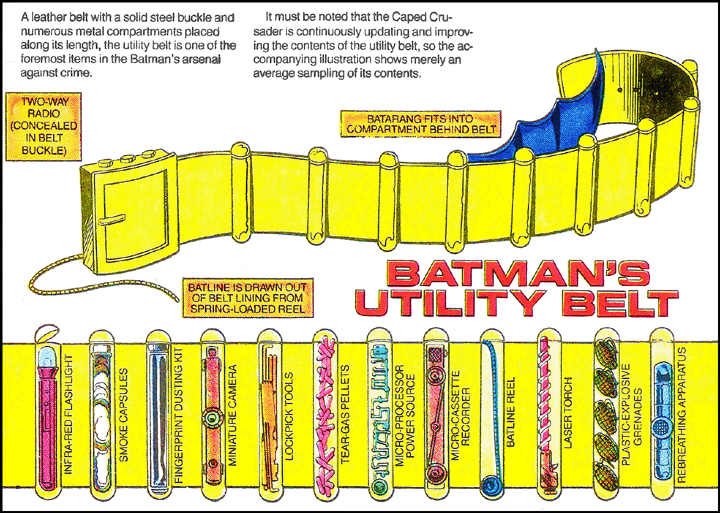
Like Batman and his utility belt, you should have an entire arsenal of prompts and queries at your ready, posing the right one at the right time.

Batman utility belt

I don’t own a utility belt, but I do keep a small index card in my pocket with question stems such as “In what ways . . .?”  “For what reasons . . .?”  “How might you . . .?” and many more.  Whenever I’m stumped for a good question, I can check my list to keep the conversation going.  And like Batman with his belt, you should continuously update and improve your questioning strategies.

Unlike the hero The Question, however, you will want to add engaging facial expressions.  Smile a little.  Make appropriate eye contact.  And talk in a welcoming tone of voice.

question image

Not the face you want to see in a classroom.

The Question wants to hide an identity and frighten bad guys.  Teachers, on the other hand, need to be personable and supportive of students.  Your questions and interactions, when used effectively, are an important part of this equation.

Speaking of which, there is no mainstream superhero called The Equation.  Get on it, math teachers!

Teachers for Hire

Standard

Happy Labor Day!  (To all you Americans, at least.)

In honor of the “yearly national tribute to the contributions workers have made to the strength, prosperity, and well-being of our country,” let’s talk about the labors of teaching.

No, we’re not going to do some cheesy comparison between the labors of teachers and the legendary labors of Marvel Comics’ hero Hercules (but you can read here to learn more, especially if you need a new spin on teaching Greek myths).

herc lightning

First labor: Reenact He-Man’s “by the power of Greyskull!” bit.

Let’s talk about the work of teachers.  

Back when I was in college, I told one of my former high school teachers I was going into teaching.  His response was something like “Teaching is a noble profession.  But it’s a terrible job.”

While this may come across as discouraging at first, my mentor went on to say that the work of a teacher is important and rewarding, but it’s not for everyone.  If you just want a career to pay the bills, he explained, go find a different job.  But if you want to make a difference no matter the cost, then teaching is for you.

It’s not about the money, money, money . . . 

Most of us in the teaching profession know that you don’t go into it to get rich.  Not financially speaking, at least.  

Honestly, I never thought much about my future paychecks when I decided to pursue teaching as my college major.  As a kid, I had always respected my teachers and thought highly of them (most of them, at least) as model citizens in our small town.  Financial stability seemed to be part of that elevated status.  

Unfortunately, it wasn’t until my “Intro to Teaching” class in college where on the first day our instructor told us, “Why do you want to be a teacher?  The pay is lousy.”

Talk about a bummer way to start my adventure in teacherhood.  I think this guy was trying to get us to realize teaching is something you do for more than a paycheck.  His approach just wasn’t quite as polished as it could be.  Or maybe he wanted to scare away all the undergrads who thought teaching would be a cinch job – summer vacations, 8:00 to 3:00 work hours, and all those notions.

Studies and Statistics

Depending on whom you ask, teachers are either overpaid or underpaid.  If you ask me, I’d probably say it depends on the teacher.  (If you ask the New York Times, it’s . . . complicated.)

Actually, someone DID ask me about teacher pay once.  It was when I was teaching at my first job and the local newspaper wanted to interview various teachers about potential state legislation increasing teacher pay (the bill failed, by the way).  At the time of the interview, my answer was basically, “I’m not in it for the money, but I’d happily take more!”  

If I remember correctly, I also talked about how I was a single young teacher living in a small apartment and could easily get by on a modest salary.  (Times have changed.  Just ask my wife and five kids.  And two dogs.  And six cats.)

The only other thing I recall from the interview is I explained how there are multiple opportunities for teachers to increase their paychecks.  Teachers typically “move up the pay scale” for taking graduate courses and completing additional degrees.  Teachers can often receive stipends for attending workshops and other “professional development” opportunities outside of the regular school schedule.  Teachers also receive a little bit of extra pay for helping out with extracurricular activities–coaching, sponsoring clubs and activities, leading committees, and so on.  

Of course, all of this extra work does require extra minutes, hours, days, weeks, and more.  Speaking of which . . . 

Time after time . . .

Other studies report on the amount of time teachers spend working.  Things are much more complicated than the notion that teachers get three months off for summer vacation.  Again, I think it depends on the teacher.  But here’s a neat “infographic” that breaks things down:

teachers-dont-work-hard-enough-think-again_51dad7447e53a

Of course, this image was brought to us by http://www.busyteacher.org, so it may be a little biased.  

Other reviews are mixed, including ones that review similar data by the Bureau of Labor Statistics (glass half-full vs. glass half-empty).  There are also some interesting results from a teacher survey completed by Scholastic and the Bill & Melinda Gates Foundation, summarized here in The Washington Post.  You can find more details, including state-by-state results, at this link.

So how does this all relate to superheroes?  

(You mean, besides the lame Herc reference above?)

Back in the 1970s, Marvel Comics featured a superhero team called “Heroes for Hire, Inc.” founded by Iron Fist and Power Man (Luke Cage, the original “Hero for Hire.”)  The basic premise is superheroes will help out the common man–security, investigation, thwarting the schemes of villians–all for a fee.  

70s heroes Heroes_for_Hire_1997,_1 h4h1_1

Through the years, the Heroes for Hire team has undergone various incarnations, including several attempts at long-running series.  Most of the series, though, last for about a year before getting cancelled.  It seems that the idea of superheroes working for hire–albeit a realistic scenario–is not as appealing to readers as their pro bono colleagues with secret identities.  

By the way, Hercules has been a member of the Heroes for Hire from time to time.  Even the “Prince of Power” needs to pay the bills.

Teachers need to an income, too.  But it’s more than a paycheck.  It should be a labor of love.

Happy Labor Day to teachers everywhere.  And remember how you can contribute to the “strength, prosperity, and well-being” of your students and community.  It is a priceless gift.


Future and Past

Standard

Yes, this post will discuss yet ANOTHER super-hero movie that recently blasted into theaters across the globe.  It’s the golden age for super-hero movies, so we might as well bask in it.

The latest super-flick selling popcorn and semi-satisfying critics/fans is X-Men: Days of Future Past.  Bonus points (i.e. “geek cred”) if you can name every character in the following poster:

XDOFP-poster-995c8

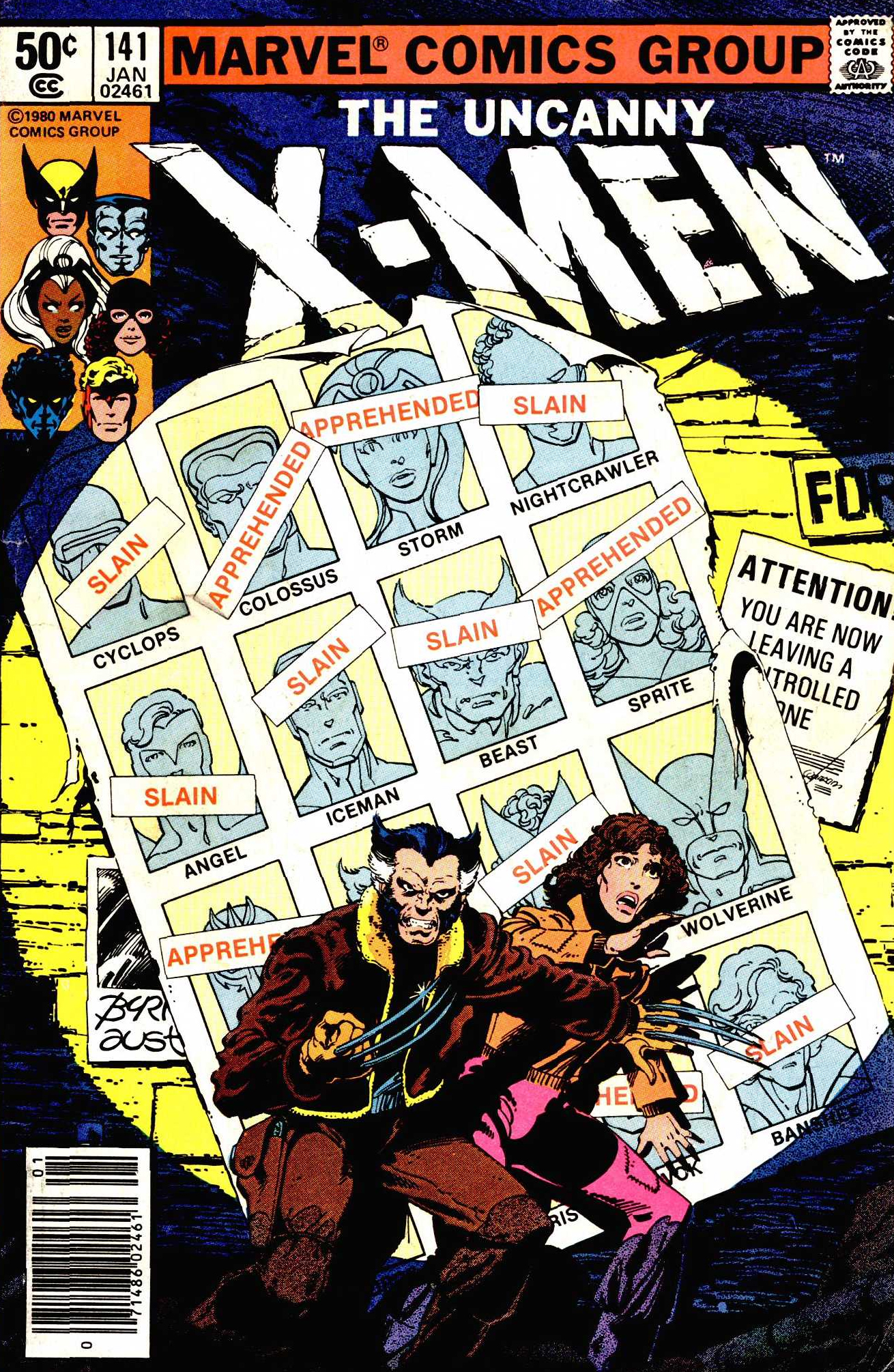
The basic premise of the film (and the classic comic book story it’s loosely based on) is that the future ends up being a mostly dismal place for mutants and humans alike.  Those grizzled heroes that are still alive decide their only hope lies in sending someone back in time (or at least their mind) to stop events that ultimately cause social dystopia.  Basically, they want to “reset” the world to make a better future.

X-Men-Days-of-Future-Past-comic-cover


It’s a story that is equally depressing AND hopeful, even if the title makes no grammatical sense at all (and created a wad of continuity problems in the X-Men cinematic universe).


Even if you have no interest in time travel or mutant oppression, I do encourage you to stop and think how teachers can learn a lesson from this story.

How many of us wish we could go back in time (the start of the school year) and try again to establish a positive, productive classroom environment?


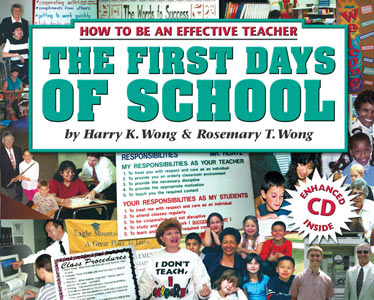
The truth is, the “first days of school” are critical to creating a climate that will endure throughout the academic calendar.  What you teach, practice, and reinforce (and what you let slide) will eventually shape the classroom setting.  It’s so important, in fact, that the best-selling teacher book of all time deals with this issue.

the_first_days_of_school book

My copy is a little more “used.”

Even though early classroom moments are so critical in establishing classroom expectations and habits, there is still hope for teachers who think they may have “lost their way” and lost their classroom to disorder and disrespect, confusion and chaos.

In fact, one of the biggest champions of this “reset” method is Harry Wong, co-author of The First Days of School.  During one of his “Effective Teacher” videos (Vol. 4), Dr. Wong describes how at the end of each day, teachers erase the classroom board in preparation for the next day’s learning.  This action should illustrate how we as teachers should view our work.

OLYMPUS DIGITAL CAMERA

Every new day is a new opportunity to “start over,” so to speak.  Even though it may be the middle of the school year, teachers can still erase past mistakes and memories and work to create a new classroom culture.  This “reset” will most likely require more than one day’s work, but we can still purposefully cultivate the type of environment we know is best for teaching and reaching our kids.  This endeavor also takes serious reflection, intentional planning, practice, reinforcement, and redirection–all in order to reestablish the classroom our kids (and we teachers) deserve.

On a larger scale, consider how the current “summer break” season is another a chance to reset your teaching expectations and actions.  Don’t stop at reorganizing your desk drawers and replacing tattered posters with shiny new bulletin board materials.  Revitalize your classroom procedures, routines, and attitudes to foster a refreshing learning environment.

The advantage to summer rejuvenation is that most of your students won’t know anything changed.  They’ll assume you’ve always been a model educator who demands excellence and champions the cause of learning.

At times, such work may seem just as challenging as mutant time travel.  But it’s definitely worth it.