Super-Rich

Standard

i am batman

When it comes to superheroes, a lot of people claim they relate the most to BATMAN.

It’s not the tragic orphan story or fascination with flying mammals that builds the bond.  Rather, it’s the fact that Bruce Wayne is a “normal guy” like the rest of us.  He’s no alien, mutant, or mystical being with special powers.  Instead, Batman saves the day using sly sleuthing skills, martial arts, and handy homemade gadgets.

I don’t know about you, but my detective prowess and hand-to-hand combat skills are so-so, at best.  My weakest link to Batman, however, is in my lack of gadgetry.  (I don’t even have a smartphone.  Guess I’m more like Captain Caveman.)

capt caveman

Bat-Rich

Recently, “comic historian” Thaddeus Howze did some detective work of his own and estimated the cost of Batman’s crime-fighting technology.  It’s a nifty little article with a breakdown of every gadget used by the Caped Crusader, including his cape made of memory cloth polymer.

cost of being batman

What’s the final bill?  Totaling up every batarang, bat-vehicle, bat-cave amenity, and bat-salary (Alfred don’t work cheap), Howze estimated the cost of being Batman at around $682,450,750.

So for anyone making over half a billion dollars, your dream of donning the Dark Knight’s identity is within grasp. The rest of us “regular folks” will have to live vicariously through our Batman toys or video games.  Or both.

LBatmanTVG

Teacher-Rich

Teachers need gizmos, too, which we give fancy names like “instructional technology,” “curriculum materials,” “educational manipulatives,” and the like.  Unlike Bruce Wayne, we don’t spend from billion-dollar bank accounts.  One year a biology teacher told me her entire department’s annual budget was $600.  (That buys you about twenty frog dissection kits, which by their very definition are perishable goods.)

For a lot of teachers, we purchase classroom supplies using our own money.  A 2015 Horace Mann Educator Survey found that 57% of teachers spend at least $200 of their own money on classroom materials every year (14% spend $600 or more).

Furthermore, 80% of responding teachers said they have abandoned projects because of a lack of funds.  (“Abandoned” is a strong word, like Batman would give up on nights he ran out of smoke bombs.)  I suspect many teachers found cheaper, alternative projects.  Of course, there are many ways to seek additional financial support at local levels (fundraisers, community drives, etc.) as well as through worldwide services like DonorsChoose.org.

DonorsChoose_org_logo

Money, while helpful, is far from the most important element in cultivating successful classrooms and making a lasting impact.  To elaborate on this point, let’s look at an example from the world of sports.  (See?  I’m not completely nerdy.  Or maybe just a sports nerd, too.)

Sports-Rich

sports-label-2003

The front sports page of a recent USA Today newspaper highlighted two stories side-by-side, convenient for comparisons.

The first was an editorial about football player Kam Chancellor finally agreeing to resume playing for his Seattle Seahawks team.  The Pro Bowl safety had been holding out–missing the first two games of the season–with hopes of getting a better contract.  Interestingly, Chancellor still had three years left on his current four-year contract, worth about $7 million a year.

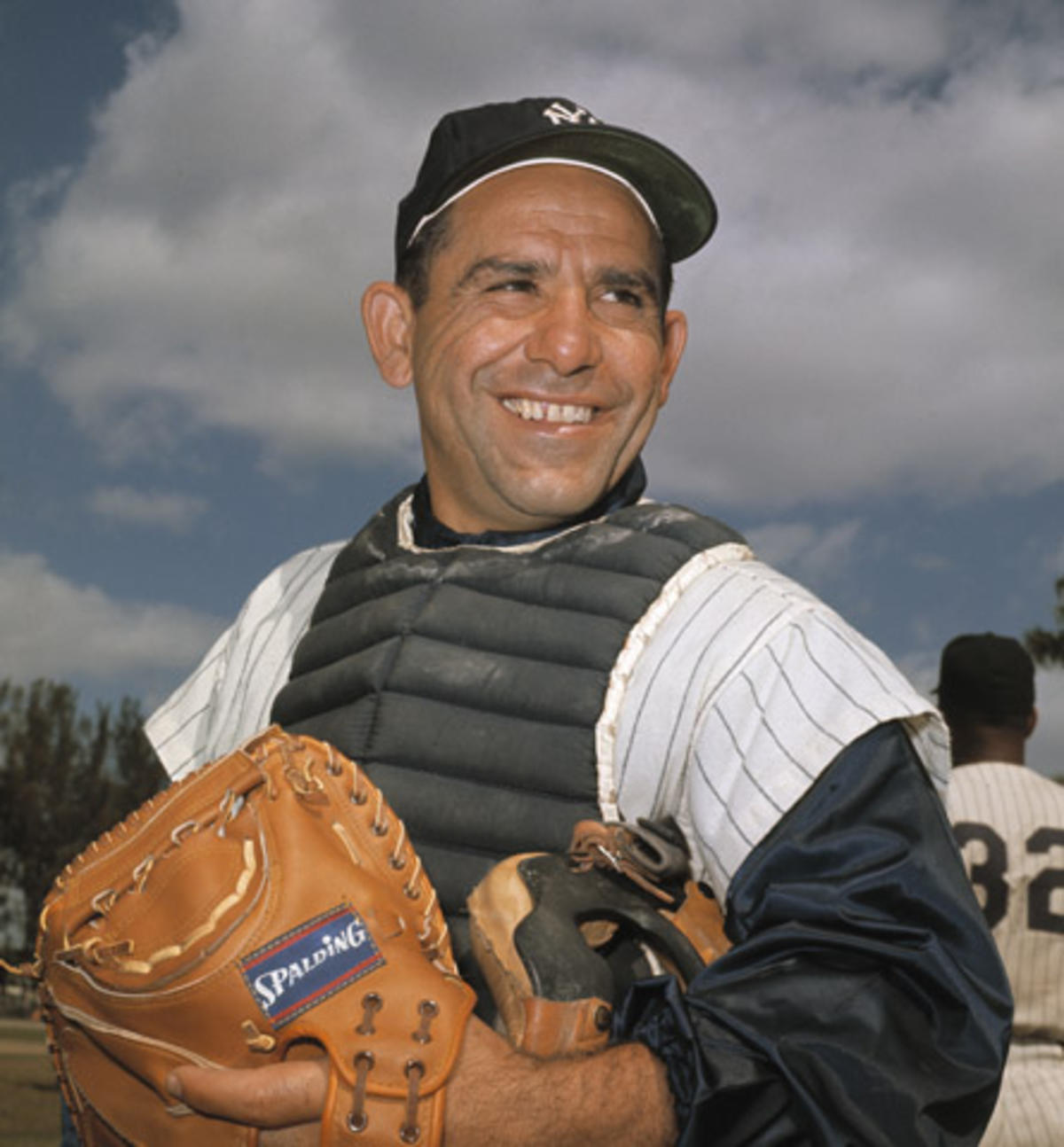
The second sports story was much more prominent, accompanied by multiple color photos, nearly a full page of text, and a second full page photograph tribute.  The subject receiving this recognition?  The late Yogi Berra.  Headlines and highlights included phrases like “one-of-a-kind,” “true national treasure,” “American icon,” and “the sweetest man you ever met.”
yogi_berrap14

Fun fact:  The highest annual salary Yogi Berra ever received for playing baseball was $65,000 in 1957.  Compare that pay with Kam Chancellor’s, and then consider whose name we’ll remember in a hundred years.

I’m not making any claims about the value of an individual’s contribution to sport or society.  And I admit there are significant differences–different sports, different teams, different centuries.  Nevertheless, I did some calculations myself (inspired by comic historian Thaddeus Howze) and here’s what I found:

The average American median household income in 1957 was $5,000, compared to $52,250 in 2015.  Considering the salaries given above, Yogi Berra made about 13 times more than the average household in 1957; Kam Chancellor earns about 134 times more than today’s average household.

HungerGamesHeader

At this rate, we’ll be living in a Hunger Games world by the end of the century.  Tempting as it is, let’s not dwell on the excessive amounts of money given to today’s professional athletes.

Let’s focus instead on building toward a better future by investing in children:  their learning, their growing, and their getting along with others–famous or nameless, poor or rich, every man and every woman.  This is the work that’s truly worthwhile.  Heroic, even.

Super-Rich

Spider-Man and Superman

Instead Batman or Iron Man or other affluent heroes, teachers can probably relate better to middle-class champions like Spider-Man or Superman.

Peter Parker started out as a teenager just scraping by, trying to earn a few bucks by taking photos of himself in costume.

spidey photos

                Peter Parker–Inventor of the Selfie!

Superman may be a super-strong flying alien, but his day job is an office gig with bustling desk areas, broken copier machines, and bland coffee.  Not far from a teacher’s workplace, eh?

1146356-daily_planet_staff

And like Clark Kent, teachers can rely on a mostly steady paycheck.  But that’s not what makes us rich.  Remember the favorite phrase quoted by many educators:

“Teaching–We’re not in it for the income; we’re in it for the outcome.”

What’s in a Name?

Standard

Keen-eyed readers will notice that this blog has recently changed its official name from Teaching is for Superheroes! to Teach Like a Superhero!  (The exclamation point remains!)

Not that big of a change, really, except that the new name rolls off the tongue a little more easily.  Another change is the primary web address:  http://www.teachlikeasuperheroblog.com.  This new URL is not very short, but it gets to the point.

(I tried a shorter address, but “www.tlash.com” sounds like an eyeliner product.  And a good of an excuse as any to share this meme inspired by Captain America: The Winter Soldier)

eyeliner

If all of this http://www.mumbo.jumbo stresses you out, don’t worry.  The old web address, http://www.teachingsupeherheroes.wordpress.com, still works and will lead you right back here.

This post is not just an announcement about blog name changes.

Let’s talk about names of superheroes and names of teachers.

Spider-Man_The_X-Men_1_Preview_3

I remember two things from my very first teacher back-to-school in-service meeting.  The first memory is a litany of details regarding health insurance and employee benefits.  The second memory is our assistant principal reminding us all that we are “Mr. Smith,” not “Smith” or “Mr. S.”

His point was to start the school year establishing a professional identify and requiring our students to address us as such.  It may seem like no big deal for a student to abbreviate your name (“Mr. B.”) or leave off your honorific (“Bergman”).  Some teachers may even welcome such nicknames to foster a more relaxed classroom environment.

But we must always be careful to not get too comfortable with our students.  Stop and consider the range of impacts this lackadaisical habit could impart.

I’m sure I’ve allowed my students to call me all sorts of things and get away with it.  But it does help to maintain a level of respect among everyone – teacher to student, student to teacher, teacher to teacher, student to student, and more.

Proper names matter among superheroes, too, and not just with maintaining secret identities.  Personally, I cringe whenever I read superheroes calling each other playful nicknames.

hawkeye-your-way-small-captain-america-2-deleted-scene-meant-cap-fighting-who-jpeg-127715

They’re heroes, not BFFs!

Superhero nicknames have long been a staple in comics.  Witty banter and clever monikers keep the “funny” in funny books, after all.  And it helps convey some characters’ personalities.

Wolverine, for example, with Colossus:

wolverine colossus

And here (off-panel) with Professor Xavier:

Chuck

The best name-caller, of course, was Stan “The Man” Lee, who was so proficient he even came up with nicknames for his real-life co-workers (e.g. Jack “The King” Kirby, “Jazzy” Johnny Romita, “Merry” Gerry Conway, and many MANY more right here).

Like any good joke, though, overuse of superhero sobriquets can get tiresome.  Especially among champions who should focus their attention on more important things – like fighting bad guys and saving the world!

Avengers1-144

What’s worse, many of these affectionate nicknames can actually undermine the job of life-risking heroics.

Spider-Man-Joins-Marvel-Cinematic-Universe

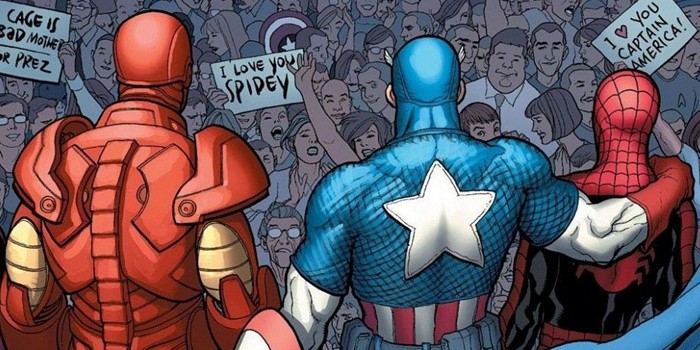
“Spidey” for Spider-Man works fine for his hip quippy character;  but take a look at other heroes and their less-dignified labels:

Batman = “Bats”

Superman = “Supes”

Green Lantern = “GL”

Ugh.  Apparently, characters in the DC Universe have a thing for abridging names.  Marvel nicknames, though more colorful, can still cheapen a heroic legacy.

The Mighty Thor = “Goldilocks”

The Hulk = “Ol’ Greenskin”

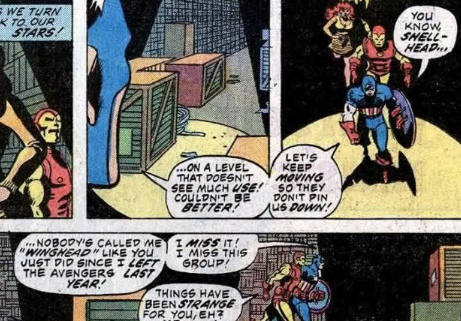
Iron Man = “Shellhead”

Captain America = “Cap,” “Winghead,” “Star-Spangled Avenger”

We come back to Captain America because it’s maybe the clearest example of a noble hero who’s legendary status is downgraded by casual familiarity.  And it’s not just by fellow heroes, but even by us regular citizens.

captain-america-kooky-quartet-107425

Call me a Stick-in-the-Mud (“Bromidic Bergman”), but superheroes deserve a little more formality.  The same goes for teachers.  Although it may seem cool for kids to use teacher nicknames, be careful with letting things get too capricious or contemptuous.

So whenever you hear a student or colleague refer to you as  “Mrs. T” or “Thompson” or “Yo, Teach,” gently remind them how they can address you more properly.

Just remember, it’s not “Mr. F.” It’s Mr. Fantastic.

Wieringo_reedrichards

And it’s not “Incredible;” it’s Mr. Incredible.

mr incredible

And it’s not “Marvel;” it’s Ms. Marvel.

Ms.-Marvel

Actually, the original Ms. Marvel goes by Captain Marvel now.

But never “Cap.”

Summer Break 2015

Standard

It’s that time again when T4SH takes a short break during the summer months.

A break from lengthy blog posts, at least.  Look for resources, updates, and links via Facebook while you’re chilling out poolside, beachside, or inside.

bishop-front summer

Time-traveling X-Man Bishop proves that blue jean cutoffs NEVER go out of style. Just beware that nasty tan line.

BONUS!  Here are some blog highlights from the past academic year, if you need something to review and recharge your mutant teaching energy:

Teachers for Hire – Research and statistics on teachers’ time and money.

Question(s) and Answer – Resources and strategies for asking good questions in the classroom.

Flex Plan – Movie studios plan superhero movies YEARS in advance.  How far into the future should teachers plan lessons?

Fantastic Teaching – Timeless traits of effective teachers, inspired by Marvel’s First Family.

Weird Superpowers – Superman has some weird superpowers.  What’s YOUR weird teacher power?  (Hopefully it is not fake-super-flabby-arm.)

superman at beach

Take time this summer to work on your beach bod AND your classroom prowess.

Educatio!

Multiple Madness

Standard

Sadly, this entry does not feature one of my favorite superheroes – Jamie Madrox, a.k.a. The Multiple Man. But I’m going to include a picture of him (them) anyway:

Multiple Man X

On to business!

Warning: Today’s topic contains both intense geekery and buzzword-bashing. Proceed cautiously.

Blockbuster movies are not the only highlight of summer. It’s also the season when comic book publishers launch company-wide crossovers that promise to shake up a universe or two (or 52).

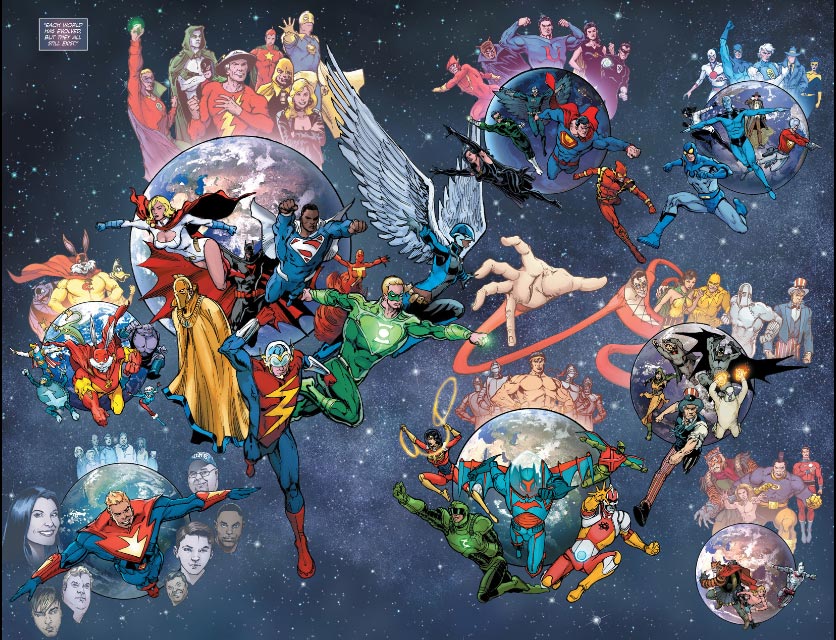
Marvel Comics and DC Comics have both blasted readers with major events this year. DC recently ran through a “Convergence” that ended with every version of its universe (pre-Crisis, pre-Zero Hour, pre-Flashpoint, etc.) returning to existence. That means every crazy version of familiar heroes and villains can appear in some form or another in one of several alternate universes, or multiverses.

convergencewrap1

Confused? Check the hyperlinks above to read more about DC’s habit of rewriting history in their comic books (“reboots”). And you can read more here and here, then impress your friends with a mindful of multiversity.

Reboots are Made for Walking . . .

DC rebooting its universe(s) is nothing new. But Marvel Comics has always prided itself on maintaining a single continuity in its main universe (called “Earth-616,” and don’t ask why).

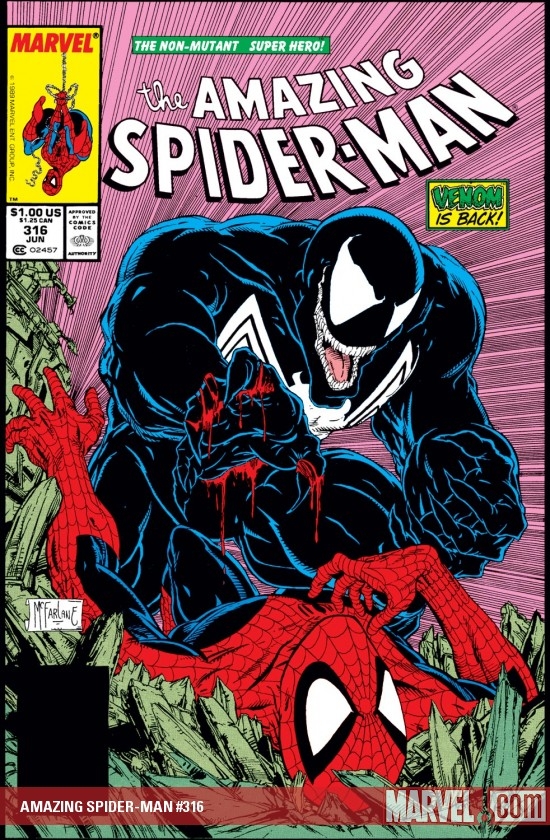
That’s all changed this summer, though, with Marvel’s tentpole production “Secret Wars.” If that name sounds familiar, the original “Secret Wars” (1984) was Marvel’s first mega-crossover teaming up all of its major heroes – Spider-Man, the Avengers, Fantastic Four, the X-Men, and more. Plus, it’s where Spidey got himself his snazzy black costume that . . . didn’t end well.

secret wars 8  spidey venom

In Marvel’s current 21st century crossover, every alternate universe (technically not the same as a multiverse; trust me) is starting to shmoosh into each other, with Earth as the epicenter.

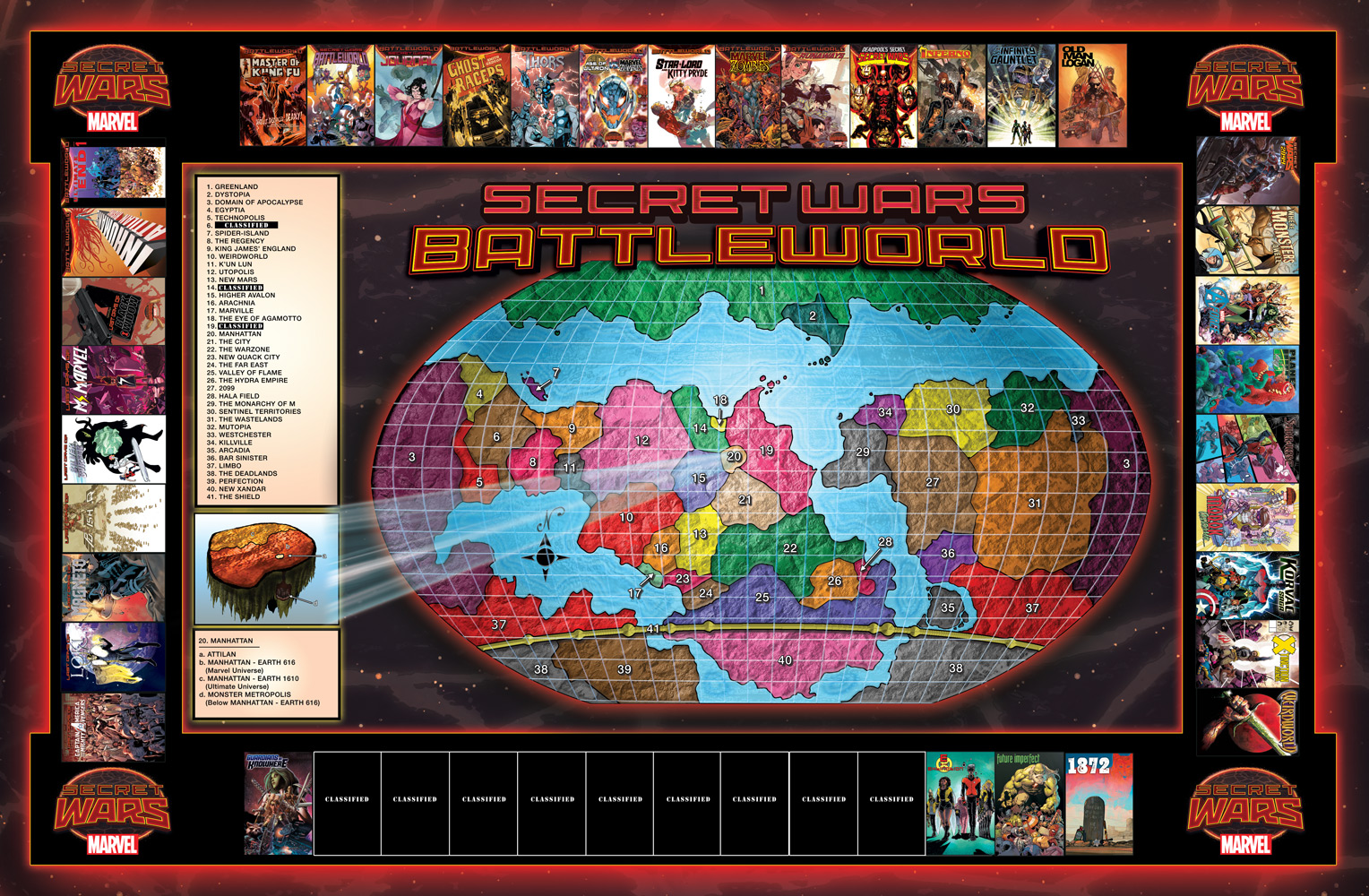
What results is a hodgepodge of alternative Marvel Earths mish-mashed all on one planet. This subsequent world is called “Battleworld,” where apparently assorted Marvel heroes and variations duke it out over land rights.

BATTLEBOARD

Actually, all of the post-Secret War/Battleworld comics look to be an excuse to revisit everyone’s favorite character or event from Marvel’s storied history. This nostalgia trip won’t last for long, with a finale that will “be the end of the Marvel Universe as we know it!”

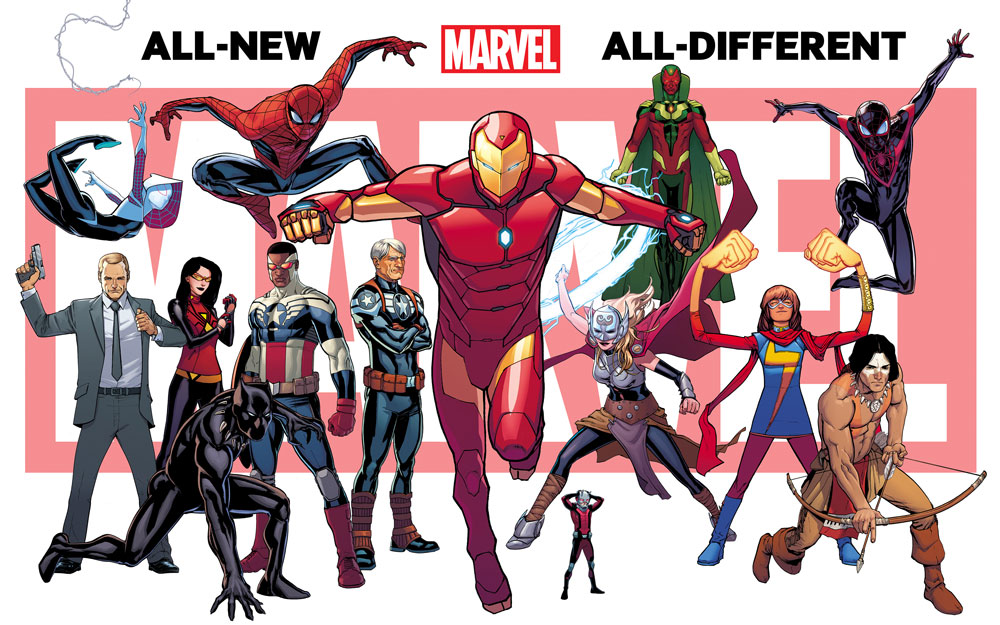
Just recently, Marvel has already given us sneak peeks at characters appearing in this “All-New, All-Different” universe.  Here’s a look:

ANADMarvel2_June5

Who knows how long either of these nascent realities will last? In recent history, world-shattering moments seem to happen every other issue.

But, hey, it’s comic books.

My concern is not a glut of mega-crossover mini-series, but rather the stampede of super-heroes – namely different versions of the same ones. Take a gander at another Marvel “All-New, All-Different” lineup:

ANADMarvel1_sm

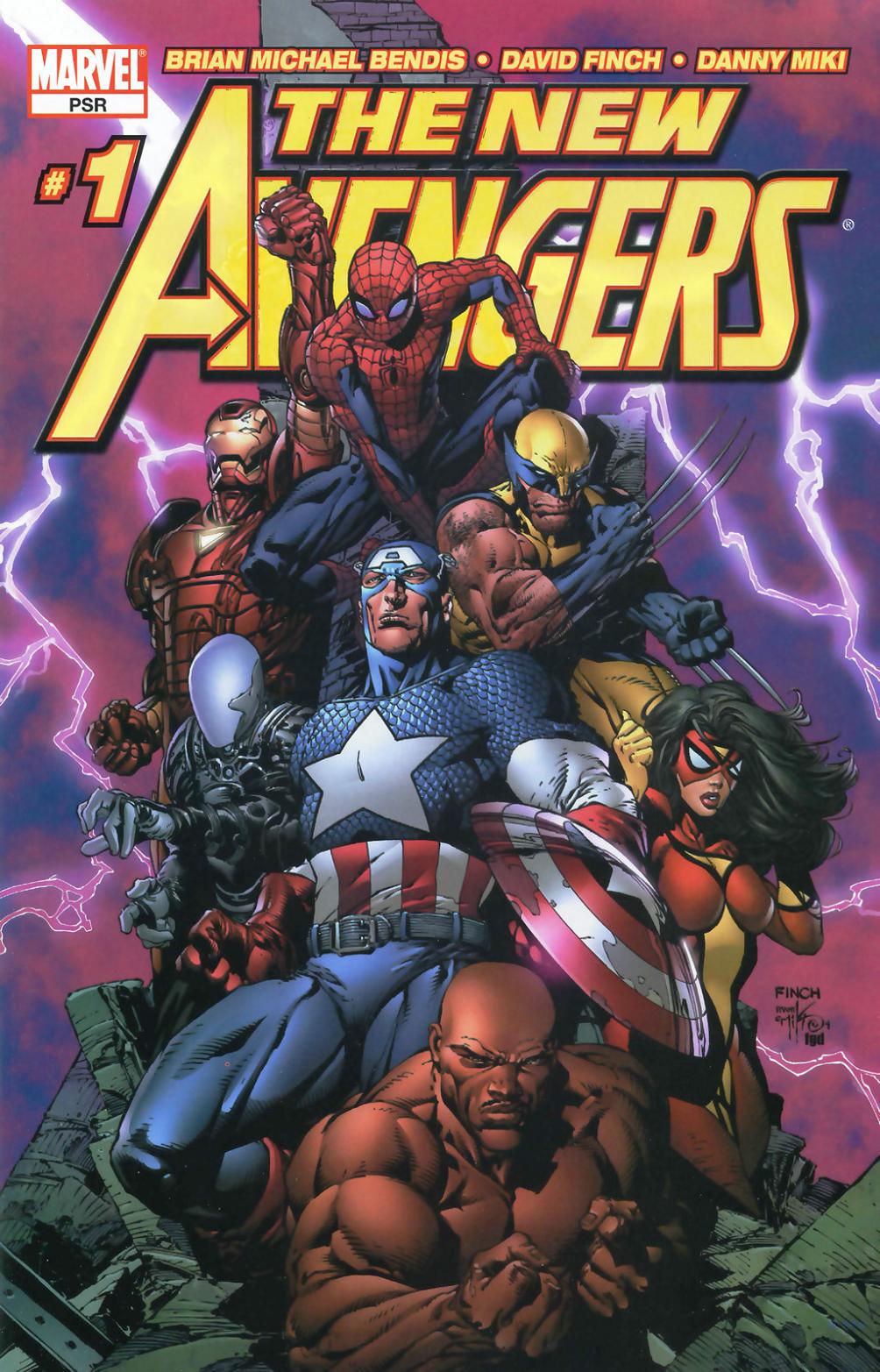
I count two Spider-Men, two Spider-Women (one is “Spider-Gwen”), and two Captain Americas (one is old Steve Rogers, the other the old Falcon). Look back at the first Marvel promo and find two Wolverines (one female, the other old Logan).

Duplicating heroes is one way to increase diversity. But it can sometimes dilute the specialness of super-heroes. I’m not just talking about spreading thin unique super-powers, but also decreasing high-stakes adventures. If a certain hero is facing life-and-death odds, it’s no big deal, since a copycat can fill any vacancy. And if your world blows up, just hop over to the next universe.

Right, DC?

convergencewrap2

Okay.  Rant over.

All-New, All-Different Rant.

Let’s talk about teaching and blow up some more multiplicity problems. “Multiple Intelligences,” to be precise.

Multiple intelligences is perhaps the most touted idea in education today. But in case you haven’t heard of it, here’s a recap:

frames of mind

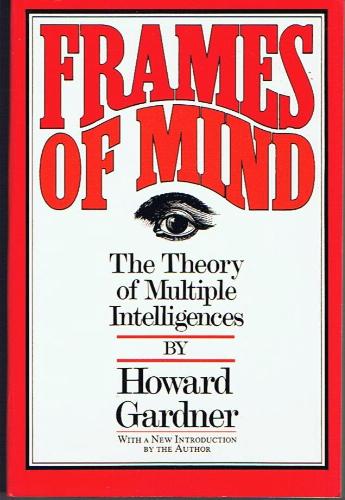
Back in 1983 (one year before Marvel’s first “Secret Wars”), Harvard professor Howard Gardner argued that a general intelligence (“IQ”) measure is insufficient, and proposed seven different “intelligences” one could possess.

MI pie smart

Most people have strengths and weaknesses around this pie, and are more comfortable in some categories (or combos) than in others.

Of course everyone has different strengths. They’re called talents. Skills. Natural abilities. Preferences. Interests. Comfort zones.

But Gardner labeled these categories “intelligences” and this notion took off like honey nut hotcakes. In fact, Gardner has admitted that his ideas wouldn’t have gotten so popular had he just called them “multiple talents.”

So what’s the problem?

Many educators – many with the best of intentions – latch onto “multiple intelligences” thinking they have to cater to everyone’s needs. Taken to the extreme, each topic to be learned requires eight different lessons or activities. That way you cover all the bases.

Another term that overlaps with multiple intelligences is “learning styles.” Educators frequently pigeonhole different students according to a specific strength or preference – visual, auditory, kinesthetic. Worse, students may self-label or assume the identity they’ve been assigned, with the notion that they are stuck in one role with no opportunity to grow or change.

To his credit, Howard Gardner has explained how his ideas of multiple intelligences are NOT the same as learning styles. This is helpful, as comprehensive learning relies on much more than just “style.” Moreover, research has found little evidence that matching teaching to a specific learning preference produces higher understanding. Unfortunately, such clarification is lost among the bulk of educational professionals and publications.

Mixed up reliance on “MI” and “learning styles” enables teachers, parents, and students who want excuses for an underwhelming performance. If Billy flunks his spelling test, that’s okay. Maybe he’s just a “kinesthetic” learner. Maybe he can form letters with his arms and legs. Or if Suzie struggles in math, just have her sing out her calculations. She does so well in choir, after all. She must be “music smart.”

Here’s another problem:  Some of these “intelligences” are more practical in everyday life than others. No matter how much you plead, no one will sing the ballot to you the next election day.  You have to read to vote. The next time you get pulled over for texting while driving, try explaining to the officer that you have interpersonal intelligence. See how far that gets you.
I’m not saying we should dismiss any student who doesn’t excel at a particular subject or skill. Celebrate their strengths. Find ways for them to use and share that talent. But don’t compromise content learning. And help people shore up their weaknesses.

By the way, for those who counted the Multiple Intelligences in that pie graphic up there (all you logical-mathematical studs), there are actually EIGHT intelligences. Gardner added “naturalistic intelligence” a few years later. And then there’s also “existential intelligence.” It’s all getting a little ridiculous, to the point where The Onion featured a parody article revealing the trials of students with “nasal intelligence.”

nasal learner

A nasal learner struggles with an odorless textbook.

So what should teachers do?

Dr. Gardner suggests three actions: 1. Individualize your teaching; 2. Plurarlize your teaching; and 3. Drop the term “styles.”  (Easy for him to say.)

If you want more concrete ideas, here are some quotes from reviews of the research:

From The Chronicle: “Teachers should worry about matching their instruction to the content they are teaching. Some concepts are best taught through hands-on work, some are best taught through lectures, and some are best taught through group discussions” (Glenn, 2009).

From the NSTA: “Using appropriate representations that carefully consider how to best convey the content is important. In addition, we need to scaffold between concrete and more abstract representations, being sensitive to the abilities of our students to handle abstractions. Finally, when students struggle to understand, we need to look at both the nature of the content as well as the prior experiences of our students” (Olson, 2006). 

This is a good start to wise planning and teaching. Click on the hyperlinked articles above for more in-depth reading and reflection.

Multiple intelligences – like multiple superheroes – can have some merit in the right context. But both can explode out of control and become gimmicky. Be wary of too much reliance and redundancy, resulting in loss of impact.

multiple supermen

Heroic Integration

Standard

It’s been a while since our last blog post and we have all kinds of critically important issues to talk about, starting with . . . OH YEAH!  AVENGERS: AGE OF ULTRON super-duper blockbuster opens THIS WEEKEND!  

ageofultron

The latest greatest superhero movie can provide a useful springboard for exploring the dangers of relying too much on technology (e.g. resulting in an evil sentient robot that tries to kill all humankind). Forget a vengeful Ultron or iPad; beware of students plugged in but tuned out to meaningful learning.

We’ll table that discussion for another time, however, given recent chatter about another famous Marvel character who may possibly join Earth’s Mightiest Heroes on the big screen:  Spider-Man.

avengersassembled-the-future-of-the-avengers-marvel-s-plans-robert-downey-jr-spider-man

Thanks to Photoshop, we already have a poster!

Like Captain America and company, Spider-Man is a mainstay Marvel Comics character. But up until now, everyone’s favorite web-slinger has appeared in his separate series of movies due to film rights owned by Sony Pictures.

spidey and avengers panel

Confused? Don’t worry, because bigwig producers have signed important papers and the stars have aligned and now Spidey can swing along with the Avengers in the official “Marvel Cinematic Universe,” or MCU.

Fan reaction has been understandably joyous, given the potential team-up between Marvel’s flagship hero and Marvel’s flagship hero team. Heck, the good folks at IGN have already imagined what Age of Ultron would look like with Spider-Man in the mix.  Take a look at their trailer here, if you’re curious.

Enthusiasm has erupted for integrating even more heroes in the movies. Speculation abounds if Marvel’s other movie heroes – the X-Men, the Fantastic Four – could ever merge into the MCU.  Even Wolverine’s Hugh Jackman wants to join in the mix.

00c

Coming to a movie theater near you?

Such integration of superheroes (a.k.a. worlds colliding) may appear as a bounty of riches; but there could be a downside.

Ever heard of too much of a good thing?

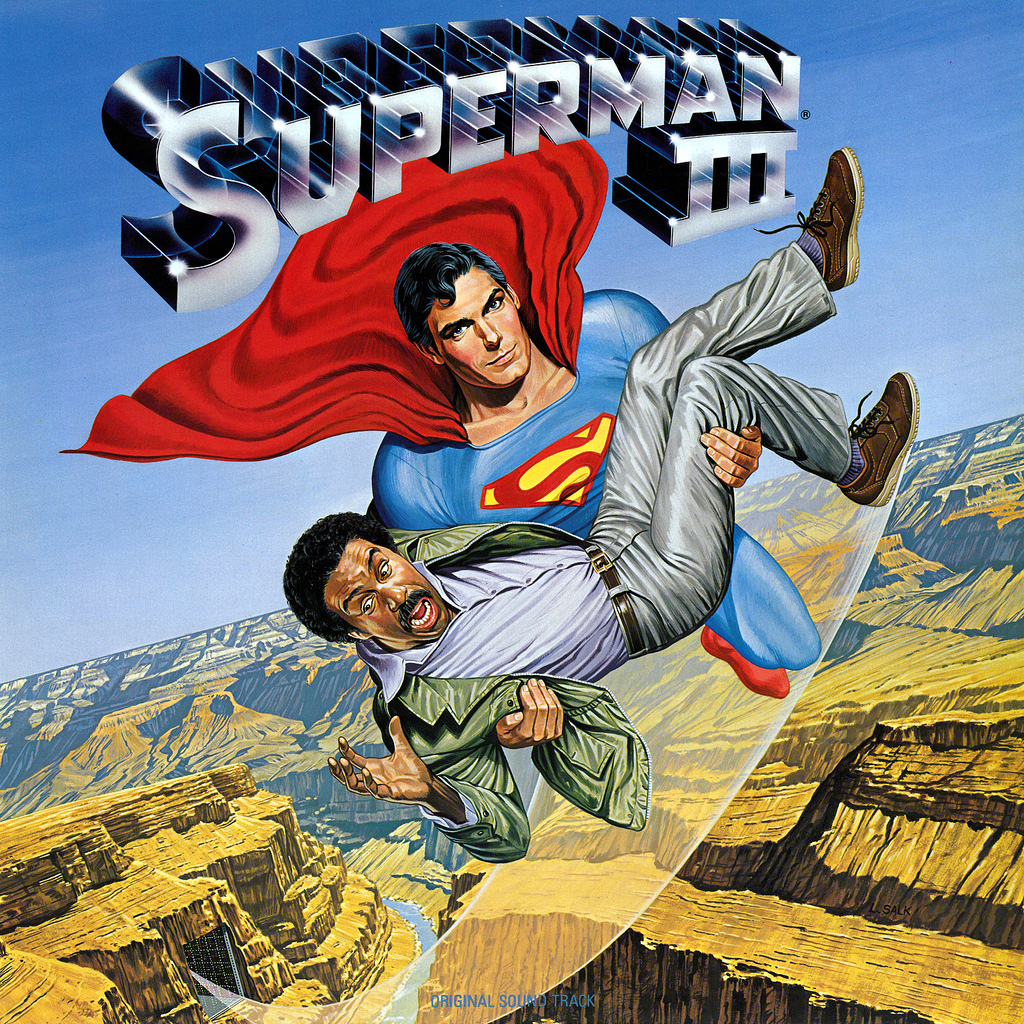
A common feature of disappointing superhero movies is a glut of characters in the script. Spider-Man 3 had Sandman and Venom and the Green Goblins clogging the villain faucet. Batman & Robin was actually Batman and Robin and Batgirl and Poison Ivy and Bane and Mr. Freeze. Superman III had Richard Pryor.

Superman3

Proving that “Two’s a Crowd.”

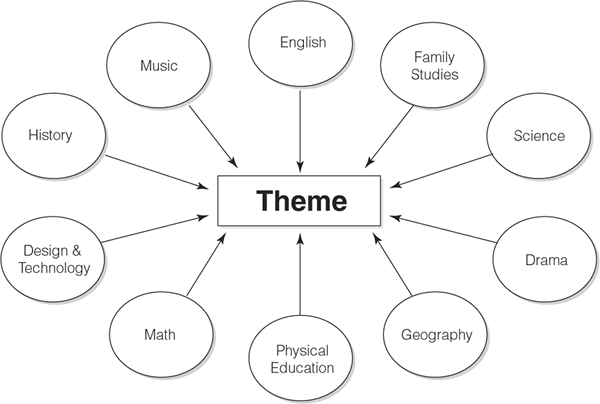
Curriculum Integration in schools is another appealing mash-up that may have a hidden downside or two.

Curriculum Integration image

Basically, integrating curriculum is what teachers do when they teach lessons combining two or more major subjects or disciplines. Examples are as obvious as teaching algebra and graphing with a science experiment, and as unique as an instructor’s imagination. I know of a middle school that features a building-wide interdisciplinary unit all about the Greek Olympics. Every class studies some aspect of the ancient athletes – math, history, language arts, visual arts, science, P.E., and more.

Olympic_Rings

Sounds neat, right? And perhaps a little daunting to pull off, given the coordination of teachers, resources, and activities. But that’s just a challenge, not the downside. The upside is collaborative educators and students energized by explicit and relevant connections among various scholarly endeavors (subjects).

The danger of curriculum integration in classrooms is similar to those in superhero movies. Cramming in too much can end up in confusion and misconceptions. Content may be watered down, spread thin, or lost in the shuffle.

Take a minute to look at this article, “A Caveat: Curriculum Integration Isn’t Always a Good Idea,” by Jere Brophy and Janet Alleman for a more robust examination of this strategy. Better yet, print it out and read it while you wait in line for your Avengers movie tickets. Or download it on your portable digital device.

Technology can be great. So can curriculum integration. Just be careful.

Weird Superpowers

Standard

As first reported by USA TodaySuperman is getting a new superpower in the DC Comics universe.

Clark Kent’s alter-ego gets a costume update, too, complete with fingerless gloves.  This makes me wonder if his new power includes playing clarinet for marching band.

superman new costume

Take a look at comic book panels revealing this new ability in action.  (No woodwind in sight . . . yet.)

superman new power panels

Art by John Romita, Jr.

DC is touting this new talent–the Super Flare–as Superman’s “first new power in decades.”  They’ve even provided a handy-dandy timeline:

superman-powers time line

Superman must be short for “Superfluous-man,” given Kal-El’s multiple Kryptonian skills.  He’s a walking flying Swiss Army Knife compared to most heroes’ singular power sets (e.g. Flash = fast; Green Lantern = ring; Batman = ruined childhood).

Both Newsarama and IGN recently came up with lists of Superman’s Weirdest Powers to celebrate the inaugural Super Flare.  There are 15 listed by IGN, and Newsarama includes 10 in their countdown.  You’ll notice some overlap as well as some rather obscure abilities in Superman’s 75-year multi-media history.

My personal favorite is “Super-Dancing,” which Clark Kent can employ without even changing outfits.

Super-Dancing

Many teachers possess this power, too.

Weird Teacher Powers

This examination of weird superpowers got me thinking about teachers’ own unique abilities.  As mentioned in a previous post, one joy of teaching is bringing personal skills and strengths to the classroom, building off of sound research and practice.

Bringing in your unique personality can also lead to sharing some special talents and abilities.  Instead of settling for America’s Got Talent or David Letterman’s Stupid Human Tricks, teachers can put these gifts to good use in schools.  So . . .

stupid human tricks

What’s your weird teacher power?  

I’m not talking about the Superman-like ability to eat a complete lunch in under five minutes.  That goes with the profession.

super eating

Fifth period starts in two minutes!

What we want to examine is using uncommon strengths for the common good:  learning.

How can you use “weird teacher powers” to inspire and educate students?

If it helps, here is how I’ve applied a few of my own particular capabilities in educational settings.

1. Left-footed.  To be honest, this one hasn’t been that useful in the classroom, except to show students that everyone is different in different ways.   Accept that fact and get along.  (I’m still waiting on Bill Belichick’s offer to punt for the New England Patriots.)

2. Music.  Not a strange talent in most cases.  It’s all how you use it, though.  I sing and play trumpet, and have done one or the other in various settings to get students’ attention, share a mnemonic memory trick, or illustrate the physics of sound.

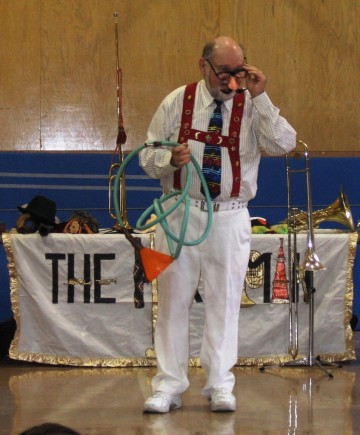
Plenty of weird potential, too.  When I student taught, one of my mentors taped a trumpet mouthpiece into one end of a garden hose, with a funnel sticking out the other end.  He would play his “hose-a-phone” on occasion, most frequently for students’ birthdays.  Not very educational, but certainly eye- and ear-catching among the students, something all teachers need.

CroppedHose-a-Phone-846x1024

Archival footage of hose-a-phone. Not actual mentor.

3. Goof.  Like my mentor’s example, often a teacher’s weird power lies in his or her ability to lower inhibitions and go for the gusto.  We don’t have to bounce off walls, but we can exhibit enthusiasm for school and learning in captivating and contagious ways.

I know an educator with a lively method of ending the class period on a day of doldrums.  When class limps into the last minute, this man pretends to get a call from the president via wristwatch, puts on a cape and cowboy hat, then runs out of the room yelling, “Super-Cowboy . . . AWAY!!!”

I’ve never tried that myself, but I have celebrated a unit assessment by theatrically revealing the test while blaring Strauss’s “Also Sprach Zarathustra” (a.k.a. the opening to 2001: A Space Odyssey).  Following a few confused faces, the triumphant entrance gets more laughs and eases anyone’s test anxiety.

During my chemistry classes’ Gas Laws unit, I make a point to wear the following t-shirt under my ordinary teacher outfit (shirt and tie, slacks).

sci never sucks t shirt

A gift from my brother (also a teacher).

The instant someone mentions the word “suck” to describe pressure differentials, I rip open my outer shirt to give the class a vivid reminder that “Science Never Sucks.”  To enhance the effect, I play Survivor’s “Eye of the Tiger” as accompaniment.

Silly?  Of course.  Memorable?  That’s the point.

Years later, all of my former students know there’s no such thing as a “suck force.”

And as an added bonus, for one fleeting minute I get to feel like a costumed superhero.

So maybe you can’t leap tall buildings in a single bound or outrace a speeding bullet.  But every teacher has special skills and quirks, able to spark meaningful and memorable learning in our students’ lives.

That makes us the most powerful superheroes ever.

Flex Plan

Standard

Where will you be in five years?

If you like superheroes, a good bet is you’ll be sitting in a theater watching the latest Marvel or DC movie.  And chances are you’ll have seen multiple superhero movies between now and then.

A recent Warner Bros. shareholder meeting featured the announcement of several tentpole movie projects into the year 2020.  This list includes TEN films starring DC Comics superheroes (and antiheroes).

upcoming-dc-films1

Not to be outdone, Marvel Studios held a special shindig where they announced NINE movies set in their “Marvel Cinematic Universe,” involving the Avengers, Guardians of the Galaxy, Black Panther, Dr. Strange, and more.

Avengers-Infinity-War-logo

“Infinity” sounds about right.

If you add in movies based on other Marvel Comics heroes (X-Men, Spider-Man, Fantastic Four, etc.), that makes OVER 40 FILMS currently planned for Marvel or DC comic book characters.

And that’s not even counting additional comic book and superhero projects.  So we’re headed either into the Double Platinum Age of Comic Book Movies or Major Market Saturation.

Of course, many of these projects may get derailed or delayed along the way.  (Don’t hold your breath for “Unannounced Female Character Spider-Man Movie” in 2017.)

Plans change, and no one knows that better than teachers.

Adventures with Scope & Sequence

Those of us in the field of education know about something called “Scope and Sequence.”  Not only does “Scope and Sequence” sound like a terrific crime-fighting duo, S&S is a general phrase given to long-term planning in the school year.

Here is an example Scope and Sequence from an elementary art teacher, courtesy of the smARTteacher website.

Art ScopeSequence BIG

I think of scope as the overall main ideas and concepts students should learn in a class, and sequence is the general order in which they could learn, connect, and practice these main ideas.

Notice the language used here:  “overall”  “general”  “could.”

It’s important to remember that long-term planning should be flexible, like the Ever-Elastic Mr. Fantastic! 

mr fan in action

Sometimes adjusting to curriculum guides can feel like deflecting bullets.

All kinds of variables arise during a school year that require adjustment and revisions:  prior knowledge, curriculum mandates, assessment schedules, special events, weather cancellations, and–MOST IMPORTANTLY–student learning.

Districts often have a Pacing Guide that indicates the key content, units, and even activities teachers should use in their specific courses.  Here are some pacing guides for science teachers in Mobile County Public Schools (AL), if you’re curious.

The key word here is “guide.”  Classroom teachers know their students best, and therefore the best methods and schedules for helping students learn.

To coin a scientific-sounding mantra:  Student learning should be the constant, with time as the dependent variable.

If students require more time to master a topic, give them more time.  Don’t plow through a chapter just because you think you need to stay “on track” to finish a certain textbook.  (Who said you had to finish the textbook in the first place?)  Conversely, don’t slog through something the kids already know or don’t need to know.

A Super Biology Teacher

I met a science teacher who was just one of six teachers who taught Biology 1 in his school building.   The basic requirement was all Biology 1 teachers had to get through Chapter 10 by the end of December.  The reason was students could switch teachers at the semester break, so everyone needed to be at “the same spot” beginning in January.

Sounds logical, but not every teacher (or student) will work at the same rate or want to focus on the same content.  Some concepts and skills are more important than others.  So what do you do if you don’t agree with a prescribed schedule?

I love what this science teacher did.  He made sure he was done with Chapter 10 by the end of December, but he shuffled chapters to create the most meaningful sequence for his students.  Moreover, this teacher spent more time on some chapters and less time on others that weren’t as necessary for learning fundamental biology concepts.

Sound out of order?  That’s nothing new to readers of comic books, where odd numbering systems abound (see multiple #1 issues, #0 issues, #-1 issues, backwards releases, flipped issues, etc.).  Heck, there’s even a blog totally committed to the convoluted topic of Comic Book Numbering.

The bottom line in comic books is finding strategies and gimmicks to sell the most issues.  The bottom line for teaching is arranging lessons and units to encourage the most learning.

So whether you’re talking about billion-dollar film franchises or the infinite potential of today’s students, do take time to plan ahead.  But always keep your plans open to change.

And always leave the door open for a dynamite sequel.

superman2

Academy, Asylum, or . . . ?

Standard

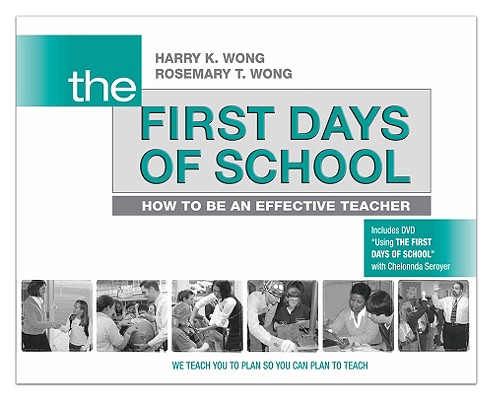
It’s Back-to-School time, and hopefully everyone is off to a terrific start, implementing new district policies and applying Harry and Rosemary Wong’s wisdom about “the first days of school.” (Routines and procedures, practice, practice, practice.)

The-First-Days-of-School-9780976423317

Batman is back in the news too, mainly the upcoming Ben Affleck movie version with Superman a la Frank Miller’s The Dark Knight Returns miniseries (e.g. short pointy ears). I’m sure we’ll have more to talk about that topic and teaching connections in the future (e.g. short pointy ears).

bat comparison

Comparison courtesy of artist Dean Trippe @deantrippe

In the near future, a bunch of new Batman-related comics are coming out. Namely, two series start this fall, as announced by Entertainment Weekly.

One title is Arkham Manor, in which Bruce Wayne (Batman’s nice face) decides to donate his Wayne Manor to house Gotham City’s criminally insane. The mansion that’s known for masking the underground Batcave has now become the new location for Arkham Asylum. There goes the neighborhood.

Arkham Manor     Gotham Academy
 

Another Bat-title from DC—Gotham Academy—focuses on the city’s private school for rich kids.  Plaid skirt uniforms and everything.

(Side note: I’m curious about the depiction of Gotham’s public schools.  If you are curious as well, the best we can do is watch the movie Dangerous Minds and assume that instead of being a former marine, Michelle Pfieffer’s character is Selena Kyle after giving up the Catwoman costume in Batman Returns. It almost works!)

As for the comics, we’ll see what happens as both series progress in the months to come. The reason I bring them up here is to encourage all of us teachers to consider our school environment.

Academy?

Does your school building feel like an academy? It’s a fancy word, coming from the Greek “grove of Akademos,” where Plato did his teaching. Good company, no? People nowadays use the term “academy” to refer to a special institution for scholarship or for the advancement of the arts or science. 

You don’t have to teach in a special institution to advance the ideas of scholarship and appreciation for culture. Wherever and whatever you teach, consider how you can promote an “academic” attitude in your students. I’m not talking about being a snob or out of touch with reality. But we can still create an environment where learning is looked upon as a noble endeavor and great adventure.

Sometimes our schools have too much adventure, though, and may even feel like an insane asylum.

Asylum?

Does anyone in your school drink from a mug like this?  

crazy mug

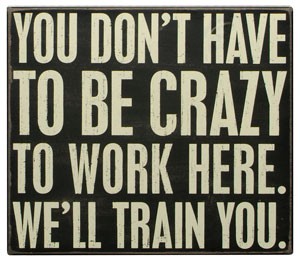
Or post this sign in their classroom or office?

crazy sign


Schools can often feel like a facility for the mentally unstable. Beyond the humor, though, there is some truth to that notion. Think about our students’ mental, emotional, and physical states. Most of them are, in fact, a little unstable. A little “shaky,” so to speak. They should be. They’re still growing up.

And that’s why we teach them. During a school year, teachers introduce students to hundreds of ideas and skills. Our students should investigate, reflect, and practice the content, all the while strengthening (and stabilizing) their foundations—intellectually, emotionally, and more. This learning process is often challenging and frustrating, even destabilizing at times, and ultimately rewarding.

Learning can create a sense of vulnerability, and students need a safe place to learn—no matter what kind of school or classroom. 

We looked at the origin of the word “academy,” so let’s do the same for asylum. Although often associated with housing the mentally ill, the word “asylum” comes from the Latin word for “sanctuary,” a “safe or secure place.”

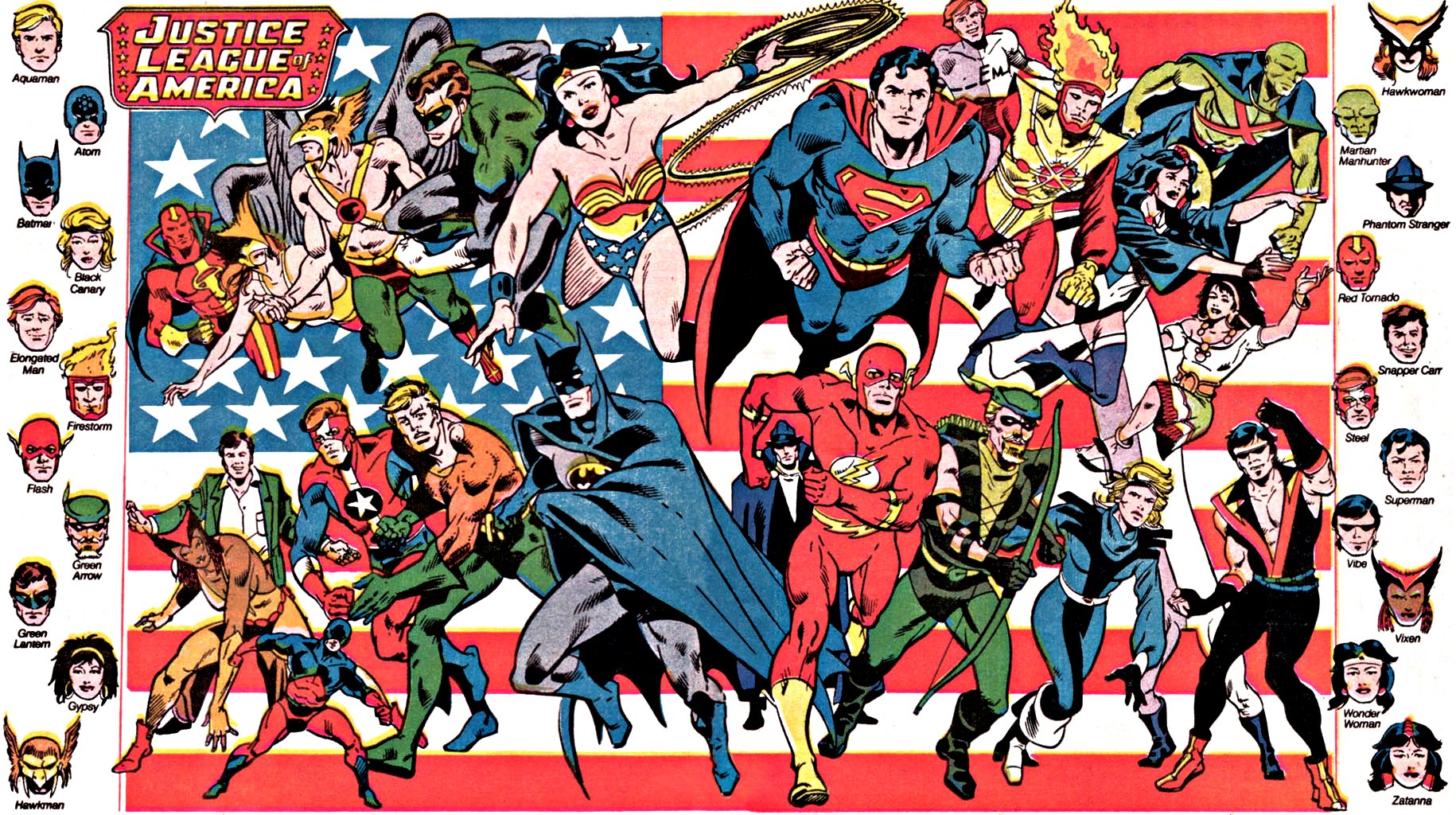
We can never protect kids from every unsafe event or bad influence, but we can all do our part. None of us can do it alone. Heck, even Batman has the Justice League. (And Alfred. And several Robins. And Nightwing. And the Gotham City Police Department. And the Outsiders. And Batman Incorporated. And Batmen of All Nations. And Ace the Bat-Hound.)

justiceleague


Fight the good fight with your trusted colleagues, mentors, and friends. (And pets.)  You get to pick who wears the cape.

Good luck in the coming year in whatever classroom you teach. Wherever you are, it can be both an academy and an asylum for your students. And so much more.


Secret Origins

Standard

ImageThis month sees the release of Secret Origins #1 by DC Comics, and you can read more about it here and see what people have to say about it here.

DC has published versions of Secret Origins before, and the purpose is to explore and explain the beginnings of superheroes and villains. Featured characters range from iconic to obscure. So if you want to know how Ambush Bug got his start, here’s your chance!

Image


Origins typically contain two essential ingredients: 1) How you get your powers, and 2) What is your motivation?


Just like superheroes, every teacher has an origin. We all come from somewhere, contrary to what my 8th Grade Earth Science teacher Mr. Musson used to say: “Teachers aren’t born; they just . . . appear.”

The same two pieces of an origin story apply to teachers, as well.


1) How did you get your powers?


Maybe you weren’t bitten by a radioactive spider or trained in the mystical martial arts of K’un-Lun, but I bet you’ve got something that makes you special.


Most of us licensed teachers have received professional preparation of some sort. Many earned our teaching credentials after completing a bachelor’s degree in education, often with a specific subject endorsement. Other non-traditional routes include “fifth year” programs as well as an assortment of alternative licensure options for college graduates who already have degrees in something other than education. In the latter case, individuals often complete formal teacher education coursework while at the same time teaching full-time in schools.


No matter what your route, the bottom line is that you studied, practiced, collaborated, reflected, and applied important concepts and skills necessary for becoming an effective educator. (The scary thing is, some people think teaching requires no formal preparation at all, and are willing to dump anyone into the classroom just to fill a need. We could talk about this important issue at another time, and I already have HERE in a newspaper editorial, if you’re curious.)


Outside of formal preparation, many of you also learned about teaching through other means. Maybe you have a teacher as a close family member or friend, or perhaps you’ve experienced teaching through various activities like sports, church, hobbies, and more. You got the bug, so to speak, and you wanted more.


That leads us to the second part of origin stories . . .


2) What’s your motivation?


Getting powers is not enough. A lot of people have skills but waste them or use them in selfish ways, just like a lot of super-powered characters.


Every good teacher needs not only special abilities, but also a special heart and passion for the classroom and beyond.


Many of us got into teaching because we love learning and want to share that joy with others. We want to make a difference in the lives of kids and their families.


Hopefully you didn’t go into teaching because of a so-called “summer vacation” or because you thought your workday would be 8:30 to 3:30.   If either of these were reasons you entered the profession, you probably learned that teachers put more total hours in the school year than most people do in 12-month jobs. You can learn some other important statistics about the teaching career here.


Unfortunately, origin stories sometimes reveal an individual’s weaknesses as well as their strengths. For example, Superman’s not a fan of green kryptonite, which came from the blown up bits of his home planet. And Iron Man sometimes likes to hit the bottle, thanks to the fast life of his alter ego Tony Stark.


I hope you do not falter to kryptonite or alcohol, but you should still be wary of potential flaws. I’ll use my “origin story” as an example:


Secret Origin . . . Revealed!


I’ve always liked school. I like to learn. I’ve had some great teachers in my family and in my schools, so it’s probably no surprise I pursued teaching as a profession.


Here’s a rare mug shot of my first year teaching way back in 1999. It’s black and white and grainy because I had to scan it from the school yearbook. It’s wrinkly and weary because it was my first year as a teacher. (To determine if I’ve aged well, compare this portrait with a more recent one on the editorial link above.)


Image
Vintage Mr. Bergman #1

The first year was tough—it always is—but I got better. Teaching is hard work, but it is worthwhile and can be a joy, even on the tough days. You stick with it and each year usually gets easier.


How else did I improve?


I learned the intricacies of my subject matter (science) to know how concepts were connected, what analogies illustrated tough ideas, and what activities gave the best opportunities to clearly master content. I also learned about my students: what motivates them, what strengths and weaknesses they possess, and how to strike a healthy balance between firm and easy when it comes to classroom management—something that can never be overestimated.


But here’s where my “secret origin” reveals some of my weaknesses.


I like school. Many students don’t. For the most part, I was a “goody-two-shoes” throughout school. Some of my students actually thrive on creating classroom chaos. So I have to overcome my nice guy tendencies and be ready and willing to draw the line when it comes to discipline. It’s not easy, but it has to be done.


Here’s another strength that can become a flaw:


I enjoy science. Some students fear it.   When I was a kid, I found satisfaction in filling out worksheets and completing exams. I was weird. A lot of students greet homework with hostility and suffer test anxiety.


So as a teacher, I have to reduce resistance in my students before I can open the doors to learning. And it starts with me. I can’t assume my students are just as eager to come to class and learn about electron configuration. I have to find out what motivates them and how I can connect concepts to their lives and interests. In a way, I have to learn the secret origins of every student.


I hope this post has helped you reflect on your past and consider how it can impact your future. Do you have special training? Hidden talents? A passion that can only be served by teaching? How did it all begin?


In other words . . .


What is YOUR origin story?


Please post a comment and share why and how you became a teacher. Your story doesn’t have to involve radioactivity.

But it’d be cool if it did.


You are not alone

Standard

An encouraging reminder that there are many other super-teachers fighting the good fight.

Take a look:

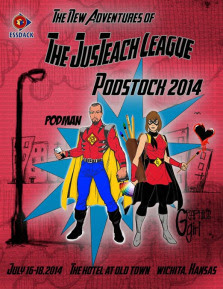
justeach

JusTeach League

Love it!

This gem comes from the folks behind Podstock, a “tech integration conference” for educators in Kansas, the adoptive home state of Superman.  (Not bad!)

Learn more about Podstock here.  Go for it!