I did my best to find a superhero linked to podcasting, but couldn’t find much.
So here’s the best I could do, thanks to Marvel, Freepik/kjpargeter, and Microsoft’s copy-paste:
Introducing . . . MR. POD-CASTIC!!!
My apologies to all the parties listed above.
Below is the only other alternative pun/wordplay I could conjure, with additional apologies to Meme Generator and Star Wars:
All this nonsense is to celebrate a local podcast – HCTalk – I recently joined to share conversation about superheroes and teaching – Hooray!
Tune in and skip around to learn about my teacher “origin story,” the publishing origins of my book, Teaching Is for Superheroes!,and other items such as . . .
Favorite teachers vs. favorite superheroes,
Jumping through hoops vs. going against the grain,
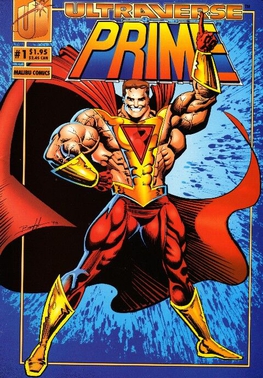
Way back in the 90s, the now-defunct Malibu Comics published PRIME, featuring a kid-turned-superhero sort of like SHAZAM (a.k.a. Fawcett/DC Comics’ Captain Marvel).
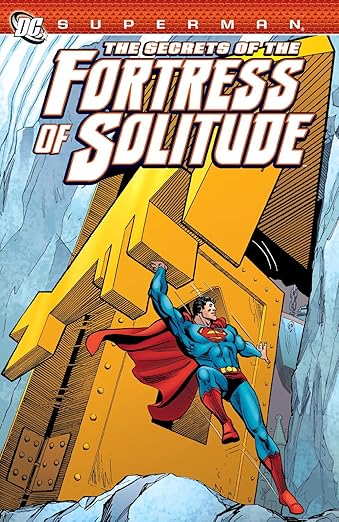
Let’s take a look at one more element of Superman lore and its educational applications – Kryptonite.
Most casual fans know that Kryptonite is the radioactive green mineral that can weaken or even kill Kryptonians like Superman. What you may not know is that there are ALL kinds of Kryptonite colors – each one with its own side effects.
My personal favorite is Periwinkle Kryptonite, which you can learn more about HERE.
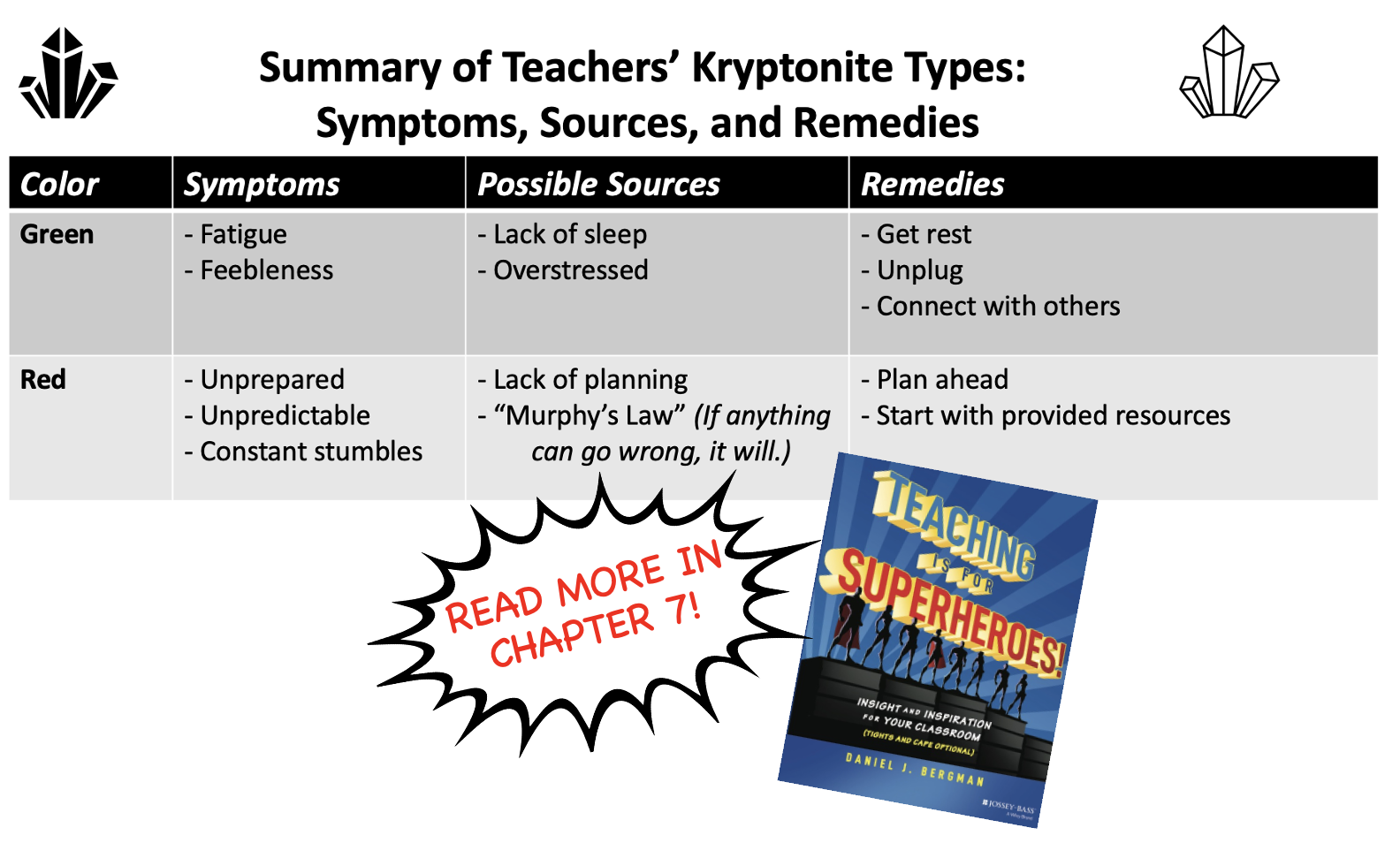
In my book, Teaching Is for Superheroes!, I devote an entire chapter to assorted Kryptonite colors and parallel vulnerabilities experienced by teachers(e.g. green = fatigue, red = unpredictability, white = lack of growth, etc.). Here’s a sneak peek:
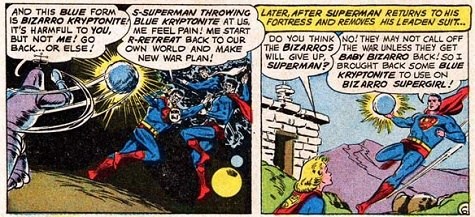
One color NOT covered in my book is Blue Kryptonite. This type is harmless to Superman, but is dangerous and lethal to his distorted doppelganger, Bizarro.
How does Blue Kryptonite apply to teachers? Each educator has their own strengths and weaknesses, personalities and professional expertise. It stands to reason, then, that we each may be vulnerable under different contexts and conditions.
Think of it this way: What’s an issue you consider no big deal, but is an incredible struggle for a colleague? When others want to rip out their hair, you simply shrug your shoulders.
This could be anything during a given school day or year. There are “big” things like curriculum choices, assessment plans, or management models. Or it might be something “small” like a fire drill, a jammed copier machine, or empty coffee pot*.
*If you’re not a coffee drinker, who cares? But watch out for Shannon, who gulps down three Ventis before lunch.
Many challenges become less of an issue as you gain experience and skills. Regardless, a seemingly “minor” item may be VERY “major” to a particular person.
Vulnerabilities often appear alongside our strengths. Teachers with meticulous lessons might struggle when plans change. Others who “wing it” day-to-day could falter when they must prepare for a substitute teacher or formal observation. Someone who’s a wiz with Apple technology could feel useless with a Chromebook, and vice versa.
Here’s the beauty of Blue Kryptonite: Those unaffected can help others who struggle. And we should ALL stay humble, knowing every one of us has our personal pitfalls.
Don’t view someone as “bizarre” for their unique liabilities. Instead, look for ways to support them and learn as a community of imperfect individuals.
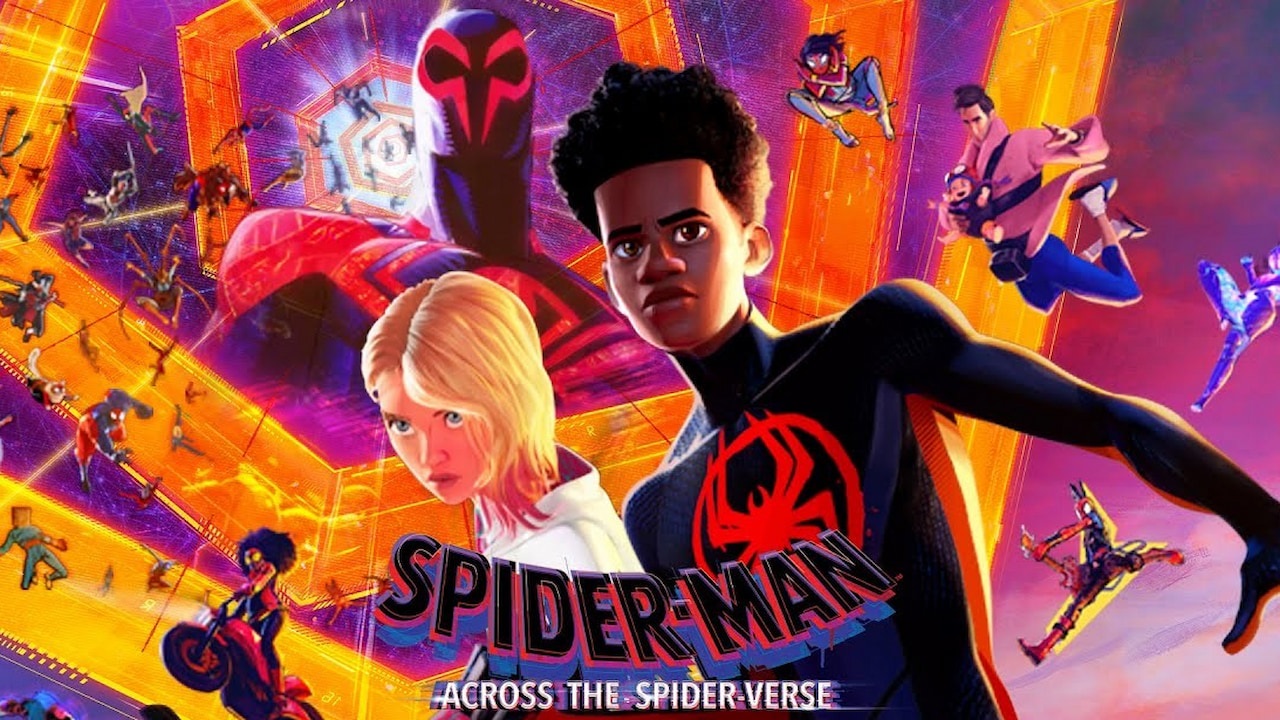
This applies to our teaching colleagues as well as our students. Each classroom contains a colorful roster of characters-such as those in the new film! (See you at the theater!)
Even though the new year has barely begun, it’s always a good time to reflect and review.
Unfortunately, the previous year wasn’t kind to superhero shows. (Or maybe it’s the other way around: Superhero shows weren’t kind to 2023.) Here is a list of superhero movies from last year and their scores on the “Tomatometer” –
Notice that only two films reach the equivalent letter grade of an “A” (both animated, by the way). And seven of these ten movies average out to a “C” or worse – including three below 50%. (Ouch.)
Aside from critics’ reviews, a film’s success also depends on how much money it makes (and also how much it costs). The criteria for “hit” movie, then, is multifaceted.
In the same way, teachers must consider a variety of factors when reflecting on classroom success.
Beyond summative assessment scores, we should account for pre-assessments, school context, and external factors. And go beyond academic measures for “success,” acknowledging the power of social and affective factors.
Again, I would argue these aspects (and more) influence all kinds of success, not merely “academic.”
We’ve talked before on this blog about defining success and evaluating outcomes. But for now, let’s focus on reviewing teachers. How do we measure teaching effectiveness? And who should do it?
Not long ago, Edutopia asked this latter question, and summarized research into various teacher evaluation methods. This is their headline and graphic, and you should click HERE to read more.
For now, here’s a quick summary (you’re welcome) on some useful elements to enhance teacher evaluation:
Teachers should review their teaching with a peer, including fellow experts in content and pedagogy.
Well–writtenrubrics (and well-trained evaluators) help provide structure and intentionality.
Video recordings afford flexibility and efficiency for review, as well as opportunities for self- and peer-reflection. (This one is a personal favorite, and helps you reach “iconic” status.)
Student feedback can be a powerful supplement to other evaluations, especially to gauge rapport, management, and relative rigor.
Teachers, what do you think? How do you use any or all of these in your self-evaluations and self-improvement?
That last one – student reviews – can be tricky. The researchers acknowledge this, noting that some students may evaluate their teachers too harshly. In the entertainment biz, it’s called “review bombing,” and teachers can be mindful of such pitfalls, however rare. (As one of my mentors used to remind her colleagues, “consider the source.”)
I’m encountering a new sort of review process now that my book, “Teaching Is for Superheroes!” is out and in the public. (Have you heard? Or seen? Or both?)
I’ll admit, I’ve taken a peek at a few reviews of my book. They’re not too bad (yet). And hey, I’ve still been writing! (Exhibit A: This blog.)
Still, I don’t want to get bogged down in second-guessing, cringe-inducing, and/or back-patting obsessions.
Teachers must also be careful in focusing too much on reflection and review that they forget to actually teach. Use reviews purposefully and proactively, but not at the expense of your instruction.
Teachers, what else do you do to review, reflect, and improve your teaching?
Please share your ideas. (Sharing and supporting the profession is a great way to help others AND yourself.)
Here’s one more suggestion: Check out a book on teaching! (I have a recommendation.)
And when you do, please provide an honest review at your favorite online merchant (or two), Goodreads, social media, or your own personal blog or podcast. I promise not to look at it . . . more than twice.
You may think this blog’s title refers to the relative lack of new posts in recent months.
I wouldn’t blame you. Hopefully we’ll get back to a semi-regular schedule soon.
But I’ve had my reasons for such blog-paucity. It’s been a busy fall semester. Exhibits A-J . . .
Actually, the topic of “Excused Absences” comes from a social media post by Marvel Studios.
Check out this “Permission Slip” fans can use to skip school or work (or both if you’re a teacher).
What’s your reaction to this note?
Ha! That’s funny.
Hey, that’s not a bad idea.
Gasp! How dare they make light of skipping school and/or work, especially in light of data on chronic student absenteeism and the detrimental effects on learning and retention?
If you responded closest to #3 above, chances are you’ve had some prior experience with students that miss or skip classes.
(Still, I’d hope you can take it as a clever joke. And maybe sympathize with those of us excited to witness two landmark events in the wider Marvel Cinematic Universe.)
But since the issue is on the table, let’s look at students who miss school. And if it’s any encouragement, superheroes go missing all the time . . . .
Focusing on STUDENTS, the causes and effects of missing school are diverse and interdependent. For example, is a student not doing well because they are missing class, or are they missing class because they are not doing well?
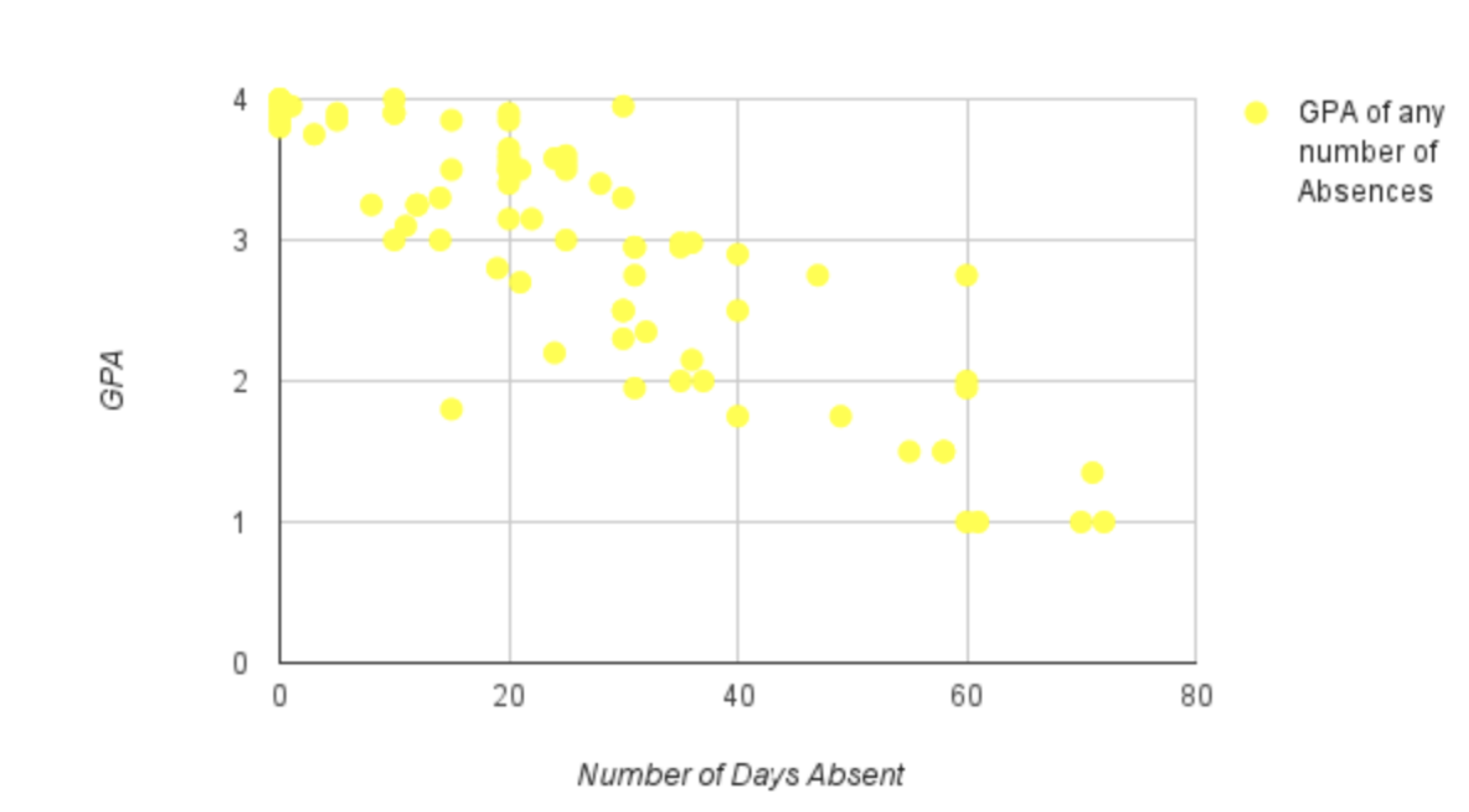
Regardless of causation, we can clearly see correlation. Here is a graph based on data of students in my university, courtesy of our Office of Academic Affairs.
Sure, there are outlier individuals who buck the trend. But overall, it’s not too hard to notice that the more classes you miss (Number of Days Absent), the lower your overall grade point average (GPA).
You can find all kinds of data and research on this important issue, including the ones listed here.
Hands down, this show is the coolest cartoon right now – on TV (Disney Channel), streaming (Disney+), OR online (full episodes available free on YouTube). The animation can get busy at times, with quick cuts, Easter eggs, and side jokes galore. But it’s a fun show, full of positive messages about family, diversity, learning and growing up, as well as at least one groovy musical number in each episode.
In addition to plenty of teachable STEM-related topics, my favorite bit is Coach Hrbek filling in as substitute teacher. Coach compensates for his lack of content knowledge by throwing out as many sports analogies that come to mind. The results are mixed (check out the 26:40 mark from the first episode HERE).
Teachers should learn from Coach Hrbek’s example: Metaphors, analogies, and illustrations can often help teach a concept. But they cannot replace authentic understanding, and can even get out of hand and create further student confusion.
(Fun Fact #1: Fred Tatasciore, who voices Coach Hrbek, is also the “voice” for Devil Dinosaur.)
(Fun Fact #2: My elementary gym teacher was also named Coach Hrbek, but we had to call him “Mister Hrbek.” Good guy.)
There’s plenty of STEM stuff in the third Ant-Man film, which takes place mostly in the subatomic Quantum Realm. More than just namedropping science-y terms, the film’s creators provide extra resources that explore science fact and science fiction. One example is this video with actor Paul Rudd and a quantum physicist, which teachers can use for a quick science primer:
The movie also features a great scene about teaching itself, during which Scott Lang tries to show his daughter Cassie how to fight with shrinking powers. Take a look:
Notice how Ant-Man attempts to teach by modeling, which is tricky when his example is too small and too fast to observe. Teachers, where do you teach by example? And what visual aids or illustrations do you need to enlarge (or slow down) to increase impact?
The connections to teaching (and science) are a bit more of a stretch for this film, but both are still there for teachers to consider. Science-wise, the main antagonist High Evolutionary does all kinds of wonky experiments that conjure conversations about genetics, “natural” selection, and bioethics.
Teaching-wise, the best lesson from GOTG3 is to remember the “little things” amid the bigger backdrop. Shortly after the movie’s release, Amelia Emberwing of IGN wrote an essay titled, “Guardians of the Galaxy Vol 3 Understands That Without the Small, the Big Doesn’t Matter.” I recommend teachers read it (Spoiler Alert, of course), and consider educational parallels.
Take this quote from the essay, for instance: “[T]he real trick to these stories — the secret sauce that has made the Guardians of the Galaxy films stand out over the years — is [writer/director] James Gunn’s understanding that without the small moments, the big ones don’t matter.”
The same sentiment goes for schools. Sure, teachers have standards, assessment data, “scopes and sequences” to plan and track over multiple semesters. But more important than these “big” things are the small moments occurring on a daily basis in the classroom, cafeteria, playground, and hallways.
Lessons from mentors, family, and loved ones? Loads of that.
That last checked box is the one teachers can apply to learning and teaching. If you haven’t seen the film yet (you should), there are several special “small moments” between main character Miles and his parents and other teacher-like figures.
No spoilers here, of course, but watch the trailer below for one such instance. Across this preview’s assorted clips, listen to the dialogue coming from a scene between Miles and his mom:
Part of effective teaching (and parenting) is letting go. Let our students go off to the wider world, try things out, apply their learning, learn from mistakes, make their own decisions (and friends), make new discoveries.
Is it hard? Of course, as are ALL worthwhile endeavors.
But we can trust in our teaching. And trust in these future heroes. Start today.
On this blog, we’ve talked many times about using classroom TEASERS (notSpoilers) as a way to ENGAGE and MOTIVATE students. Travel back in time to read more about this strategy HERE and HERE.
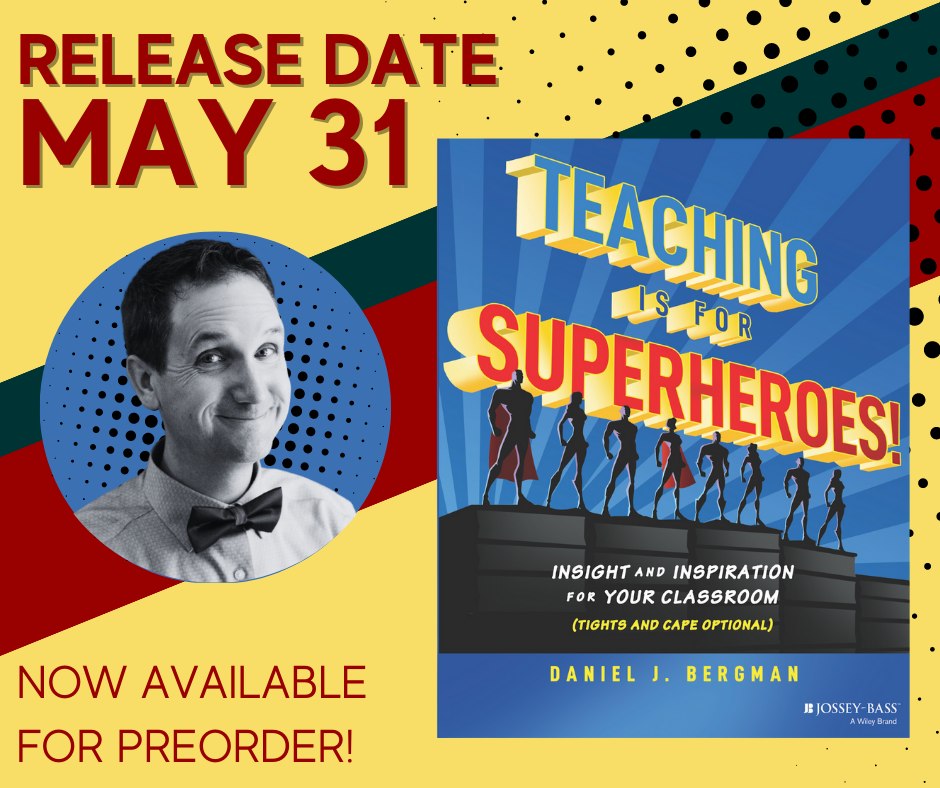
In honor of only ONE WEEK left before the release of my book, Teaching Is for Superheroes! check out this tune . . .
Keep in mind, the wait between comic book issues for ongoing stories “to be continued” is ONE MONTH, or about 30 days. So only 7 days doesn’t sound too bad.
What about the break between school years? Do you get three months over the summer? Or more frequent, shorter breaks between trimesters or quarters?
Hopefully, whatever time “away” you get from school provides refreshment and rejuvenation. And ideally, both students and teachers are RECHARGED and ready to dive back in for “back to school” season!
Over your upcoming break, get in some summer reading while you hangout at the pool or beach or campground (or back porch or air conditioned couch).
I know one good book you could read . . . and there’s still time to PRE-ORDER!
The official release for Teaching Is for Superheroes! is still a few weeks away. But until then, you can take a SNEAK PEEK INSIDE the book!
Look for AMAZING things like Additional Praise! Table of Contents! Copyright Protections! And a preview of completely original (and creative, I might add)interior artwork melding superheroes and teachers, courtesy of Kevin Yancey himself.
We’ve talked before (HERE and HERE) about using classroom TEASERS (notSpoilers) as a way to ENGAGE and MOTIVATE students. These approaches can fit a range of instructional settings.
No matter where they fall, such strategies often include a preview, or “sneak peak,” fostering further learning ahead. They work much in the same way as Amazon’s “Look Inside” feature.
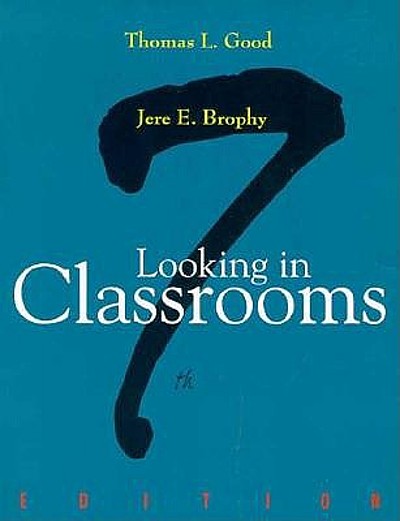
Speaking of “Looking Inside,” one of the BEST educational books out there (11 editions and counting!) is Looking in Classrooms. You can find older editions for pretty cheap, and the newest is available here on Amazon (of course), with its own “Look Inside” (of course).
Check out this book, and you’ll see chapters full of Important School Stuff like Motivation, Assessment, Management (two parts, natch), and my favorite, “Classrooms are Complex.”
Of course, if you are more of a “bottom line” sort of person, you can just skip ahead to the end of this preview and skim the Index.
You can do that for either book. And if you check out MY book’s index, you’ll see everything from “The ABCs of Classroom Management (Kovarik), 80″ (one of the first items) all the way to the very last item, “Zipper, checking, 42.”
If THAT doesn’t get you motivated to read more, I don’t know what will.





























 Teach Like a Superhero!