Charge Up, Mon Chere

Standard

Newgambit bachalo

Add X-Man Gambit to the list of superheroes getting a new movie, starring hunky actor Channing Tatum. Here is Screen Rant’s review of the news and a brief bio of Remy LeBeau.

Gambit was a Marvel ‘90s superstar known for his Cajun accent and scheming ways as much as his mutant ability to charge objects with energy. (The trendy trench coat and headgear also helped enhance his popularity.)

Character issues aside, Gambit can inspire teachers with his superpowers. Instead of charging up playing cards, teachers should strive to charge up their lessons.   (Minus the headgear and explosions.)

Take a look at your most recent lessons. What question, prompt, activity, application, media, or more could you add to energize students?

gambit charge card

Non-Mutant Teachers

Standard

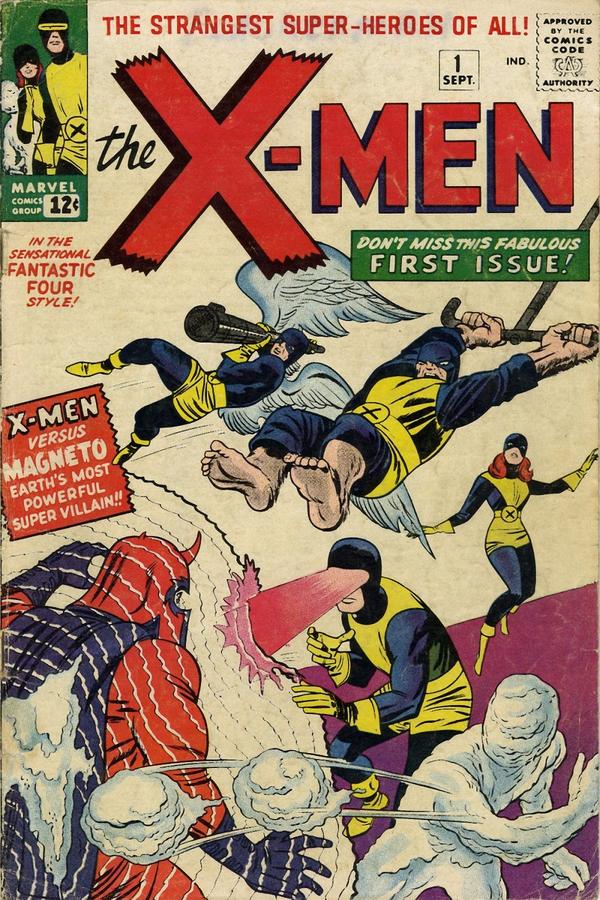
My favorite superhero team has always been the X-Men.  I’ll admit, these mutant heroes first caught my eye with their nifty matching uniforms.  Plus, “X” is the absolute coolest letter in the alphabet by far.  (Uncanny Y-Men . . . just doesn’t cut it.)

X-Men_Vol_1_1

The main reason I like the X-Men, however, is because this superhero team’s origin starts at a school.  “Gifted youngsters” have gathered together not because they’re family or friends or famous heroes, but instead to learn and understand their powers and identities.  And ultimately, these students strive to “protect a world that hates and fears them.”

A new generation of students has taken up the cause of Professor X, as featured in the series Wolverine and the X-Men.  Unfortunately, headmaster Wolverine has recently died in the Marvel Comics world, leaving a void in the faculty at the Jean Grey School for Higher Learning.

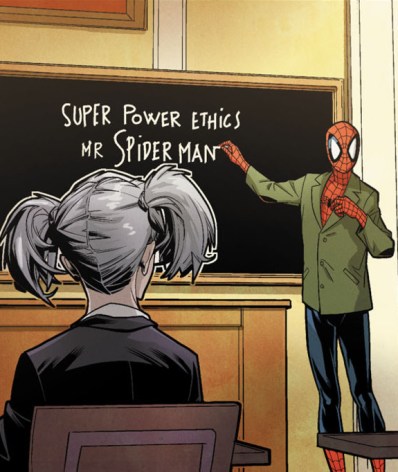
I bet Wolverine’s health will improve soon, but in the meantime another hero has joined the staff of mutant educators:  your friendly neighborhood Spider-Man.
Spider-Man_The_X-Men_1_Preview_3

That’s Mr. Spider-Man to You

One potential problem, though:  Spider-Man is NOT a mutant.  In other words, he was not born with his extra-human abilities.  Peter Parker needed a radioactive spider bite to get his superpowers.  Remember this iconic scene?

1567552-parker_spider_bite_super

Pre-Spider Bite Peter Parker = Lame-o

Differences in genetic background and superhero lifestyle could become a source of conflict not only between Mr. Spider-Man and his students, but also with the mutant teachers and staff at the school.

Such educational discrepancies do not occur in comic books only.  They can also arise in real life.

Real World Research

Research studies have found a “racial/ethnic gap between students of color and their teachers,” something that has increased over the years (Villegas, Strom, & Lucas, 2012).  With a growing population of minority students, teachers from similar racial/ethnic backgrounds are in high demand (Bireda & Chait, 2011).

Why is it important to match teacher and student demographics?

One may assume that students react more positively to teachers who share common characteristics.  Likewise, minority teachers can serve as positive role models to minority students.  However, clear empirical evidence of these assumptions is hard to find, understandable given the complexities of schooling and learning.

Some research studies have found learning gains when teachers and students share similar ethnicity (Dee, 2004; Klein, Le, & Hamilton, 2001).  Nevertheless, these reports note an underlying factor that could have the greatest impact on student success:  the actual quality of the teacher.
peter_parker_spiderman

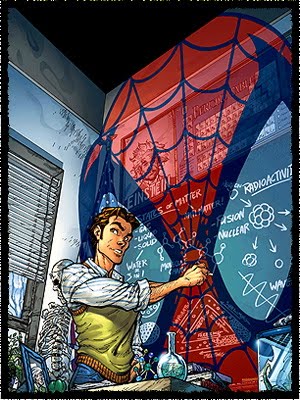
Mr. Parker

Spider-Man does have previous teaching experience.  While plainclothes Peter Parker during the day, he did a stint as science teacher for his alma mater, Midtown High School, in Queens, New York.

250px-Midtown_High_School_from_Spider-Man_Season_One_Vol_1_1

Home of the Fightin’ Living Brains!

Mr. Parker’s public school teaching experience reflects real world trends.  Typically, teachers like to teach close to where they grew up as students (Reininger, 2011).  Or if not the same or nearby location, teachers may teach in a similar type of district or community.

That was me.  I grew up in a small Nebraska town of ~4,000 people.  I graduated from a public high school with a class of ~70 students.  My first teaching job was in a small Nebraska town of ~4,000 people (about 130 miles from my hometown).  Each graduating class at this public school had ~70 students.

What about you?  Where did you go to school?  Where do you teach?  

One of the biggest advantages about the teaching profession is that it can take you anywhere in the world.  Once I had a student encourage me to apply for a teaching job in Dubai.  (Maybe he had selfish motives for introducing me to this opportunity.)

But one of the biggest challenges about teaching is that it requires extraordinary effort to assimilate the context and culture of the school when you first start.  Even teachers who teach in their hometown must navigate through this transitional period.  Moreover, imagine the degree of difficulty for teachers new to a community, culture, and/or country.

It makes sense that teacher recruitment initiatives focus on fostering “pipelines” to increase quality teachers from high-need urban and rural settings (CTEP, 2014Darling-Hammond, 2011).

Mutant or Non-Mutant?

As much as I’d like, I can’t turn myself into a mutant, or even a super-powered human.  (I’ve been bitten by spiders before.  No wall-crawling abilities yet.)  Still, I can be the best teacher I can be, no matter where or whom I teach.

Regardless of our ethnic, cultural, genetic, or other demographic descriptors, we can all work to cultivate meaningful relationships, creating memorable learning experiences for our students.  Part of this work includes finding ways to connect with the kids and their community.

Don’t try to fake it, however.  Students have a special (mutant?) ability to see through disingenuous teachers, even those with good intentions.  Admit your differences, if need be, and authentically work to find common ground.  A universal purpose in all schools is to expand understanding and appreciate learning.

Who knows how long Spider-Man will stay on staff at the Jean Grey School for Higher Learning?  You can read more about the creators’ plans for Spider-Man and the X-Men herehere, and here, if you’re interested.  I hope Mr. Spider-Man makes a positive difference during his tenure, long or short.

Spidey may not be a mutant, but he does know a little about struggling to make it in the world (of both heroes and humans).  Additionally, he has firsthand experience learning the importance of “great powers” and “great responsibility.”

And like the best teachers, Spider-Man should learn from his students as much as they learn from him.

Spider-Man__The_X-Men_Bengal_Variant-720x1093

Question(s) & Answer

Standard

Question_34

One comic book character who is prime for a screen adaptation is DC’s The Question.  In fact, the folks at  WhatCulture.com list The Question as one of their “10 Obscure Superheroes That Badly Need a Movie Treatment.”

A movie may work fine, but an ongoing Question TV Series would be a perfect fit, featuring a street-level noir hero with regular crimes and conspiracies to solve. If you want to see The Question in animated action, you can find some highly regarded appearances in the Justice League Unlimited series.

You can also find a nifty short YouTube documentary on “Who is the Question?” right here.  The most iconic version is Vic Sage, although more recently the moniker (and mask) was taken over by Renee Montoya, best known as a detective in the Gotham City Police Department.  [A live TV version of Det. Montoya has appeared in Fox’s Gotham series.  No sign of any Question(s), though.]

250px-Reneequestion

In case you’re wondering, there IS a superhero known as The Answer in comic books.  You can read more about The Answer here and here.  Judging from his appearance, I’d say a more appropriate name is The Exclamation Point or The Interjection!

the-answer-1

In teaching, we know that “Questions are the Answer.”  Often, what makes or breaks a lesson is how the teacher interacts with students during the activity.

Rather than just talking at students, teachers must ask questions throughout each lesson.  Questions and similar prompts are effective ways to encourage thoughtful reflection, promote engaged discussion, monitor student thinking, and more.

Unfortunately, research has found that a vast majority (70-80%) of questions asked by teachers require nothing more from students than reciting facts or guessing simple answers (Gall, 1984; Watson & Young, 1986; Bergman & Morphew, 2014).

So the question is this:  What kind of questions do you ask?  

Challenge yourself to challenge students by habitually asking  questions that require high-level thinking, such as those skills classified in Bloom’s taxonomy of educational objectives:  Application, Analysis, Synthesis, and Evaluation (Bloom, 1956).

How do you begin?  Here are a few resources I’ve recently come across that may be a good start:

– From Edutopia: “5 Powerful Questions Teachers Can Ask Students”

– From The Huffington Post*“25 Ways to Ask Your Kids ‘So How Was School Today?’ Without Asking Them ‘So How Was School Today?'”

*This second resource is more for parents, but teachers can gain ideas from the example questions for encouraging conversation.

The goal is to get kids thinking, reflecting, and sharing so you and their classmates can also think, reflect, and share ideas.

I’m glad there are two Questions running around in comic books. It reminds us that teachers need to use multiple questions in our interactions with students.  One question is often not enough.

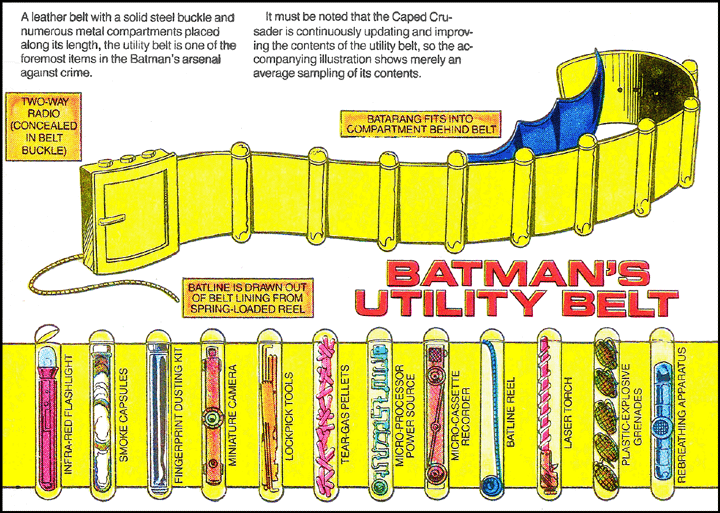
Like Batman and his utility belt, you should have an entire arsenal of prompts and queries at your ready, posing the right one at the right time.

Batman utility belt

I don’t own a utility belt, but I do keep a small index card in my pocket with question stems such as “In what ways . . .?”  “For what reasons . . .?”  “How might you . . .?” and many more.  Whenever I’m stumped for a good question, I can check my list to keep the conversation going.  And like Batman with his belt, you should continuously update and improve your questioning strategies.

Unlike the hero The Question, however, you will want to add engaging facial expressions.  Smile a little.  Make appropriate eye contact.  And talk in a welcoming tone of voice.

question image

Not the face you want to see in a classroom.

The Question wants to hide an identity and frighten bad guys.  Teachers, on the other hand, need to be personable and supportive of students.  Your questions and interactions, when used effectively, are an important part of this equation.

Speaking of which, there is no mainstream superhero called The Equation.  Get on it, math teachers!

Teachers for Hire

Standard

Happy Labor Day!  (To all you Americans, at least.)

In honor of the “yearly national tribute to the contributions workers have made to the strength, prosperity, and well-being of our country,” let’s talk about the labors of teaching.

No, we’re not going to do some cheesy comparison between the labors of teachers and the legendary labors of Marvel Comics’ hero Hercules (but you can read here to learn more, especially if you need a new spin on teaching Greek myths).

herc lightning

First labor: Reenact He-Man’s “by the power of Greyskull!” bit.

Let’s talk about the work of teachers.  

Back when I was in college, I told one of my former high school teachers I was going into teaching.  His response was something like “Teaching is a noble profession.  But it’s a terrible job.”

While this may come across as discouraging at first, my mentor went on to say that the work of a teacher is important and rewarding, but it’s not for everyone.  If you just want a career to pay the bills, he explained, go find a different job.  But if you want to make a difference no matter the cost, then teaching is for you.

It’s not about the money, money, money . . . 

Most of us in the teaching profession know that you don’t go into it to get rich.  Not financially speaking, at least.  

Honestly, I never thought much about my future paychecks when I decided to pursue teaching as my college major.  As a kid, I had always respected my teachers and thought highly of them (most of them, at least) as model citizens in our small town.  Financial stability seemed to be part of that elevated status.  

Unfortunately, it wasn’t until my “Intro to Teaching” class in college where on the first day our instructor told us, “Why do you want to be a teacher?  The pay is lousy.”

Talk about a bummer way to start my adventure in teacherhood.  I think this guy was trying to get us to realize teaching is something you do for more than a paycheck.  His approach just wasn’t quite as polished as it could be.  Or maybe he wanted to scare away all the undergrads who thought teaching would be a cinch job – summer vacations, 8:00 to 3:00 work hours, and all those notions.

Studies and Statistics

Depending on whom you ask, teachers are either overpaid or underpaid.  If you ask me, I’d probably say it depends on the teacher.  (If you ask the New York Times, it’s . . . complicated.)

Actually, someone DID ask me about teacher pay once.  It was when I was teaching at my first job and the local newspaper wanted to interview various teachers about potential state legislation increasing teacher pay (the bill failed, by the way).  At the time of the interview, my answer was basically, “I’m not in it for the money, but I’d happily take more!”  

If I remember correctly, I also talked about how I was a single young teacher living in a small apartment and could easily get by on a modest salary.  (Times have changed.  Just ask my wife and five kids.  And two dogs.  And six cats.)

The only other thing I recall from the interview is I explained how there are multiple opportunities for teachers to increase their paychecks.  Teachers typically “move up the pay scale” for taking graduate courses and completing additional degrees.  Teachers can often receive stipends for attending workshops and other “professional development” opportunities outside of the regular school schedule.  Teachers also receive a little bit of extra pay for helping out with extracurricular activities–coaching, sponsoring clubs and activities, leading committees, and so on.  

Of course, all of this extra work does require extra minutes, hours, days, weeks, and more.  Speaking of which . . . 

Time after time . . .

Other studies report on the amount of time teachers spend working.  Things are much more complicated than the notion that teachers get three months off for summer vacation.  Again, I think it depends on the teacher.  But here’s a neat “infographic” that breaks things down:

teachers-dont-work-hard-enough-think-again_51dad7447e53a

Of course, this image was brought to us by http://www.busyteacher.org, so it may be a little biased.  

Other reviews are mixed, including ones that review similar data by the Bureau of Labor Statistics (glass half-full vs. glass half-empty).  There are also some interesting results from a teacher survey completed by Scholastic and the Bill & Melinda Gates Foundation, summarized here in The Washington Post.  You can find more details, including state-by-state results, at this link.

So how does this all relate to superheroes?  

(You mean, besides the lame Herc reference above?)

Back in the 1970s, Marvel Comics featured a superhero team called “Heroes for Hire, Inc.” founded by Iron Fist and Power Man (Luke Cage, the original “Hero for Hire.”)  The basic premise is superheroes will help out the common man–security, investigation, thwarting the schemes of villians–all for a fee.  

70s heroes Heroes_for_Hire_1997,_1 h4h1_1

Through the years, the Heroes for Hire team has undergone various incarnations, including several attempts at long-running series.  Most of the series, though, last for about a year before getting cancelled.  It seems that the idea of superheroes working for hire–albeit a realistic scenario–is not as appealing to readers as their pro bono colleagues with secret identities.  

By the way, Hercules has been a member of the Heroes for Hire from time to time.  Even the “Prince of Power” needs to pay the bills.

Teachers need to an income, too.  But it’s more than a paycheck.  It should be a labor of love.

Happy Labor Day to teachers everywhere.  And remember how you can contribute to the “strength, prosperity, and well-being” of your students and community.  It is a priceless gift.