
Future and Past

Standard

Yes, this post will discuss yet ANOTHER super-hero movie that recently blasted into theaters across the globe.  It’s the golden age for super-hero movies, so we might as well bask in it.

The latest super-flick selling popcorn and semi-satisfying critics/fans is X-Men: Days of Future Past.  Bonus points (i.e. “geek cred”) if you can name every character in the following poster:

XDOFP-poster-995c8

The basic premise of the film (and the classic comic book story it’s loosely based on) is that the future ends up being a mostly dismal place for mutants and humans alike.  Those grizzled heroes that are still alive decide their only hope lies in sending someone back in time (or at least their mind) to stop events that ultimately cause social dystopia.  Basically, they want to “reset” the world to make a better future.

X-Men-Days-of-Future-Past-comic-cover


It’s a story that is equally depressing AND hopeful, even if the title makes no grammatical sense at all (and created a wad of continuity problems in the X-Men cinematic universe).


Even if you have no interest in time travel or mutant oppression, I do encourage you to stop and think how teachers can learn a lesson from this story.

How many of us wish we could go back in time (the start of the school year) and try again to establish a positive, productive classroom environment?


The truth is, the “first days of school” are critical to creating a climate that will endure throughout the academic calendar.  What you teach, practice, and reinforce (and what you let slide) will eventually shape the classroom setting.  It’s so important, in fact, that the best-selling teacher book of all time deals with this issue.
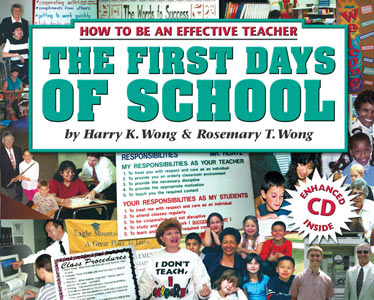
the_first_days_of_school book

My copy is a little more “used.”

Even though early classroom moments are so critical in establishing classroom expectations and habits, there is still hope for teachers who think they may have “lost their way” and lost their classroom to disorder and disrespect, confusion and chaos.

In fact, one of the biggest champions of this “reset” method is Harry Wong, co-author of The First Days of School.  During one of his “Effective Teacher” videos (Vol. 4), Dr. Wong describes how at the end of each day, teachers erase the classroom board in preparation for the next day’s learning.  This action should illustrate how we as teachers should view our work.
OLYMPUS DIGITAL CAMERA

Every new day is a new opportunity to “start over,” so to speak.  Even though it may be the middle of the school year, teachers can still erase past mistakes and memories and work to create a new classroom culture.  This “reset” will most likely require more than one day’s work, but we can still purposefully cultivate the type of environment we know is best for teaching and reaching our kids.  This endeavor also takes serious reflection, intentional planning, practice, reinforcement, and redirection–all in order to reestablish the classroom our kids (and we teachers) deserve.

On a larger scale, consider how the current “summer break” season is another a chance to reset your teaching expectations and actions.  Don’t stop at reorganizing your desk drawers and replacing tattered posters with shiny new bulletin board materials.  Revitalize your classroom procedures, routines, and attitudes to foster a refreshing learning environment.

The advantage to summer rejuvenation is that most of your students won’t know anything changed.  They’ll assume you’ve always been a model educator who demands excellence and champions the cause of learning.

At times, such work may seem just as challenging as mutant time travel.  But it’s definitely worth it.

 

High Flying Falcon

Standard

captain-america-2-poster-us-full

So Captain America: The Winter Solider celebrated a record-breaking $96.2 million opening for the month of April.  (Haven’t seen it, so don’t spoil it for me!)

But what I have seen is co-star Anthony Mackie (a.k.a. The Falcon a.k.a. A Younger Will Smith) making his memorable appearance on The Tonight Show with Jimmy Fallon a few days ago.

TheFalcon marvel-falcon_large

All teachers should see this clip, too, and take away some of the actor’s enthusiasm.

Watch Anthony Mackie egg on Bill O’Reilly at the 1:00-minute mark, and then look for the main event around 3:25, in which the actor explodes with energetic commentary of his own movie clip.

http://www.youtube.com/watch?v=s9IpyoDcfyY

Try something like this the next time you show a video in your classroom.

Maybe tone it down a notch, so your students can actually hear important information.  And don’t curse.

But don’t lose that sky-high excitement!

(Sorry. Couldn’t resist.)

Teaser Teachers

Standard

One of my Super Bowl highlights is the glut of new movie trailers during the commercials.  Never mind that the 20 seconds or so may or may not actually wind up in the actual film.

Nowadays, most of these trailers go straight to the internet before the Super Bowl.  And now we don’t just have trailers, but also teasers, which are basically trailers for the trailers.

Here are a couple of teasers and/or trailers that caught my eye this year.  (Don’t blink.)

http://www.youtube.com/watch?v=MSzAfgULwUE

Cool, huh?  Even a few seconds can get the adrenaline pumping.

So how about us teachers?  How can we take some Hollywood magic and use it to “tease” our students?

A common practice is the use of bell work (or bell ringer), which helps with classroom management and should engage students in thinking.  Many teachers use bell work to review something from a past lesson or preview something  for the immediate next lesson.

Bell work helps create a useful routine in which students start the class (not the bell or the teacher) and the teacher can use these few minutes for taking attendance, addressing specific students’ needs, or other important tasks.

There are several resources out there for using “puzzlers” or trivia for bell work.  These are good in a pinch, and some can even foster meaningful discussions about students’ personal views and experiences.  Here is a variety of bell ringers from Kentucky (home state of mutant siblings Sam Guthrie a.k.a. Cannonball and Paige Guthrie a.k.a. Husk).

cannonball_and_husk_color_by_graconius-d5p11rs

Thanks, Kentucky and Graconius.  We owe ya both.

This is a start, and such resources are good for some days.  But let’s go beyond student/time management and really get students excited (or at least interested).

What sort of question or prompt can you pose on a given day that will not only get the students to work, but get them to think more deeply about the content you want them to learn?  How can you “tease” them?

Here are a few paired examples.  One bland, one better.  Reflect on these ideas to create or modify your own bell work prompts for upcoming classes.

BLAND: Please open your book to page 16.

BETTER: Please open your book to page 16.  Examine the two photos and write down as many similarities you can find.

BLAND: Please get out yesterday’s homework.

BETTER: Please review your homework with a neighbor and discuss any discrepancies in your answers.  Who is correct?  How do you know?

BLAND: Please copy the vocabulary words on the board.

BETTER: Pick out your favorite vocabulary word and draw a picture related to that term.  Share your sketch with a partner and see if they can guess the word.

See?  Not that hard to take a basic task and make it better (i.e. increase the students’ interest).

In addition to bell work at the start of class, teachers should tease their students at the end of class.

End-of-class activities often focus on a “wrap-up” or recap in which the class reviews what they learned that day.  If you do such activities, be sure to have the students tell YOU what they’ve learned, instead of you just telling them what they should have learned.

Strategies such as the Exit Slip or Ticket-out-the-Door provide other opportunities for students to share what they have (or have not) learned.  Teachers can prompt students to apply the content to a new situation.

Don’t make it a simple task.  Tease the students with a challenge or question that gets them wondering and thinking between the end of class and the next time they return to you.  It’s okay to leave students in suspense sometimes!

So here’s a challenge:

What’s your best “end of day” or “start of day” strategy?  Post a comment and share below!