Vibrant “Hughs”

Standard

Although the upcoming Deadpool 3 movie is a loooong way from its release in theaters, fans are still excited for any news.

The BIGGEST reveal came recently with a sneak peek photo of the film’s two stars, Ryan Reynolds (Deadpool) and Hugh Jackman (Wolverine). Check it out!

Understandably, the BIG DEAL is that for the first time in two decades of movies, Hugh Jackman’s attire finally bears close resemblance Wolverine’s comic book costume. Nice!

Before, many fans believed it impossible to pull off a nearly all-yellow, non-ugly outfit in live-action cinema. But I admit, Hugh’s golden duds look pretty good. Chalk it up to movie magic!

This is not the first time we’ve used Hugh Jackman as a launching point to discuss teachers and teaching. Now in Part Three of our “Hughology” (trademark, 2023) we’ll use the charming Wolverine actor to reflect on teaching wardrobes.

We’ve also talked before about teacher outfits based on superhero icons, including both what to (or not to) wear in the classroom, and when (and how) to undergo an “extreme makeover,” which is more than just appearances.

Now let’s ask another important question:

Should teachers wear yellow?

Ready for the answer?

It depends.

Is yellow part of your school colors? Do you root for the the “Yellowjackets,” or “Golden Lions” or “Wheat Shockers?” If yes, then by all means, go for it. Especially on game days. Who cares if yellow is a bad match for your complexion? Show your team spirit!

All teachers can still wear yellow, no matter their school’s mascot. In fact, yellow is a common color recommendation for first day outfits. Both style and teaching websites give their approval (and examples, such as below).

You can find additional resources at websites like This Stylish Teacher, The Styled Teacher, Real Men Real Style, and more. (Keen observers will note Mr. Harrington wearing his golden jacket for the Midtown School of Science and Technology Academic Decathlon Team!)

Beyond trendy styles, there’s actual research to support adding a ray of sunshine via your threads. Fashion psychologists note how the color yellow conveys optimism, brightness, and energy. These are all great things to share in the classroom, on the first day of school and beyond.

A little bit of yellow goes a long way, however. A teacher with too much brightness and energy can overwhelm a class, whether by what they wear or how they act. Be purposeful and judicious in your appearance and behavior.

For further superhero inspiration, consider how many of the following heroes brandish yellow–sometimes a bit, sometimes a bunch–on their costumes. Instead of insignias or capes, teachers can add their own bright splashes with a necktie, scarf, jewelry, and more.

If you want to learn more about fashion psychology and superhero costumes, there’s a super-neat four-part feature at Comics Alliance about different color combinations, including those shared above.

And read more about teacher attire AND teacher actions in my new book, Teaching Is for Superheroes! – NOW available anywhere online where you find GOOD BOOKS! Find out the latest at www.TeachingIsForSuperheroes.com!
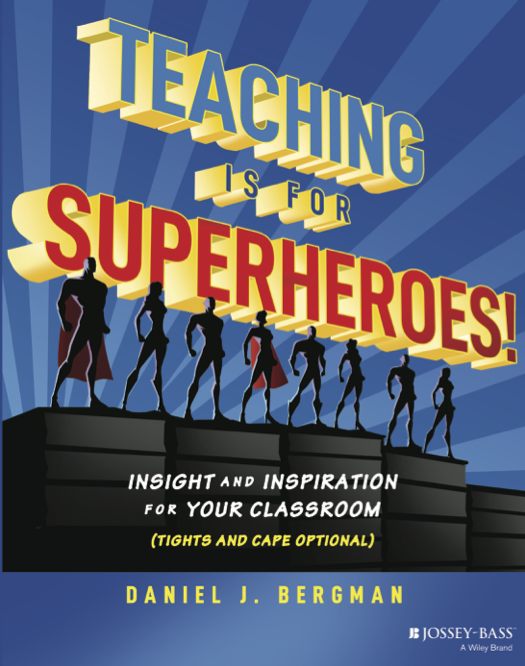
(Note the savvy use of yellow on the cover – just enough to catch your attention!)

Stoop Like Hugh

Standard

It wasn’t that long ago that we talked about Wolverine actor Hugh Jackman (and how teachers also need a “Hugh”).

Now we’re back with another teacher tip from everyone’s favorite Australian nice guy actor playing everyone’s favorite Canadian grumpy mutant hero.

(Quite the difference in personality there. I guess that’s why they call it “acting.”)

Let’s talk about one more difference between Hugh Jackman and Wolverine.

In the comics, Wolverine is stocky and short, with a height of 5′ 3″. In reality, Hugh Jackman is 6′ 2”.

It doesn’t take a math teacher to quickly figure out that’s a difference of 11 inches–almost one whole foot in length. (Or 27.94 centimeters for those of you using the metric system–Canadians and Australians alike.)

So how did a tall actor first win the part of Wolverine?

(Remember, before Hugh Jackman got this role for the first X-Men movie, he was a relatively unknown actor. Check out this neat time capsule web announcement announcing–and decrying–the official casting waaaaaaaaaaay back in 1999.)

Recently, CNN’s Chris Wallace asked the actor this same question (or very similar, at least). Zip ahead to the 0:45 mark for the question and answer:

In his explanation, Hugh Jackman also gives an example of his behavior. It may look goofy to “stoop,” but it got him the part! (His thespian skills probably helped, too.)

A while back, I read the following sentence in a reflection paper by one of my future science teachers:

“As an educator, I need to remember that my first priority is to the student. I need to STOOP and listen.”

There was a typo. She meant “STOP and listen.”

Still, my first reaction was to write a snarky response like, “If you teach elementary kids, you certainly will need to stoop!” 🙂

(I didn’t.)

The more I think of it, though, sometimes teachers DO need to STOOP. Not only when they stop and listen, but often when they interact with students. And not just with younger kids, but with all ages and grade levels.

There’s a whole bunch of research on “nonverbal behaviors,” those unspoken actions and mannerisms that occur during human interactions. Teachers can gain a lot of insight and application when they focus on such behaviors in the classroom.

Sure, what teachers say during lessons is vital, such as engaging questions and responses that encourage further discussion and reflection.

But stop and think about what you actually look like when you teach. How is your eye contact? Your facial expressions? Hand gestures? Mannerisms and more?

And where are you compared to your students? The fancy name for this is “PROXIMITY.”

Wolverine (Mr. Logan) demonstrating why teachers should NOT stay at the front of classrooms, especially with their back turned to students.

Proximity is not just the front of the classroom versus the back, or in between student desks (although such movement is important for many reasons).

Proximity also includes the posture and level at which you interact with students. Check out this quote from Sean Neill and Chris Caswell, authors of the book, Body Language for Competent Teachers:

“Leaning towards another person, whether sitting or standing, is an ‘intention movement;’ your intention, if you actually moved, would be to get closer to them . . . . Leaning away sends the opposite signal. Leaning over someone, or being higher than them, is dominant and potentially threatening because if you actually wanted to attack someone you could launch your attack better from above. Sitting or kneeling down to someone, at or below their level, is correspondingly non-threatening” (p. 11)

So I guess we now know why Wolverine is always hunched over, ready to strike.

And we also know why it’s important for teachers to STOOP. Not always, but definitely when working with students in small groups or one-on-one. Leaning and learning–literally at “their level”–conveys a collaborative spirit. We’re in this together to grow and get better!

And who knows? Maybe all this learning will help us become “the best there is at what we do.”

Unlike Wolverine, however, what teachers do–learning and teaching–is VERY nice!

Find more SUPER-teaching resources and strategies HERE or HERE!