Take Care of Yourself*

Standard

Thunderbolts* is the newest movie in the Marvel Cinematic Universe (MCU), and it’s a good one!

So good, in fact, that it got a brand NEW title right out of the gate (spoilers ahead, of course):

Beyond the clever name change (i.e. marketing ploy), the film itself is memorable for its meaningful look at mental health. Numerous news outlets have explored this key ingredient in the film, including interviews with the film’s creators and stars (such as this article from Entertainment Weekly).

Like the superheroes (super-spies? super-thieves?) in Thunderbolts*, educators also face challenges with stress and self-care.

In one survey, teachers and principals both fared worse than other working adults in multiple mental factors. Here’s a visual summary courtesy of the folks at Education Week.

Granted, this report is from 2022 as schools were crawling out of a pandemic shadow. Still, a more recent study finds similar issues, as indicated by its title, “The Teachers are Not All Right.

In better news, things are improving with educators’ awareness and ability to find help. Another Education Week survey found that teachers are better at supporting one another in their work. Check out this nifty graphic summary:

In the linked Entertainment Weekly article above, actress Florence Pugh elaborates on the importance of collaboration and kindness:

“[T]he real message is we have to be together. We have to connect, we have to help each other. We have to be humans and actually care, and love, and look after each other. And that is the key.”

She’s talking about fictional superhero characters, but the same holds true for real teachers in real life. Amid a notoriously labeled “isolated profession,” educators must seek support from each other AND for each other.

Even so, don’t rely on colleagues to provide and receive all necessary assistance. There are numerous resources from health experts and professional organizations, some of which teachers can use with their students.

Don’t wait for a crisis or summer break. Find people and services that can help you now, and help others do the same.

*And each other.

Marvelous Outcomes

Standard

Have you seen The Marvels movie in theaters yet?

If your answer is “NO,” you’re not alone. The Marvels had the worst box office opening ever for a movie in the MCU franchise.

Considering the Marvel Cinematic Universe has earned a worldwide gross income of nearly THIRTY BILLION DOLLARS* from its combined movies, I’m sure they’ll be fine.

*That’s “Billion” with a B-b-b-b-b-b . . . .

I’m even more confident in Marvel’s well-being given recent comments by one of their up-and-coming stars.

In an interview with Yahoo Entertainment, actress Iman Vellani (Ms. Marvel herself) shared her honest feelings about the film’s performance and audience perceptions.

“I’m happy with the finished product, and the people that I care about enjoyed the film. It’s genuinely a good time watching this movie, and that’s all we can ask for with these films. It has superheroes, it takes place in space, it’s not that deep and it’s about teamwork and sisterhood. It’s a fun movie, and I’m just so happy that I can share it with people.”

Whether you like The Marvels or not–heck, whether you even go see the movie or not–you have to respect the Ms. Vellani’s positive outlook. Enjoy the creativity and enthusiasm, and share that enjoyment with those who are important to you.

I bolded that previous statement because the same approach applies to TEACHERS.

Like movies, schools may find themselves in the headlines due to lackluster performance. Often, the stumbles and setbacks get more scrutiny than the successes.

Notice the sad-to-happy ratio of 8-to-1.

Teachers can take it upon themselves to create positive buzz. Advocacy is a topic we’ve addressed in this blog a few times, thanks to Stan “The Man” Lee and the American Federation of Teachers (AFT).

On other occasions, we may just need to rely on thick skin, like Ben “The Thing” Grimm of Fantastic Four fame.

Or maybe we don’t have thick sin, but a magical bracelet that combines with our mutant powers to create a shield of hard light energy. That’d be nice . . .

Here’s another excerpt from the interview with Iman Vellani:

“I had a lot of experience in high school alone when I would share my excitement with someone, and then they’d immediately shut me down for being so excited . . . . If people are excited about something, let them be excited about it. And if you have constructive criticism, voice it — but never be the wet blanket on someone else’s excitement.”

Wise words from a 21-year-old.

And not only sage advice, but also a practical strategy for teachers working with students.

We all encounter kids who have grand ideas, but maybe not the best plans. Effective teachers are those who can encourage and cultivate enthusiasm in the classroom.

Marvelous teachers harness that energy for productive outcomes inside school and beyond.

We–AND our students–should cherish such experiences.

Marvel at the Future . . . AND Past

Standard

Apologies for using the “Marvelous” pun twice in a row, but in this case it’s doubly appropriate.

Not only are we talking about another Marvel superhero; we’re talking about the superhero, Ms. Marvel.

Yes, the Disney+ series has been out for a while, and we’re already in the middle of the new She-Hulk series. We’ll get to that one someday.

Still, we have our reasons for playing “catch-up.” (Busy with an EXCITING project. More on that . . . soon . . .) Plus, what better time to explore themes from the Ms. Marvel show than our current “back-to-school” season?

Specifically, let’s talk about the past, present, and future. All three are key elements in the show, especially in how they pertain to our teenage heroine and her friends.

The very first trailer for Ms. Marvel features a scene in which Kamala meets with her high school guidance counselor. Check out their conference in the first 45 seconds or so:

“Conference” is probably not the correct word. Kamala doesn’t listen to Mr. Wilson as much as she daydreams and can’t wait to escape.

Don’t blame Mr. Wilson. It’s his job to not only be the hip GC, but also help students plan for their future. He does the same with Kamala’s friend Bruno later in the series, sharing news of Bruno’s acceptance into Caltech.

In both cases, Kamala and Bruno are initially ambivalent about looking ahead to tomorrow. That’s because they each have a lot going on in the present – hobbies, jobs, social lives, superpowers, etc.

As teachers, we have to consider the current ups and downs of our students at all times. And we must help them connect their present choices and actions to future dreams, as well as the past.

In the book Teaching as Decision Making (Sparks-Langer et al., 2004), the authors share an analogy that teaching is like building bridges. We start with students on one end, and connect them to content comprehension on the other.

Courtesy of Sparks-Langer et al. (2004), who borrowed it from Starko et al. (2003). It’s a bridge!

It’s a lot more complicated, of course, involving unique characteristics and circumstances, personal beliefs and pedagogy, and relationships. I’d argue this last element – relationships – is the most important, since teaching and learning involves interpersonal connections, communication, and collaboration. These relationships play out among all sorts of individuals, not just those in the classroom.

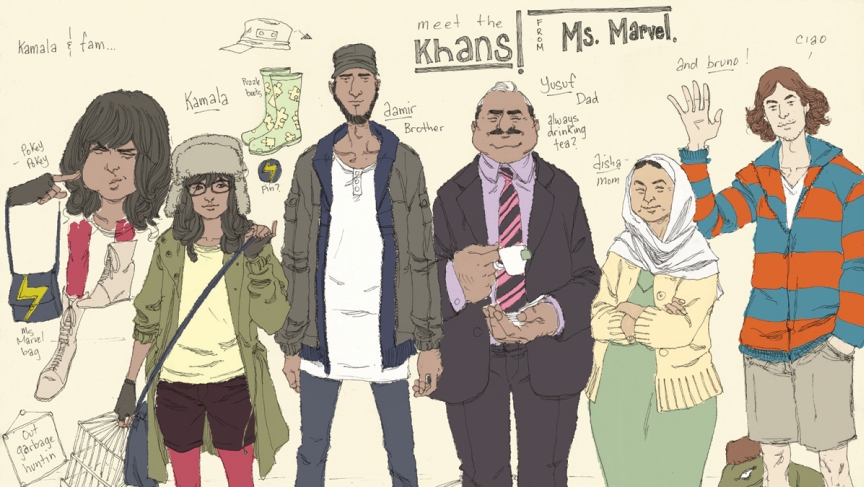
One of the strongest parts of the Ms. Marvel Disney+ series is attention to Kamala’s family and cultural background. It’s something the show has in common with the original comic book, along with a memorable cast.

The Ms. Marvel television show even takes us on a literal trip across time and space to explore Kamala’s past. Viewers learn about real historical events, and the repercussions still felt today.

As an added bonus, the very end of the show teases a potential connection to even MORE superheroes, when Bruno drops the term “mutation” in explaining Kamala’s powers. Will we see more mutants in the future?

“X” marks the spot . . . sometime soon?

Whether it be a massive geopolitical movement or an individual personal change, everybody has previous experiences and perspectives that shape their lives.

Teachers can truly help students plan their future steps when we seek to understand their history. That’s how we build bridges that last.

Let’s start right now.

Further Reading and Resources:

Sparks-Langer, G.M., Starko, A.J., Pasch, M., Burke, W., Moody, C.D., & Gardner, T.G. (2004). Teaching as Decision Making: Successful Practices for the Secondary Teacher (2nd ed.). Upper Saddle River, NJ: Pearson/Merril/Prentice Hall.

Starko, A.J., Sparks-Langer, G.M., Pasch, M., Frankes, L., Gardner, T.G., & Moody, C.D. (2003). Teaching as Decision Making: Successful Practices for the Elementary Teacher (2nd ed.). Upper Saddle River, NJ: Pearson/Merril/Prentice Hall.

Wilson, G.W., Alphona, A., Wyatt, J., & Pichelli, S. (2014/2019). Ms. Marvel, Vol. 1: No Normal. New York: Marvel Comics.