
Extreme Makeovers

Standard

new gr with car

Marvel Comics is redesigning Ghost Rider for an upcoming series, which you can read about here (courtesy of http://www.newsarama.com).

Personally, I think the new digs look like the Japanese manga/anime series Bleach more than any American comic book hero/anti-hero.   See the resemblance?

Bleach_125 Raw 051    GR_FinalBustShot_TraddMoore

I see that both Bleach’s “Soul Reaper” and the Ghost Rider’s “Spirit of Vengeance” may need some ointment.  Or maybe some Maybelline.

This latest superhero redesign has inspired Newsarama writers to revisit their list of Top 10 Superhero Extreme Makeovers–The Good, the Bad, and the Super Ugly.

Superhero makeovers typically last less than a year before the hero/heroine returns to his/her iconic design.  Usually, the change coincides with a slight bump in sales and fan interest (or outrage) before things return to normal (i.e. Electro-Superman, Beard-n-Hook-Aquaman).

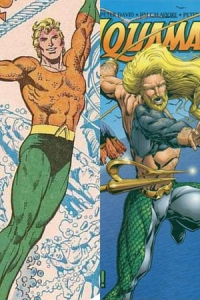
superman makeover                    aquaman makeover

Have you noticed any parallel with teaching yet?

Fads come and go, but quality teachers base their decisions on well-founded research and well-grounded application.

For those superheroes whose costume changes DO last for decades (and beyond), it’s typically because the original design was somehow incomplete or inconsistent with the true nature of the character (see Green Arrow, Daredevil).  Or maybe something didn’t click with the readers.  (When I see the original yellow/red DD, I don’t think hero.  I think hot dog.)

greenarrow makeover                      daredevil makeover

Unfortunately, some teachers are in dire need of an extreme makeover.  Perhaps they were insufficiently prepared, or they’ve developed some bad habits as the years go by.  Or maybe they just lost their passion.

How about you?

Do you need an extreme makeover?  (Move that bus!  Move that BUS!)

Not just change for change’s sake.  Don’t settle for a surface-level image update that will last  only a season.  Instead, challenge yourself to seriously reflect on your practice and its impact on students.  Search for any rough spots needing a revision.

The best teachers always GET BETTER.

And the best “change for the better” is the kind that remains for the years–and students–to come.


Super-Memory

Standard

Marvel Comics’ Wolverine has been a favorite superhero for decades, and there are so many reasons why:

  1. Adamantium-laced claws (and skeleton)
  2. Healing factor
  3. Canadian
  4. Short
  5. The best at what he does
  6. Hugh Jackman

The_Wolverine_Movie_Poster_large_verge_medium_landscape  I’ve always thought Wolverine’s past has been one of his coolest features, namely, that he had no memory of his past.  Over countless issues of X-Men-related titles, comic book readers saw only snippets of these lost years sporadically through various flashbacks.

After teasing readers with glimpses (and maybe deciding they’d better beat the movie studios to the punch), Marvel finally revealed Wolverine’s true origin with the Paul Jenkins/Andy Kubert mini-series Origin (original, eh?).

We soon learned that the man known only as Logan was actually a wimpy boy named James Howlett who wore a nightshirt and cried a lot.  (A little disappointing, to say the least.)

Origin_Vol_1_2_page_-_James_Howlett_(Earth-616)


So what does all this have to do with teaching? 

A recent paper in the Proceedings of the National Academy of Sciences (PNAS) summarized its study of individuals possessing super-memory, or “Highly Superior Autobiographical Memory” (HSAM).  Fewer than two dozen people (humans, not mutants) are known to have this ability.

How many of us teachers mistakenly assume our students possess superhuman memory?  Sure, we sigh and shake our heads when they forget a pencil or their homework.

But let’s be honest.  Sometimes we inundate our students with endless terms or steps with the lame excuse we’re “covering all the standards.”   (As a colleague of mine says, if you’re going to cover the content, you might as well cover it in dirt because it’s already dead.)

Formal education in America arose when memorized facts served one well in their future studies, intellectual pursuits, and careers.  But we currently live in an age where information is available in a wi-fi instant.

Sure, there are moments for memorization.  And those times are typically when we practice and apply information in useful and meaningful ways.  I remember “every good boy does fine” not because of cramming the treble clef into my adolescent mind, but as a result of spending hours practicing, playing, and performing.

Here’s something interesting from that PNAS study of HSAM humans:  It turns out that individuals with super-memory as just as susceptible to manipulation as the rest of us.  This includes distorting data or adding false memories that never existed.

You can read a summary here from Discovery Magazine and find the whole report here from the National Academy of Sciences.  Good luck remembering it all.


Sadly, not many superheroes are known for their super-memory, and a quick Google search will find you these USB-compliant gems:

superhero-usb-flash-drives

It turns out that Logan/Wolverine/James Howlett eventually did regain all of his memories at the end of the House of M mini-series event (by Brian Michael Bendis and Olivier Coipel).  Along with a whole slew of mutant/magic messiness, Wolverine with memories was now a little less cool.

wolverine_remembers

I’d love to have super-memory.  It’d help me remember the last time I wore a certain outfit so I don’t repeat it a week later.  (I’m sure my students remember particular shirt-tie-pants ensembles.)

But most of us have normal human-level memory abilities.  The kind that forgets from time to time, but remembers when the information is relevant, useful, and encourages further learning.

Something for all of us to remember . . .

super-memory